

Blog
Can You Stop Retatrutide Once You Start? What Happens Next


Most people start retatrutide with an end in mind: a goal weight, a wedding, a budget that covers six months. Somewhere in the dose steps the next question arrives. Once the weekly injection stops, does the body go back to where it was, and is there any way to come off without paying for it on the scale?
Nothing about retatrutide locks anyone in. There is no dependence to wean off, and the drug clears itself over about a month. What it leaves behind is the appetite it was holding down. In the closest trial on record, people switched from tirzepatide to placebo put 14% of their body weight back on within a year, and retatrutide’s own stopping trial won’t finish until 2028.
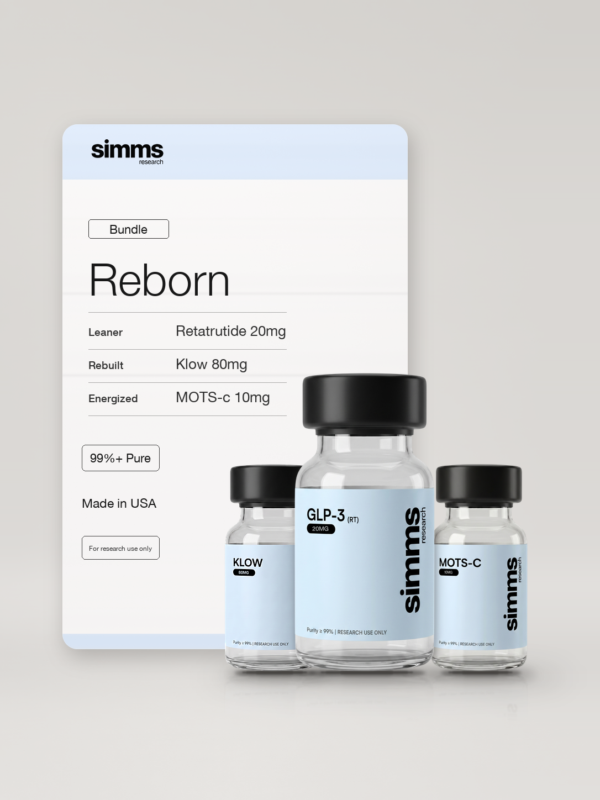
Simms Research sells Retatrutide (GLP-3) as research powder in 10, 20, 30 and 60mg vials, sizes that line up with the dose steps on the way down as well as the way up.
What happens when you stop taking retatrutide
Nothing sudden. The drug fades over three to four weeks, appetite returns as it fades, and the scale follows over the months after.
Retatrutide’s half-life is about six days, and its blood levels rise and fall in step with the dose (Urva, The Lancet, 2022). After the last injection the level halves roughly every six days, so someone leaving a steady dose passes back down through the lower doses on the way out. Each cell shows the steady weekly dose the level matches:
| Weeks after the last injection | Stopping from 12mg | Stopping from 4mg |
|---|---|---|
| 1 | Same as 12mg: the usual low point before an injection | Same as 4mg |
| 2 | Like a steady 5mg | Like a steady 1.8mg |
| 3 | Like a steady 2.4mg, near the 2mg starting dose | Like a steady 0.8mg |
| 4 | Like a steady 1mg | Like a steady 0.4mg |
| 5 | Like a steady 0.5mg | Like a steady 0.2mg |
The first week is like any other, because the level is where it always sits before the next injection. By the third week it is close to the 2mg dose the trials started everyone on, and by the fifth there is almost nothing left. A cold stop is, in effect, a three-week taper the body runs by itself.
Weight moves slower than the drug. Across 37 studies of weight-loss medicines, people put back an average of 0.4 kg (just under 1 lb) a month after stopping, faster than after diet programs, and their blood pressure, blood sugar and cholesterol were projected back to their starting points within 1.4 years (West, BMJ, 2026). How much comes off before that point, checkpoint by checkpoint, is in How Long Does Retatrutide Take to Work? Results at 24, 48, 80 and 104 Weeks.
Retatrutide withdrawal and side effects after stopping
There is no withdrawal syndrome. What people call retatrutide withdrawal is hunger coming back, and the stomach side effects run the other way: they fade.
The proof comes from trials that moved people from a weekly drug to placebo without warning, which is exactly what stopping cold looks like. When SURMOUNT-MAINTAIN switched people from full-dose tirzepatide to placebo for a year, 2.2% reported nausea against 5.8% of those who stayed on, 1.1% had diarrhea against 7.2%, and nobody on placebo stopped over a side effect (Horn, The Lancet, 2026). In STEP 4, stomach complaints ran at 26.1% after the switch to placebo and 49.1% on continued semaglutide (Rubino, JAMA, 2021).
What comes back is what the weight loss had fixed. In the year after STEP 1 took people off semaglutide, blood pressure, blood sugar markers and cholesterol drifted back toward where they started, in step with the weight (Wilding, Diabetes, Obesity and Metabolism, 2022). Expect the same pattern after retatrutide: the numbers on a blood test follow the number on the scale, in both directions.
Retatrutide weight regain: what the trials show
Most of it returns within a year in the trials that stopped retatrutide’s closest relatives, and retatrutide’s own stopping results are still to come.
Three trials took people off a weekly drug and tracked them on placebo. In STEP 4, people who had lost 10.6% on semaglutide 2.4mg over 20 weeks put 6.9% of their body weight back on in the next 48 (Rubino, JAMA, 2021). In the STEP 1 extension, a 17.3% loss over 68 weeks on the same dose was followed by 11.6% of starting weight coming back within 52. In SURMOUNT-4, 20.9% lost on tirzepatide 10 or 15mg over 36 weeks became 14.0% regained in 52 (Aronne, JAMA, 2024).
In these three, the bigger the loss, the more came back, and none of it was a cliff. A year after the switch, the STEP 1 group still sat 5.6% below their starting weight, about a third of what they had lost, and the SURMOUNT-4 group sat 9.9% below it, close to half. Only 16.6% of the SURMOUNT-4 placebo group held on to 80% of their loss, against 89.5% of those who stayed on tirzepatide.
The reason is the body, not the drug. A year after weight loss, the hunger hormone ghrelin is still raised and the fullness signals still muted (Sumithran, New England Journal of Medicine, 2011). Retatrutide holds both down while it’s in the blood, and when it leaves, the pressure it was holding back is still there.
Retatrutide’s own answer is TRIUMPH-6, a Lilly trial that began in March 2025. Its 643 adults take retatrutide for 80 weeks and are then split for 36 more: one group stays on the same dose, one moves to a lower dose and one switches to placebo. The trial’s main measurements are due to finish in April 2028, and one of them is the exact question here: how much of the 80-week loss is still held at week 116. Until then, the tirzepatide and semaglutide trials are the best guide.
Retatrutide maintenance dose: stepping down instead of stopping
A lower dose holds most of the loss. The clearest evidence is tirzepatide’s: people who dropped from the top dose to the second-lowest kept about three-quarters of what they had lost for a full year.
SURMOUNT-MAINTAIN put 441 adults on tirzepatide at 10 or 15mg for 60 weeks, then split the 378 who got there three ways for another 52 (Horn, The Lancet, 2026). From week 84, anyone who regained more than half their loss could go back on the drug. At week 112, those who stayed on 10 or 15mg weighed 21.9% less than at the start, those who stepped down to 5mg 16.6% less and those switched to placebo 9.9% less. Only 8% of the full-dose group regained more than half and restarted, against 25% on 5mg and 67% on placebo.
In Lilly’s own figures, the 5mg group came down from 113.4 kg to 89.0 kg on the full dose and stood at 94.6 kg a year after stepping down: 5.6 kg (about 12 lb) back, from a loss of about 24 kg. Those who stayed on the full dose lost a little more. Placebo, as in every other trial, gave back the most.
No retatrutide maintenance dose has been tested yet; that is the lower-dose arm of TRIUMPH-6. The natural candidate is 4mg, the lowest dose in Phase 3, which took off 19.0% on its own over 80 weeks in TRIUMPH-1. It also halves the cost of staying on: in Simms Research vials, holding 4mg runs about $26 a week against $52 at 12mg, and the retatrutide vs tirzepatide comparison breaks the cost down dose by dose.
Stopping retatrutide cold turkey or tapering off
Cold turkey is safe, and it is how every stopping trial did it. A taper changes how the exit feels, not where the weight ends up.
A cold stop already comes with its own slope, as the table at the top shows. A slower step-down stretches that out, which gives appetite more time to come back gradually and gives new habits more time to set. What no trial has shown is that tapering to zero keeps more weight off a year later than stopping cold. In the data, what holds weight is the dose that stays, not the speed of leaving.
A taper runs the climb in reverse, one step about every four weeks: 12, 9, 6, 4 and 2mg, then stop or hold. Each lower step fits a smaller vial, and the units for any dose and vial size come from the retatrutide calculator. Holding at 4mg instead of stopping turns the taper into the step-down above.
How to keep weight off after stopping retatrutide
Exercise is the one habit with trial evidence behind it once the drug is gone, and the time to build it is while the drug is still working.
A Copenhagen trial put people who had just lost about 13 kg on a diet through a year of liraglutide, supervised exercise, both, or placebo, then followed them for a year after everything stopped. In that year off, the drug-only group regained 6.0 kg more than the exercise group, and the group that had done both was still 5.1 kg lighter than the drug-only group at the end (Jensen, eClinicalMedicine, 2024). Both exercise groups were also more likely than placebo to stay at least 10% below their starting weight.
The habit has to be in place before appetite returns, because building it afterwards means starting a new routine at the hungriest point. The other piece is a line drawn in advance. SURMOUNT-MAINTAIN used half the loss as the point to go back on the drug; a weekly weigh-in catches the drift long before that, while the gap is still small.
So, can you stop retatrutide once you start?
Yes, in any week. There is nothing to wean off, the drug steps itself down over about three weeks, and stopping brings fewer side effects, not more.
What stopping can’t do is hold the weight by itself. In the trials that stopped retatrutide’s closest relatives, people still had a third to a half of their loss a year later. Those who stepped down to a lower dose kept about three-quarters, and those who stayed on kept all of it. So the real decision isn’t stop or stay; it’s how much drug the weight needs, and TRIUMPH-6 will put a retatrutide number on that in 2028.
For a step-down, Simms Research’s Retatrutide (GLP-3) comes in four sizes that line up with the steps: 10mg at $84, 20mg at $129, 30mg at $159 and 60mg at $259. The latest batch, tested on July 16, 2026 across three vials, came back 99.611% pure with 10.68mg found where the label says 10mg; the certificate sits on the retatrutide lab results page, and the retatrutide dosage chart lays out the steps.
Frequently asked questions
Can you take a break from retatrutide and restart?
Yes. One skipped week leaves a bit under half the usual level by the time the next dose is due, so it counts as a missed dose. After three weeks or more, the stomach’s tolerance has faded with the drug, and a restart begins a step or more below the old dose. The retatrutide dosage chart sets out the rule for each case.
Should you stop retatrutide before surgery?
Usually not. Guidance issued in October 2024 by five societies, including the American Society of Anesthesiologists, says most people on drugs in this class can keep taking them before elective surgery, with a liquid diet for the 24 hours before when the stomach risk is higher, such as during dose increases (Kindel, Surgery for Obesity and Related Diseases, 2024). Tell the anesthesia team about it either way.
How long does retatrutide stay in your system?
About a month. Its level halves roughly every six days, so under a tenth of the last dose’s peak remains after three weeks and about 2% after five.
Is Simms Research legit?
Yes, on every point a buyer can check before ordering. Simms Research ships its own vials from Florida, publishes batch certificates from an independent ISO-certified lab, and an order placed before 5PM Eastern leaves the same day; UPS Standard then takes three to five business days, and FedEx 2-Day costs nothing on orders above $200. Under its Free Delivery Guarantee, a parcel that goes missing, is stolen or arrives damaged gets replaced. Support is reachable by email at support@simmsresearch.com or by phone at 855-592-8507 on weekdays between 9AM and 5PM Eastern, and the full range is in the Simms Research shop.