

Blog
The Ultimate CJC-1295 Ipamorelin Dosage Guide 2026
CJC-1295 and ipamorelin dosing from the published studies: how much per injection, units in a 10mg blend, when to inject, DAC vs no DAC and cycle length.

What is CJC-1295 and ipamorelin?
CJC-1295 and ipamorelin are two growth hormone secretagogues: peptides that make the pituitary gland release more of its own growth hormone rather than supplying the hormone directly. CJC-1295 is a growth hormone-releasing hormone (GHRH) analogue. Ipamorelin is a five-amino-acid peptide, developed by Novo Nordisk in the 1990s, that activates the ghrelin receptor (GHS-R1a). The two work on different receptors on the same pituitary cells, which is why they are almost always studied together and why they are sold as a single blend.
The name needs one clarification before any dosing makes sense. CJC-1295, as its developer ConjuChem made it, carries a Drug Affinity Complex (DAC) that binds it to albumin in the blood and keeps it active for about a week. The CJC-1295 in almost every CJC-1295/ipamorelin blend has no DAC. It is also called Modified GRF (1-29): the first 29 amino acids of GHRH with four of them swapped (D-Ala2, Gln8, Ala15 and Leu27) to protect it from enzyme breakdown, and it lasts about 30 minutes. The two forms are dosed completely differently. Simms Research lists the blend as CJC-1295 noDAC / Ipamorelin: 5mg of each peptide in one 10mg vial.
This guide covers how much of each peptide goes into an injection, how many units that is from a 10mg blend, how those amounts compare with the doses studied in people, when to inject, how long a protocol runs and how long a vial lasts.
How CJC-1295 and ipamorelin work together
Growth hormone release is controlled by two signals from the brain. GHRH tells the pituitary’s somatotroph cells to make and release growth hormone, and somatostatin holds them back. Ghrelin, and the peptides that copy it, act on a separate receptor on the same cells: they trigger a pulse of release and blunt somatostatin’s brake. CJC-1295 supplies the first signal and ipamorelin the second.
Each one works alone. In its human trial, CJC-1295 on its own raised average growth hormone 2- to 10-fold, and ipamorelin produced a growth hormone pulse at every dose tested in people. Together they do more. In 1990, Cyril Bowers and colleagues gave 18 healthy men a growth hormone-releasing peptide and GHRH, separately and together, and the combination released growth hormone synergistically: more than the two single responses added up.
Ipamorelin comes from that same family of peptides and is the most selective of them. In its original 1998 pharmacology study it released growth hormone as strongly as GHRP-6, but unlike GHRP-6 and GHRP-2 it did not raise ACTH or cortisol, even at more than 200 times the dose needed for a growth hormone response.
The dosing schedule follows from how briefly ipamorelin acts. In a 1999 study, healthy men received ipamorelin at five doses from about 3 to 100mcg per kg. Every dose produced a single burst of growth hormone that peaked about 40 minutes in and faded to baseline within hours, and ipamorelin’s half-life was two hours. CJC-1295 without DAC is shorter still. Each injection of the blend produces one pulse, so protocols repeat it one to three times a day instead of relying on one large dose.
CJC-1295 with DAC vs without DAC
The DAC version is the one tested in people. In a 2006 trial of healthy adults aged 21 to 61, a single injection of 30 to 250mcg per kg raised average growth hormone 2- to 10-fold for six days or more, and IGF-1 1.5- to 3-fold for 9 to 11 days. Its half-life was 5.8 to 8.1 days. Repeat doses of 20 or 30mcg per kg weekly, or 30 or 60mcg per kg every two weeks, kept IGF-1 above baseline for up to 28 days.
A week-long peptide might be expected to flatten growth hormone into a constant level. It doesn’t. A follow-up study measured growth hormone every 20 minutes overnight, one week after a single DAC injection: the pulses came at the same frequency and size as before, while the level between pulses rose 7.5-fold, average growth hormone rose 46% and IGF-1 rose 45%.
Without DAC, CJC-1295 behaves like the body’s own GHRH: a short burst, gone within the hour. That is why it is paired dose for dose with ipamorelin and injected at the same moment, so the two signals land together.
| Peptide | Half-life | How often | Typical amount |
|---|---|---|---|
| CJC-1295 without DAC (Mod GRF 1-29) | About 30 minutes | With every ipamorelin injection, 1–3 times a day | 100mcg per injection |
| CJC-1295 with DAC | 5.8–8.1 days | Once a week, sometimes split into two | 1–2mg a week |
| Ipamorelin | 2 hours | 1–3 times a day | 100–200mcg per injection |
The two forms are not interchangeable: a no-DAC vial dosed once a week leaves six days with nothing active, and a DAC vial dosed daily stacks up a peptide that lasts a week. To tell which one is in a vial, look for “no DAC” or “Mod GRF (1-29)” on the label and certificate. The formulas differ too: CJC-1295 without DAC is C152H252N44O42 (3,367.9 g/mol), and with DAC it is C165H269N47O46 (3,647.2 g/mol).
CJC-1295 Ipamorelin dosage per day
Protocols for the no-DAC blend are built from one unit: 100mcg of CJC-1295 with 100mcg of ipamorelin in the same injection. What changes between protocols is the number of injections a day.
| Protocol | Per injection | Units, vial mixed with 2.5mL | Injections | Per day, each peptide | Per week, each peptide |
|---|---|---|---|---|---|
| Starting | 100mcg + 100mcg | 5 units (0.05mL) | Once a day, at bedtime | 100mcg | 0.7mg |
| Standard | 100mcg + 100mcg | 5 units (0.05mL) | Twice a day, on waking and at bedtime | 200mcg | 1.4mg |
| Five days on, two off | 100mcg + 100mcg | 5 units (0.05mL) | Twice a day, five days a week | 200mcg | 1mg |
| Upper range | 100mcg + 100mcg | 5 units (0.05mL) | Three times a day | 300mcg | 2.1mg |
| Higher single dose | 200mcg + 200mcg | 10 units (0.10mL) | Once or twice a day | 200–400mcg | 1.4–2.8mg |
The units column assumes the vial was mixed with 2.5mL of water. Other volumes are in the reconstitution table below.
How protocol doses compare with the studies
Protocol doses are flat amounts; the studies dosed by body weight. Converting one to the other shows where the protocols sit.
| Peptide | Doses studied in people | Typical protocol | Protocol dose for an 80kg adult |
|---|---|---|---|
| CJC-1295 with DAC | 30–250mcg per kg once; 20–30mcg per kg weekly; 30–60mcg per kg every two weeks | 1–2mg a week | 12–25mcg per kg a week |
| CJC-1295 without DAC | Its parent hormone, GHRH, at 1mcg per kg in the clinical stimulation test | 100mcg per injection | 1.25mcg per kg |
| Ipamorelin | 3–100mcg per kg once; 30mcg per kg twice a day for up to 7 days | 100–200mcg per injection | 1.25–2.5mcg per kg |
Every protocol amount falls inside or below the range studied in people. The weekly DAC protocols land at 12 to 25mcg per kg, against 20 and 30mcg per kg weekly in the trial. The 100mcg no-DAC injection roughly matches the per-kg dose of GHRH used in clinical growth hormone testing. Ipamorelin’s protocol amounts are below the lowest dose in its 1999 study and a 12th to a 24th of the dose given twice daily in its largest trial.
How to reconstitute a 10mg CJC-1295 Ipamorelin blend
The blend comes as a freeze-dried powder and is mixed with bacteriostatic water, sold by Simms Research as Research Water. Both peptides dissolve into the same water, so every draw holds equal amounts of each. The math is simple as long as it is done per peptide: the vial holds 5mg of CJC-1295 and 5mg of ipamorelin, and a dose of 100mcg of each is 200mcg of powder.
The most common mistake runs the math on the 10mg total. Entering 10mg and 100mcg into a peptide calculator gives the draw for 100mcg of blend, which holds only 50mcg of each peptide, half the intended dose. The correct calculation uses 5mg as the vial size. The Simms peptide reconstitution calculator gives the right answer that way: 5mg in the vial, the water added, and 100mcg as the target.
| Water added | Each peptide per mL | 100mcg of each | 200mcg of each |
|---|---|---|---|
| 1mL | 5mg | 2 units (0.02mL) | 4 units (0.04mL) |
| 2mL | 2.5mg | 4 units (0.04mL) | 8 units (0.08mL) |
| 2.5mL | 2mg | 5 units (0.05mL) | 10 units (0.10mL) |
| 3mL | 1.67mg | 6 units (0.06mL) | 12 units (0.12mL) |
Units are the marks on a U-100 insulin syringe, where 100 units is 1mL. Most researchers add 2 to 3mL. At 1mL a dose is 2 units, where a small misreading of the syringe is a large share of the dose; 2.5mL gives a clean 5 units per 100mcg of each. The syringe matters at these volumes: a 0.3mL (30-unit) insulin syringe is marked in single units, while a 1mL syringe is usually marked in twos, which puts a 5-unit dose between two lines.
To mix, wipe both stoppers with alcohol, run the water slowly down the inside wall of the vial and swirl gently instead of shaking. Store the mixed vial upright in the fridge at 36–46°F (2–8°C) and use it within 28 days. More on storage in Do peptides need to be refrigerated?
When to inject CJC-1295 and ipamorelin
Two findings set the timing. First, growth hormone follows sleep. In adult men, the pulse that comes shortly after falling asleep, during the first deep (slow-wave) sleep, is usually the largest of the day and often the only major one. A bedtime injection adds to that pulse, which is why the once-a-day protocol puts its dose at night.
Second, food blunts the response. In healthy men, a glucose drink almost abolished the growth hormone response to GHRH, the hormone CJC-1295 copies, and raised blood fats nearly abolished it too (Broglio and colleagues, Clinical Endocrinology, 2002). Blood sugar and fats from a meal work against the injection, so protocols dose on an empty stomach, two hours or more after eating, and hold the next meal for about 30 minutes, while the pulse builds toward its peak at around 40 minutes.
| When | Injection | Food |
|---|---|---|
| On waking | 100mcg + 100mcg | Breakfast about 30 minutes later |
| After training (three-a-day protocols) | 100mcg + 100mcg | Post-training meal or shake about 30 minutes later |
| Bedtime | 100mcg + 100mcg | Last meal two or more hours before |
A once-a-day protocol uses the bedtime row, twice a day adds the morning, and three times a day adds the one after training. The injection is subcutaneous, usually into the fat of the abdomen, rotating sites.
CJC-1295 Ipamorelin dosage for bodybuilding
Bodybuilding protocols use the same building block and add an injection after training: 100mcg of each, two or three times a day, for 8 to 12 weeks, with some moving to 200mcg of each per injection. Training raises growth hormone by itself, and the post-training injection adds to that rise.
The food rule matters most here. A post-workout shake or meal with sugar in it is exactly the glucose that blunts the response to GHRH, so the injection goes in first and the shake follows about 30 minutes later.
IGF-1 is the marker most bodybuilders track. A single injection of the DAC version raised IGF-1 45% a week later in healthy men, and repeat doses kept it above baseline for up to 28 days.
How long to run CJC-1295 and ipamorelin
Most protocols run 8 to 12 weeks, often five days a week with two days off, followed by about four weeks off. The human trials of the DAC version followed people for 28 and 49 days.
How long a 10mg vial lasts depends only on injections per week. At 100mcg of each per injection, the vial holds 50 injections.
| Schedule | Injections a week | One vial lasts | Doses left on day 28 | Vials for 12 weeks |
|---|---|---|---|---|
| Once a day | 7 | 50 days | 22 | 2 |
| Twice a day, five days a week | 10 | 5 weeks | 10 | 3 |
| Twice a day | 14 | 25 days | None, finished on day 25 | 4 |
| Three times a day | 21 | About 17 days | None, finished on day 17 | 6 |
A mixed vial keeps 28 days in the fridge, and that clock starts when the water goes in, however much water is added. Only the twice- and three-times-a-day schedules finish a vial inside it.
CJC-1295 and ipamorelin side effects
At protocol doses, the reaction people notice most often is a warm flush in the face and a tingling head rush within minutes of the injection. It comes from the GHRH side: facial flushing is expected after GHRH in the clinical stimulation test, and in the CJC-1295 trial flushing started within 30 minutes, cleared in one to two hours and became more common as the dose rose.
| Reaction | When it starts | How long it lasts |
|---|---|---|
| Warm flush in the face, tingling head rush | Within minutes | About 10 to 15 minutes |
| Small red bump or itch at the injection site | Right away | A few hours |
| Mild water retention, tingling in the hands | First weeks | Usually eases within weeks |
The trial numbers put protocol doses in context. In the single-dose CJC-1295 study, headache, diarrhea and flushing were concentrated at 125 and 250mcg per kg, 10 to 20mg for an 80kg adult, and 125mcg per kg was still judged well tolerated. No serious adverse reactions were reported, and glucose, liver tests and heart tracings showed no consistent changes. The 1 to 2mg weekly DAC protocols sit far below that range, and a 100mcg no-DAC injection is active for minutes.
Ipamorelin has the cleaner record of the two, with no rise in ACTH or cortisol. In its largest human trial, 117 patients recovering from bowel surgery received 0.03mg per kg intravenously twice a day for up to seven days, about 2.4mg per dose at 80kg or 24 times a 100mcg injection. It was well tolerated, and adverse events were no more frequent than on placebo.
Why the vial decides the dose
Every number in this guide assumes the vial holds what its label says. A blend adds a failure point a single peptide doesn’t have: the split between the two. If a vial sold as 5mg plus 5mg actually holds 6mg of one and 4mg of the other, every draw is 20% off in opposite directions, and nothing on the syringe shows it.
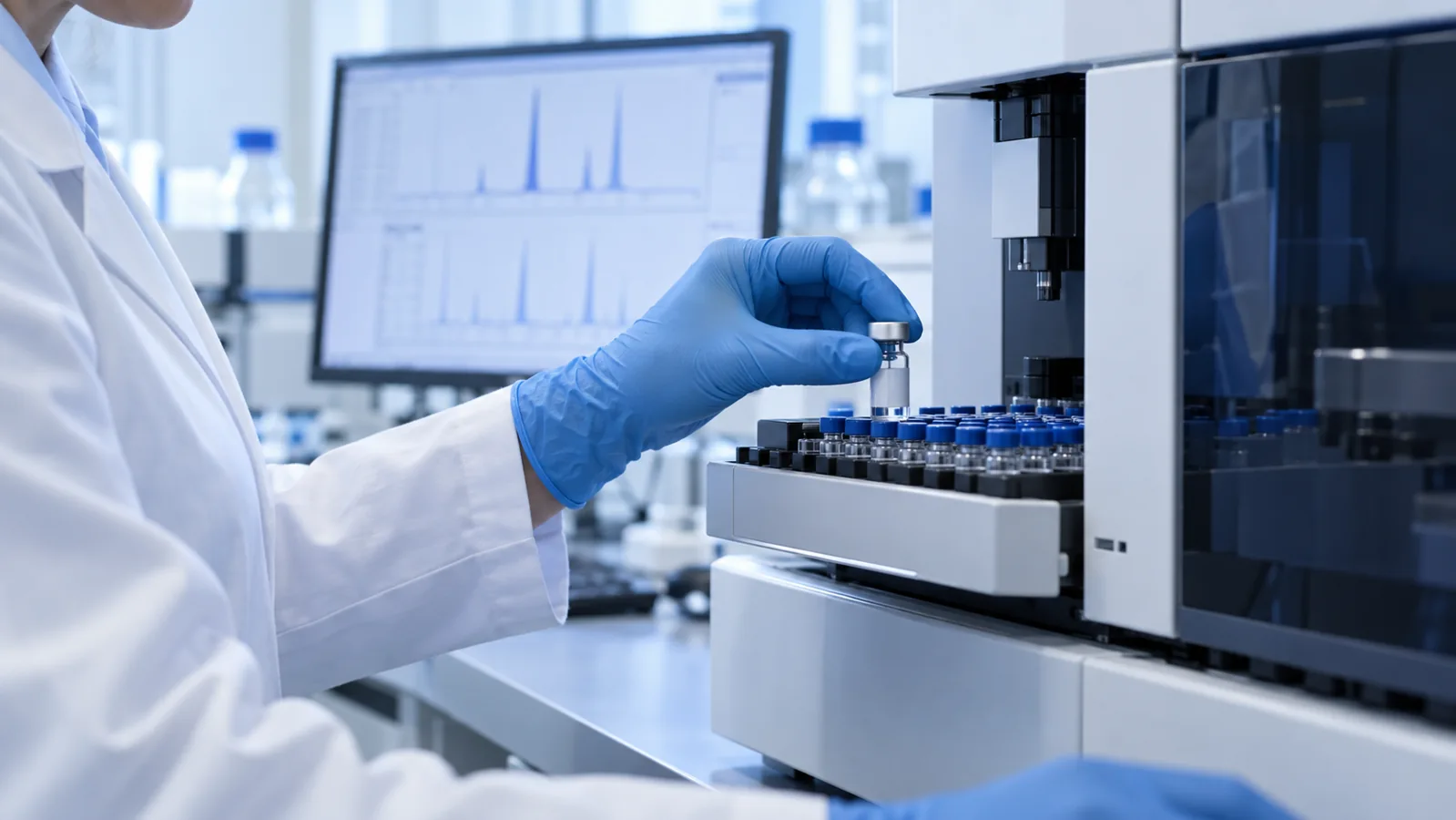
A single content figure for the whole vial can’t show that split, and a purity number alone says nothing about how much peptide is in the vial. A blend’s certificate needs each of these:
| What to check | What it shows | Simms batch CI224 |
|---|---|---|
| Form named on label and certificate | Which CJC-1295 is in the vial | CJC-1295 noDAC |
| Identity by LC-MS | Both peptides are what the label says | Confirmed for both |
| Purity by HPLC | How much of the powder is the intended peptides | 99.93% |
| Net content for each peptide | The real amount of each, and the ratio | 5.33mg CJC-1295, 5.28mg ipamorelin |
| Endotoxin test | Bacterial toxins left from manufacturing | Pass, two replicates |
Simms Research’s current batch of CJC-1295 noDAC / Ipamorelin, CI224, was tested May 5, 2026. Its two peptides sit within 1% of each other and about 6% above the label, so a 5-unit draw from a vial mixed with 2.5mL holds about 107mcg of CJC-1295 and 106mcg of ipamorelin. The certificate is on the CJC-1295 / Ipamorelin lab results page.
Frequently asked questions
How many units is 100mcg of CJC-1295 Ipamorelin?
It depends on the water added to the 10mg blend. With 2mL, 100mcg of each peptide is 4 units on a U-100 insulin syringe; with 2.5mL, 5 units; with 3mL, 6 units.
How much bacteriostatic water for 10mg CJC-1295 Ipamorelin?
2 to 3mL. With 2.5mL, each peptide is at 2mg per mL and every 5 units holds 100mcg of each.
How long does a 10mg vial of CJC-1295 Ipamorelin last?
50 injections at 100mcg of each: 25 days at twice a day, 50 days at once a day. A mixed vial keeps 28 days in the fridge.
What is the CJC-1295 dosage per week?
Without DAC, 0.7 to 2.1mg of each peptide a week, from one to three 100mcg injections a day. With DAC, 1 to 2mg once a week.
What size syringe for CJC-1295 Ipamorelin?
A 0.3mL (30-unit) U-100 insulin syringe. It is marked in single units, which a 4- to 6-unit dose needs.
Can CJC-1295 and ipamorelin be injected in the morning?
Yes, on an empty stomach right after waking. It is the usual second dose; the bedtime dose comes first because it adds to the day’s largest natural growth hormone pulse.
Does CJC-1295 work without ipamorelin?
Yes. On its own, the DAC version raised growth hormone 2- to 10-fold in its human trial, and the no-DAC version produces a short pulse with each injection. Ipamorelin makes each pulse larger.
Can ipamorelin be used without CJC-1295?
Yes. Ipamorelin produced a growth hormone pulse at every dose tested in people, and on its own it is dosed the same way, 100 to 200mcg one to three times a day. Simms Research sells Ipamorelin in 10mg vials.
Is CJC-1295 the same as sermorelin?
They are close relatives. Sermorelin is the unmodified first 29 amino acids of GHRH and is broken down within minutes. CJC-1295 without DAC is the same chain with four amino acids swapped to resist that breakdown, which stretches its half-life to about 30 minutes. CJC-1295 with DAC adds the albumin-binding group on top and lasts about a week.
Is CJC-1295 Ipamorelin for human use?
No. Simms Research sells it for laboratory research use only.