

Blog
NAD+ Injection Dosage Chart 2026
NAD+ dosing for 500mg and 1000mg vials: how much bac water to add, the syringe units for every dose at each strength, published subcutaneous, IM and IV amounts, which vial size fits a 28-day schedule, and why a strong mix stings.

Fifty times the powder of a peptide vial
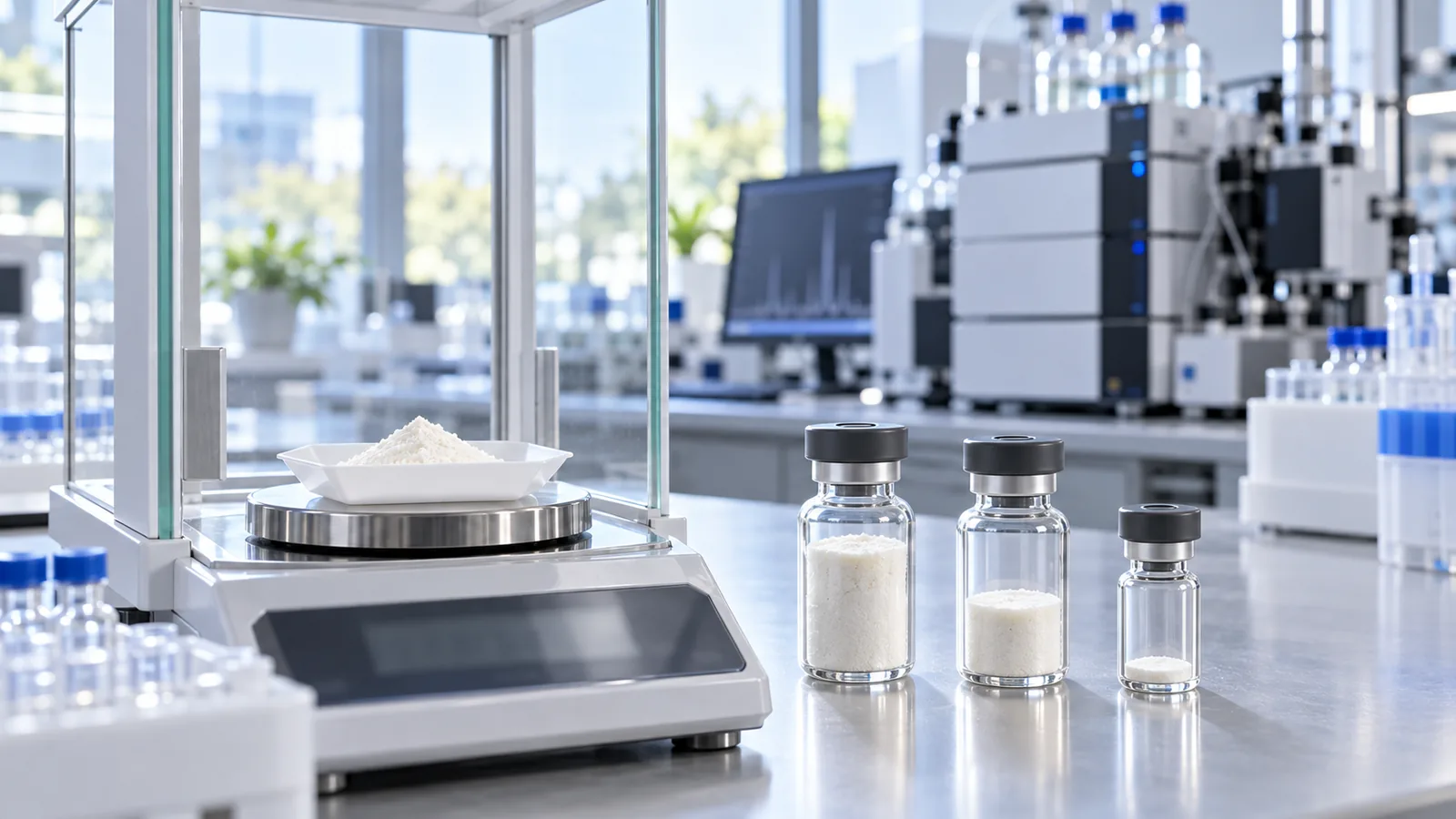
A 500mg vial of NAD+ holds fifty times the powder of a 10mg peptide vial, and nearly every number in an NAD+ protocol follows from that. Doses are counted in milligrams rather than micrograms, the vial takes several millilitres of water instead of one or two, and the water decides whether a 50mg dose reads 25 units on an insulin syringe or 50.
Simms Research sells NAD+ as a white freeze-dried powder in 500mg ($76) and 1000mg ($104) vials. It is the free-acid form of the coenzyme (formula C21H27N7O14P2, CAS 53-84-9), which matters later for why a strong mix stings. Each section below answers one of the questions researchers bring to these two vial sizes, in the order they come up: the water, the units, the dose for each route, how long the vial holds out, and the batch data.
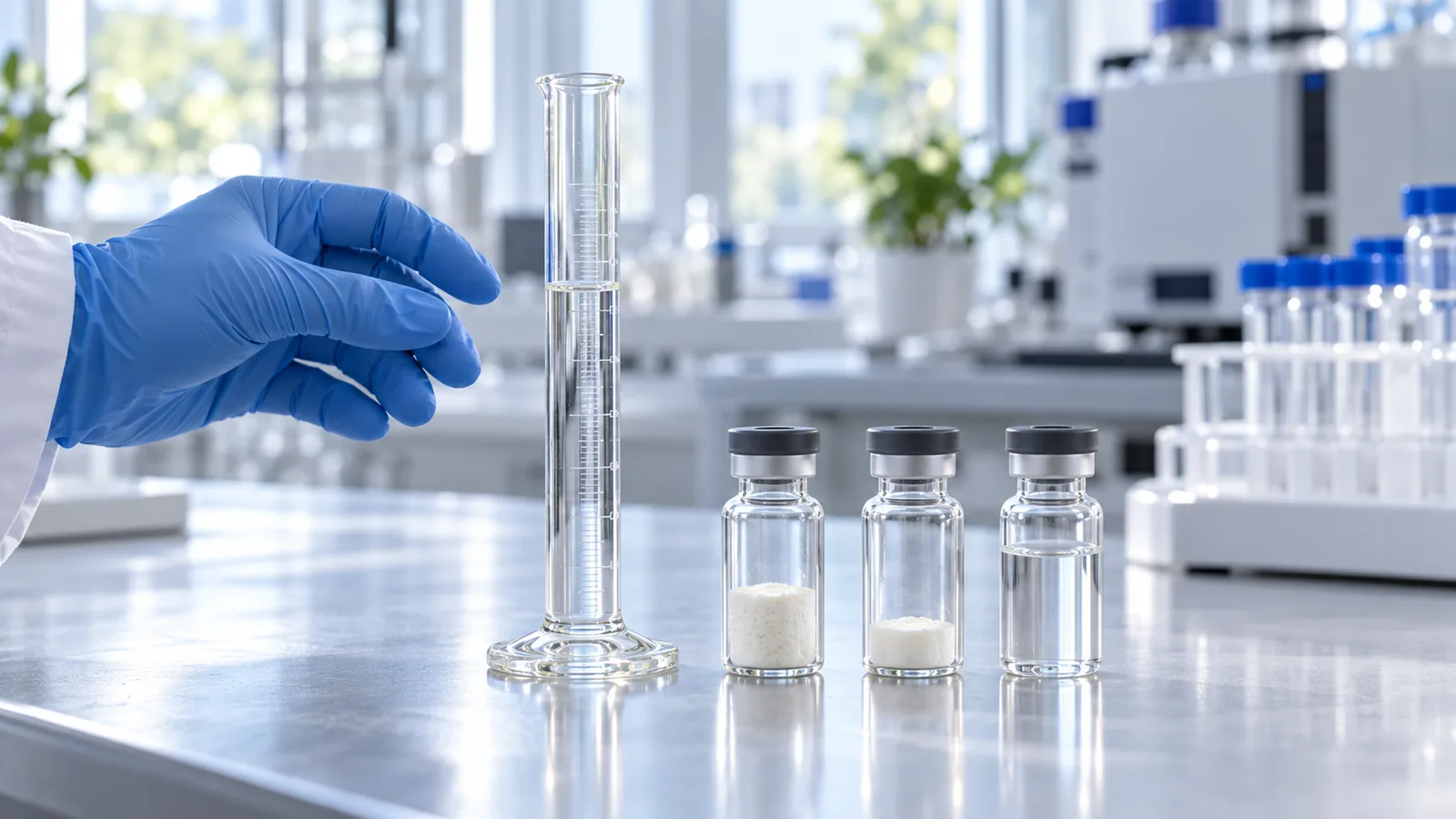
How much bac water for 500mg and 1000mg NAD+
Bacteriostatic water changes how concentrated the NAD+ is, never how much the vial holds. Divide the vial’s milligrams by the millilitres of water and the answer is the strength. 500mg in 5mL comes to 100mg per mL, the setting where the syringe reads straight across in milligrams: 50 units is 50mg, 100 units is 100mg. It is also one of the two strengths, 100mg and 200mg per mL, that compounded NAD+ injections are sold at, so published unit charts translate without conversion.
| Vial | Water | Strength | 50mg dose | 100mg dose | A full 1mL syringe holds |
|---|---|---|---|---|---|
| 500mg | 2.5mL | 200mg/mL | 25 units | 50 units | 200mg |
| 500mg | 3mL | 166.7mg/mL | 30 units | 60 units | 167mg |
| 500mg | 5mL | 100mg/mL | 50 units | 100 units | 100mg |
| 1000mg | 5mL | 200mg/mL | 25 units | 50 units | 200mg |
| 1000mg | 10mL | 100mg/mL | 50 units | 100 units | 100mg |
A 1000mg vial reaches the same 100mg per mL with 10mL. With 5mL it runs at 200mg per mL: each unit then carries 2mg, a 25mg step falls halfway between two marks at 12.5 units, and the whole 1mL syringe holds 200mg. The 3mL mix often used for 500mg vials lands at 166.7mg per mL, where every 5mg is exactly 3 units.
One 10mL bottle of Research Water, the bacteriostatic water Simms sells (sterile water with 0.9% benzyl alcohol), covers a 1000mg vial mixed at 10mL, two 500mg vials at 5mL, or four at 2.5mL. For any other volume the reconstitution calculator does the division and returns the units.
NAD+ dosage chart in units
Every cell is the reading on a standard insulin syringe, the U-100 kind that fills to 100 units at 1mL. A dose past 100 units won’t fit a single draw, so the chart marks it as two draws; the stronger mix in the next column brings it back under one.
500mg vial
| Dose | 2.5mL (200mg/mL) | 3mL (166.7mg/mL) | 5mL (100mg/mL) |
|---|---|---|---|
| 25mg | 12.5 units | 15 units | 25 units |
| 30mg | 15 units | 18 units | 30 units |
| 50mg | 25 units | 30 units | 50 units |
| 75mg | 37.5 units | 45 units | 75 units |
| 100mg | 50 units | 60 units | 100 units |
| 150mg | 75 units | 90 units | 150 units (1.5mL, two draws) |
| 200mg | 100 units | 120 units (1.2mL, two draws) | 200 units (2mL, two draws) |
| 250mg | 125 units (1.25mL, two draws) | 150 units (1.5mL, two draws) | 250 units (2.5mL, two draws) |
1000mg vial
| Dose | 5mL (200mg/mL) | 10mL (100mg/mL) |
|---|---|---|
| 25mg | 12.5 units | 25 units |
| 30mg | 15 units | 30 units |
| 50mg | 25 units | 50 units |
| 75mg | 37.5 units | 75 units |
| 100mg | 50 units | 100 units |
| 150mg | 75 units | 150 units (1.5mL, two draws) |
| 200mg | 100 units | 200 units (2mL, two draws) |
| 250mg | 125 units (1.25mL, two draws) | 250 units (2.5mL, two draws) |
Wherever the strength matches, so do the units: a gram vial mixed with 10mL reads exactly like a 500mg vial mixed with 5mL, and the 5mL gram vial reads like a 500mg vial taken up with 2.5mL.
What 20, 30, 50 or 83 units of NAD+ holds
Protocols get passed along as a unit count with the mix left off. That count is meaningless on its own: 50 units is 50mg at 100mg per mL and twice that at 200mg per mL. Read any unit figure against the strength it was written for.
| Syringe reading | At 100mg/mL | At 166.7mg/mL | At 200mg/mL |
|---|---|---|---|
| 10 units | 10mg | 16.7mg | 20mg |
| 20 units | 20mg | 33.3mg | 40mg |
| 30 units | 30mg | 50mg | 60mg |
| 50 units | 50mg | 83.3mg | 100mg |
| 83 units | 83mg | 138.3mg | 166mg |
| 100 units | 100mg | 166.7mg | 200mg |
NAD+ dose by route: subcutaneous, intramuscular and IV
The NAD+ amounts in circulation come from clinical dosing charts written for compounded injections and from a small set of IV studies. A 2026 systematic review of 113 NAD+ studies found no outcome trials of injected or infused NAD+ itself; the only direct human data it turned up was a 2019 IV pharmacokinetic pilot. What the published protocols agree on is scale: tens of milligrams under the skin or into muscle, hundreds through a drip.
| Route | Amount per dose | How often | Weekly total | Source |
|---|---|---|---|---|
| Subcutaneous, daily | 30mg, rising to 50mg | Daily for the first week, then Monday to Friday | 210mg, then 250mg | Compounding-pharmacy dosing chart |
| Subcutaneous, weekly | 50mg, rising to 100mg after four weeks | Once a week | 50–100mg | Clinic injection procedure (100mg weekly ceiling) |
| Intramuscular | 50mg | Up to three times a week | Up to 150mg | Compounding-pharmacy dosing chart |
| IV, single session | 250mg in 500mL saline, or 500mg in 1,000mL | Weekly | 250–500mg | Compounding-pharmacy dosing chart |
| IV, loading | 500mg in 500mL saline | Four days in a row | 2,000mg in four days | Reyna et al., 2026 |
| IV, research infusion | 750mg over 6 hours (about 2mg a minute) | Once | 750mg | Grant et al., 2019 |
Under the skin, the clinical starting points are 30mg a day or 50mg once a week, and neither clinical chart goes past 100mg in one injection. At 100mg per mL that is 30 to 100 units, always a single draw. The intramuscular schedule uses the same 50mg spaced up to three times a week; in a regulatory safety study, rabbits given intramuscular NAD+ for 14 straight days showed no muscle irritation.
IV amounts run ten times higher and always go into saline over hours. The one controlled measurement, 750mg infused into healthy men at about 2mg a minute over six hours, found that plasma NAD+ did not rise at all for the first two hours: tissue took up or broke down everything that arrived. Only by the end of the infusion did levels reach about 400% above baseline. In vial terms, a 1000mg vial holds two 500mg infusion doses or twenty 50mg injections.
How long a 500mg or 1000mg vial lasts
A mixed NAD+ vial gets 28 refrigerated days, so the useful question is how many doses land inside that window, not how many the vial holds. Run the schedules from the route table against both sizes and the answer splits cleanly.
| Schedule | Per week | 500mg vial | 1000mg vial | Cost per 4 weeks (500mg / 1000mg) |
|---|---|---|---|---|
| 30mg daily | 210mg | 16.7 days, all used | 28 days, 840mg used, 160mg left | $128 / $104 |
| 50mg Monday to Friday | 250mg | 14 days, all used | 28 days, all used | $152 / $104 |
| 50mg three times a week | 150mg | 23.3 days, all used | 28 days, 600mg used, 400mg left | $91 / $104 |
| 100mg once a week | 100mg | 28 days, 400mg used, 100mg left | 28 days, 400mg used, 600mg left | $76 / $104 |
| 50mg once a week | 50mg | 28 days, 200mg used, 300mg left | 28 days, 200mg used, 800mg left | $76 / $104 |
Below about 170mg a week the 500mg vial wins, because a gram vial mixed for a light schedule is still more than half full when its 28 days are up. From 50mg every weekday upward the gram vial is used up by day 28, and on that schedule it costs $48 less every four weeks than two 500mg vials.
How long reconstituted NAD+ stays good
The 28 days is Simms’s guidance for the mixed vial at 2–8°C (36–46°F), kept dark. NAD+ in water holds up best slightly acidic and breaks down quickly with heat or in alkaline solutions, and manufacturer data for the same free-acid form shows how far conditions move it. A 10mg per mL solution kept more than 99% of its NAD+ through eight weeks in the fridge. A 50mg per mL solution at pH 2.0 kept 91% after ten days in the fridge and about 83% after ten days at 33°C (91°F).
So the mixed vial goes straight back into the fridge after every draw, and a gram vial gets mixed whole only when the schedule will finish it inside the window. The dry powder is far more forgiving, which is why it ships without ice; Do peptides need to be refrigerated? covers the unmixed vial.
Why NAD+ stings and flushes
Two separate things get called NAD+ side effects. One is local: the burn, redness or welt where the needle went in. The other is systemic: warmth, flushing, nausea, cramping or chest pressure, and it belongs to fast IV delivery.
The local sting starts with the powder. Free-acid NAD+ dissolved in water is strongly acidic, about pH 3.0 at 50mg per mL in the manufacturer’s data, against tissue at roughly 7.4, and injection mixes of 100–200mg per mL pack in more acid per millilitre still. Extra water lowers that strength at the injection site without changing the dose: 50mg at 100mg per mL is spread over 50 units instead of the 25 it takes at 200mg per mL. The clinic procedure behind the weekly protocol adds two more fixes, a slower push and a larger dose split between two sites.
The systemic reactions follow speed. In clinic records published in 2026, all six people given 500mg IV NAD+ on four straight days had cramping, nausea, a faster heart rate or chest pressure during the drip. Every symptom stopped the moment the infusion ended, and the participants slowed their own drips to an average of 97 minutes. The six-hour 750mg study, at roughly 2mg a minute, reported the infusion as well tolerated. A 50mg injection under the skin is a tenth of one loading infusion, absorbed from a small depot instead of dripped into a vein.
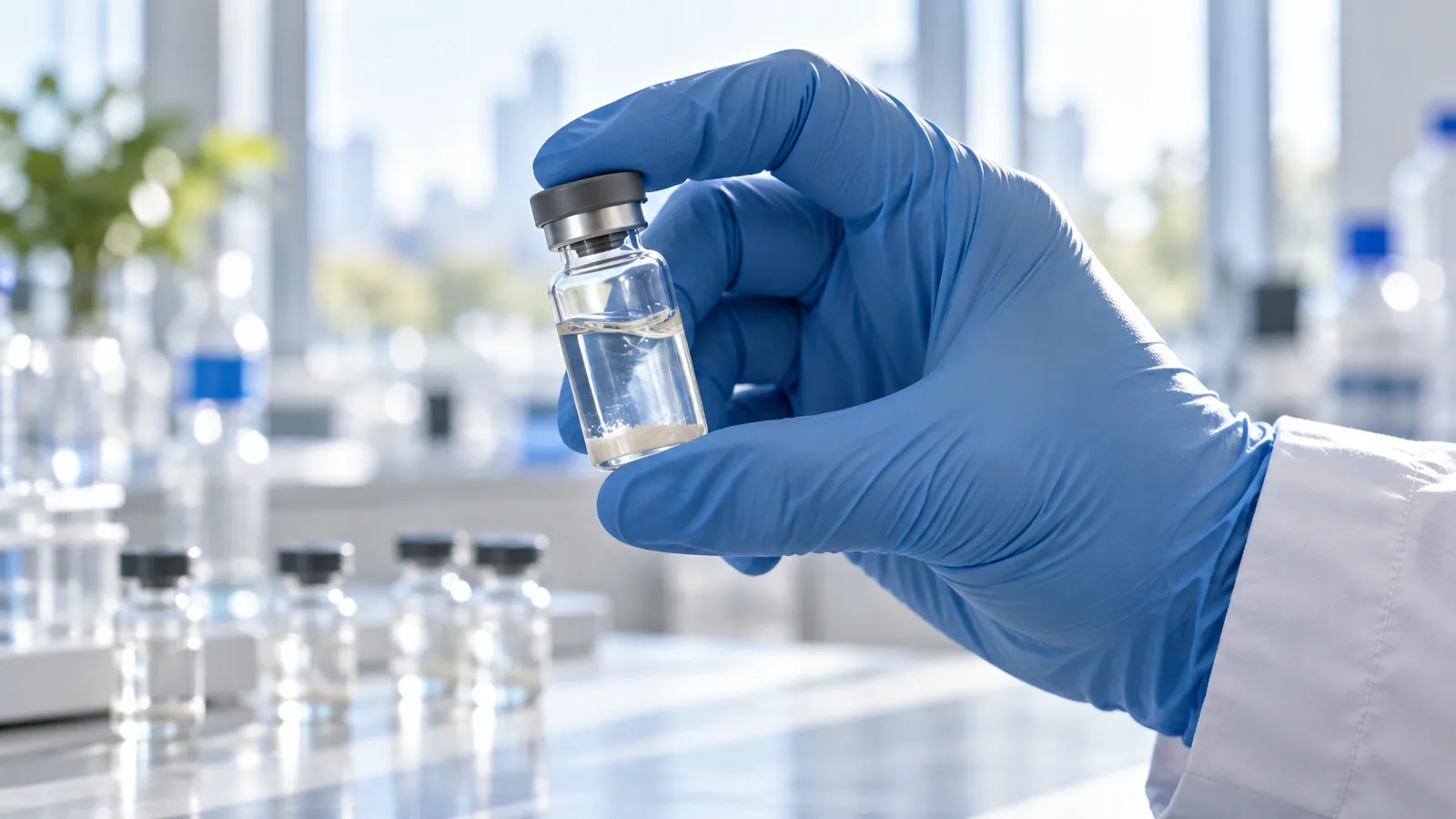
Mixing a gram of NAD+
Reconstituting NAD+ uses the same clean routine as any freeze-dried vial. What changes is the volume. Five or ten millilitres would take five to ten refills of an insulin syringe, so the water goes in with a 5mL or 10mL syringe and the doses come out with insulin syringes afterwards.
That much liquid also pressurises a sealed vial. Drawing out about as much air as the water going in keeps the stopper from pushing solution back up the needle; the water runs down the glass rather than straight onto the cake. A 500mg or 1000mg cake takes longer to wet through than a few milligrams of peptide, so the vial gets swirled or rolled, never shaken, and a few minutes to finish. Done, it is clear with nothing on the bottom or clinging to the shoulder.
The strength and the date go on the label the moment it is mixed. With two vial sizes and three common water volumes, the strength is the number most likely to get lost, and every unit figure above is only right for the mix it was read from.
What each NAD+ batch measured
Simms publishes each NAD+ certificate on the NAD+ lab results page. Both published batches are 500mg vials, and both came in slightly over label.
| Batch 2026-N299 | Batch N254 | |
|---|---|---|
| Labeled | 500mg | 500mg |
| Vials tested | 3 | 1 |
| Measured content | 519.11, 508.73 and 505.19mg (average 511.01mg) | 511.38mg |
| Purity | 99.492%, 99.891% and 99.842% (average 99.742%) | 99.58% |
| Identity | NAD+ confirmed by LC-MS | NAD+ confirmed by mass spectrometry |
| Endotoxins | Pass | Not tested |
| Heavy metals | Not detected | Not reported |
| Sterility | No growth | Not reported |
| Tested | July 16, 2026 | March 21, 2026 |
| What 50 units holds at 5mL | 51.1mg | 51.1mg |
The extra 2% nudges the unit math in the researcher’s favour: mixed with 5mL, the latest batch runs about 102mg per mL, so 50 units carries 51.1mg. Purity between 99.49% and 99.89% across its three vials means almost all of that is NAD+ itself, and its contaminant screens came back clean: endotoxin pass, no heavy metals detected, no growth on the sterility culture.
Frequently asked questions
How much NAD+ to take per week?
Published subcutaneous and intramuscular schedules run from 50mg to 250mg a week: 50–100mg as one weekly injection, 150mg as 50mg three times a week, 210–250mg as daily or weekday doses. IV schedules use 250–500mg in one weekly session, and the loading pattern puts 2,000mg in over four days.
Is 1000 mg of NAD+ too much?
As a vial, no. As one dose it is larger than any single amount in the published human studies, where the top figures are 750mg infused over six hours and 500mg dripped over about an hour and a half. A 1000mg vial is meant to be divided: twenty 50mg doses or two 500mg infusions.
How many units of NAD should I start with?
The published starting doses are 30mg a day or 50mg a week. At 100mg per mL that is 30 or 50 units; at 200mg per mL, 15 or 25 units; at 166.7mg per mL (500mg with 3mL), 18 or 30 units.
How much BAC water for 1000mg NAD?
10mL gives 100mg per mL, where units and milligrams match. 5mL gives 200mg per mL, where each unit carries 2mg and the whole 1mL syringe holds 200mg.
Can NAD+ go in the same syringe as tirzepatide?
Keep them apart. One syringe dilutes each by the other’s volume and changes the acidity of the NAD+ solution, so neither unit chart is right anymore. Tirzepatide units are worked out in the tirzepatide dosage chart.
Is NAD+ approved?
No. Simms Research sells NAD+ for laboratory research use only.