

Blog
How to Reconstitute Retatrutide
The exact bacteriostatic water for 10mg, 20mg, 30mg and 60mg retatrutide vials: the strength each mix makes, what 20 or 25 units really holds, why the 60mg vial takes 3mL, and the water that matches each batch's measured content.

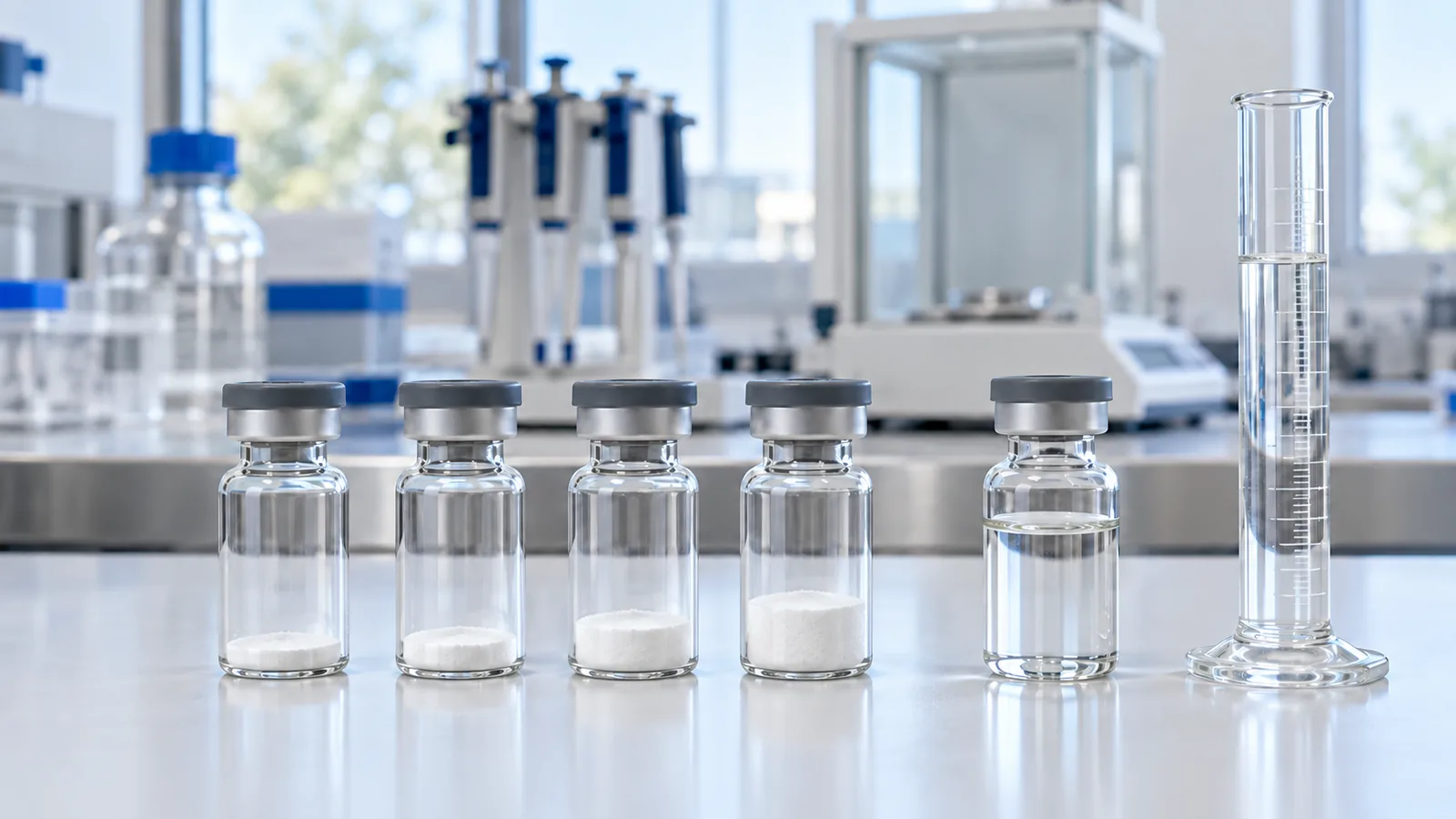
Retatrutide arrives as a dry white cake, and the water added to it changes only one thing: how much peptide each unit on the syringe carries. The milligrams in the vial are fixed whether it gets 1mL or 6mL. What the water decides is how many units a dose takes, whether those units fall on a printed mark, and whether the largest dose still fits in a single draw.
That makes the volume a real choice, and the mixes passed around for retatrutide don’t all hold up. 10mg with 3mL, 20mg with 3mL and 30mg with 2mL are all common, and each one works for some doses and turns awkward for others. Simms Research sells Retatrutide (GLP-3) in 10mg, 20mg, 30mg and 60mg vials, at $84, $129, $159 and $259. Each size has one water volume that keeps every dose it covers on a clean mark. Three of the four arrive at the same strength; the 60mg vial breaks the pattern, for a reason the 12mg dose explains.
Retatrutide reconstitution chart: 10mg, 20mg, 30mg and 60mg
Strength is the vial’s milligrams divided by the millilitres of water. On a U-100 insulin syringe, 100 units fill 1mL, so a single unit carries one hundredth of the strength. For each vial size, the first row is the recommended mix and the rows under it are the alternatives in common use.
| Vial | Water | Strength | One unit holds | Doses that land on clean marks |
|---|---|---|---|---|
| 10mg | 1mL | 10 mg/mL | 0.1mg | Every dose up to 10mg, at milligrams × 10 |
| 10mg | 2mL | 5 mg/mL | 0.05mg | Every dose up to 5mg, at milligrams × 20 |
| 10mg | 3mL | 3.33 mg/mL | 0.033mg | 1, 2 and 3mg at 30, 60 and 90 units; 4mg takes two draws |
| 20mg | 2mL | 10 mg/mL | 0.1mg | Every dose up to 10mg, at milligrams × 10 |
| 20mg | 1mL | 20 mg/mL | 0.2mg | Every dose up to 20mg, at milligrams × 5; 1mg is only 5 units |
| 20mg | 3mL | 6.67 mg/mL | 0.067mg | 2, 4 and 6mg at 30, 60 and 90 units; 9mg takes two draws |
| 30mg | 3mL | 10 mg/mL | 0.1mg | Every dose up to 10mg, at milligrams × 10 |
| 30mg | 2mL | 15 mg/mL | 0.15mg | 6, 9 and 12mg at 40, 60 and 80 units; 2 and 4mg fall between marks |
| 30mg | 1.5mL | 20 mg/mL | 0.2mg | Every dose up to 20mg, at milligrams × 5 |
| 60mg | 3mL | 20 mg/mL | 0.2mg | Every dose up to 20mg, at milligrams × 5; 12mg is 60 units |
| 60mg | 6mL | 10 mg/mL | 0.1mg | Every dose up to 10mg; 12mg is 120 units, two injections |
10mg vial: 1mL, or 2mL for doses under 2mg
The 10mg vial is the one the retatrutide dosage guide pairs with the 2mg starting step, five weekly doses inside the 28 days a mixed vial keeps. With 1mL it becomes 10 mg/mL and the dose reads straight off the barrel: 2mg is 20 units. 2mL halves the strength, which turns the small doses tested in Phase 2, 1mg and 0.5mg, into 20 and 10 units instead of 10 and 5. The 3mL mix that turns up in so many searches also works at this step, with 2mg at 60 units, but a unit then holds 0.033mg and anything above 3mg needs a second draw.
20mg vial: 2mL
The 20mg vial covers the 4mg step. At 2mL it reaches the same 10 mg/mL as the 10mg vial at 1mL, so 4mg is 40 units and nothing about reading the syringe changes from one step to the next. The popular 3mL mix makes 6.67 mg/mL, and it’s cleaner than the decimal suggests: 2, 4 and 6mg come out at 30, 60 and 90 units. It fails at 9mg, which needs 135. With 1mL the vial runs at 20 mg/mL, where 4mg is 20 units and 1mg shrinks to 5.
30mg vial: 3mL
The 30mg vial carries the 6mg step, and 3mL holds it at 10 mg/mL with 6mg at 60 units. The 9mg step uses a 30mg and a 10mg vial together, and mixing both to 10 mg/mL keeps the dose at 90 units whichever vial it comes from. With 2mL instead, the 30mg vial runs at 15 mg/mL: 6, 9 and 12mg fall on 40, 60 and 80 units, all single draws, but 2mg and 4mg become 13.3 and 26.7 units, between the marks. That mix suits a vial used only at the upper steps.
60mg vial: 3mL, the exception
The 60mg vial is built for 12mg a week. It is the only size that holds exactly five 12mg doses, one for each week of the 28-day window, and that dose is where 10 mg/mL stops working. Reaching 10 mg/mL takes 6mL of water, 60% of a 10mL water vial, and turns 12mg into 120 units, more than a 1mL syringe holds, so every dose becomes two injections. 3mL makes 20 mg/mL and puts 12mg at 60 units in one draw.
The trade is resolution. Each unit at 20 mg/mL holds 0.2mg, and a 9mg dose lands on 45 units, an odd number that sits between the 2-unit marks of a 1mL syringe. A 0.5mL syringe, marked in single units up to 50, reads 45 exactly.
How much retatrutide is in 20 or 25 units
A unit is a volume, not a dose. On any U-100 syringe 20 units is 0.20mL and 25 units is 0.25mL. How much retatrutide that volume holds depends entirely on the mix, which is why the same number of units can be a starting dose from one vial and more than twice that from another:
| Units drawn | 10mg + 3mL | 10mg + 2mL | 20mg + 3mL | Any 10 mg/mL mix | 60mg + 3mL |
|---|---|---|---|---|---|
| 10 units (0.10mL) | 0.33mg | 0.5mg | 0.67mg | 1mg | 2mg |
| 20 units (0.20mL) | 0.67mg | 1mg | 1.33mg | 2mg | 4mg |
| 25 units (0.25mL) | 0.83mg | 1.25mg | 1.67mg | 2.5mg | 5mg |
| 40 units (0.40mL) | 1.33mg | 2mg | 2.67mg | 4mg | 8mg |
| 50 units (0.50mL) | 1.67mg | 2.5mg | 3.33mg | 5mg | 10mg |
| 60 units (0.60mL) | 2mg | 3mg | 4mg | 6mg | 12mg |
So 25 units is 2.5mg from a vial mixed to 10 mg/mL, a little above the 2mg starting dose. From a 60mg vial mixed with 3mL it is 5mg, past the 4mg step, and from a 10mg vial mixed with 3mL it is 0.83mg, below the start. The reverse direction, each dose on the trial schedule converted to units, is in the retatrutide dosage guide.
The syringe sets how finely any of this can be read. A 1mL insulin syringe is marked every 2 units, a 0.5mL syringe every unit up to 50, and a 0.3mL syringe every unit up to 30. At 10 mg/mL a 2-unit mark is 0.2mg; at 20 mg/mL it is 0.4mg. The stronger the mix, the more a misread mark is worth.
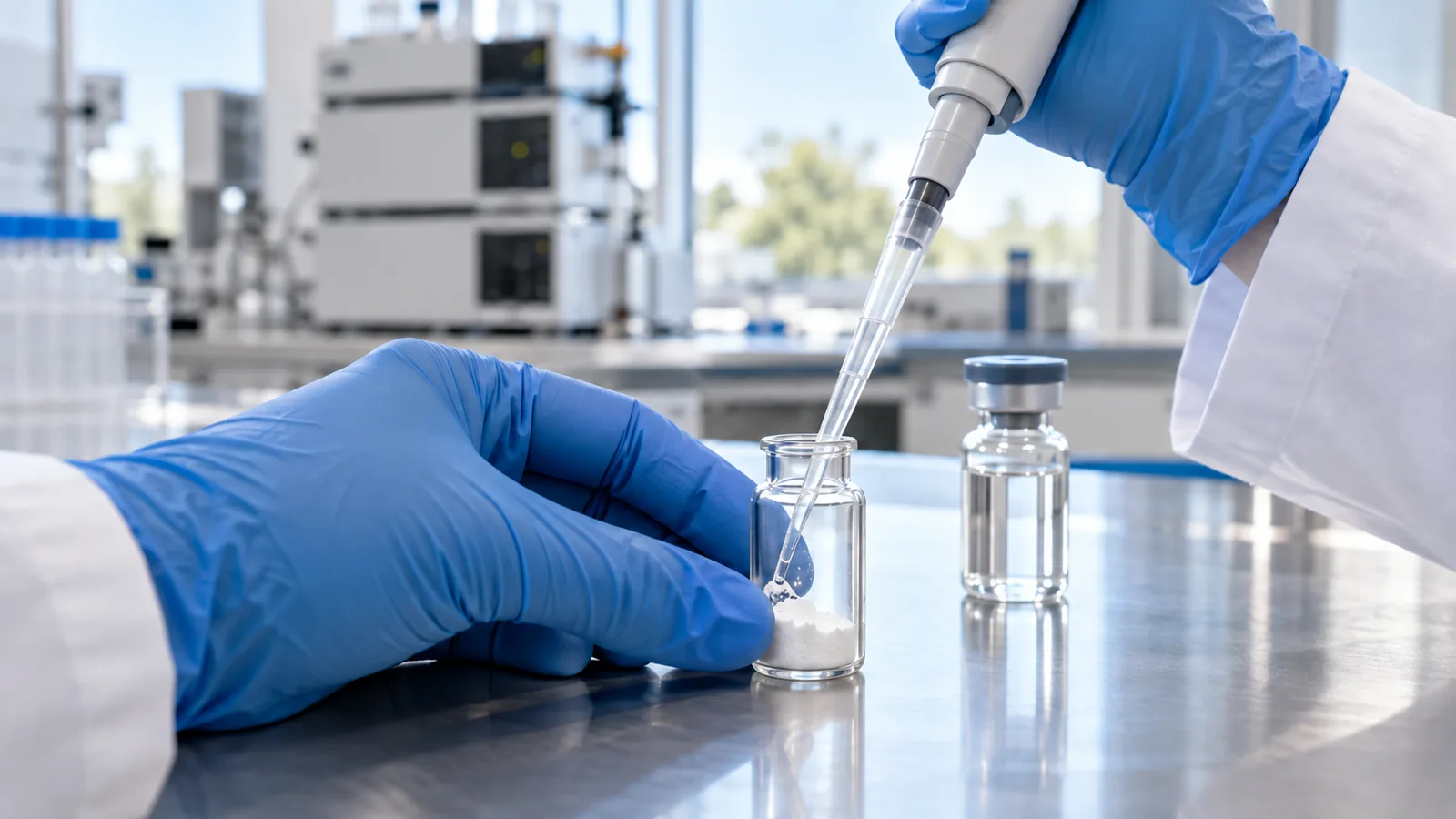
Mixing retatrutide with bacteriostatic water
Measuring 1, 2 or 3mL
Retatrutide is mixed with bacteriostatic water, sterile water carrying 0.9% benzyl alcohol, the preservative that lets one vial be drawn from for 28 days. Simms Research sells it as Research Water, in 10mL vials at $20. A 1mL insulin syringe filled to the 100 mark measures 1mL exactly, so the 2mL and 3mL mixes are two or three full draws. A 3mL syringe does it in one, but its marks sit 0.1mL apart, ten times coarser than an insulin syringe’s. The exact-content volumes further down, such as 1.07mL, are one full insulin-syringe draw plus 7 units.
Getting the powder into solution
The water goes in slowly, with the needle tip against the glass so it runs down the wall onto the cake instead of jetting into it. The 30mg and 60mg cakes are larger and take longer to wet through than a 10mg one. Rolling the vial between the palms or tilting it in slow circles dissolves it without the foam a hard shake whips up, and a stubborn vial clears after a few minutes upright in the fridge and another roll.
The vial is ready when the liquid is clear and colorless with nothing floating in it, and it can be used straight away; there is no resting period. Pushing 2 or 3mL into a sealed vial also compresses the air inside, which presses back on the plunger. Letting the syringe draw a little air back out before the needle comes out evens the pressure.
Writing the strength on the vial
Over the dose ladder, vials of up to four sizes share the fridge, and a 10mg vial mixed with 2mL looks exactly like a 20mg vial mixed with 2mL while holding half the strength. 2mg is 40 units from one and 20 from the other. The strength in mg/mL and the mixing date, written on the label the day the water goes in, settle which is which.
Exact water from the vial’s measured content
The chart takes every label at face value. The batch certificate gives the real amount per vial, listed as net content, and dividing that figure by the strength wanted gives the exact water. These are the retatrutide batches Simms Research has published:
| Batch | Vial | Measured content | Water for exactly 10 mg/mL | Water for exactly 5 mg/mL |
|---|---|---|---|---|
| 2026-G460 | 10mg | 10.68mg, average of 3 vials | 1.07mL | 2.14mL |
| G392 | 20mg | 19.82mg | 1.98mL | 3.96mL |
| R30 | 10mg | 11.95mg | 1.20mL | 2.39mL |
| G361 | 10mg | 11.11mg | 1.11mL | 2.22mL |
| G236 | 10mg | 10.19mg | 1.02mL | 2.04mL |
| G170 | 10mg | 10.82mg | 1.08mL | 2.16mL |
For the current batch, 2026-G460, tested in July 2026, a 10mg vial mixed to label with 1mL runs at 10.68 mg/mL, 7% strong. 1.07mL brings it back to 10 mg/mL. The published certificates cover the 10mg and 20mg sizes; the 30mg and 60mg vials mix by label until theirs are posted. Every certificate is on the retatrutide lab results page, and the guide to how to read a peptide certificate of analysis walks through every line on it.
How exact the water can get
Matching the certificate removes the largest gap. What’s left is small, and only one part of it can’t be fixed:
| Source | How large | What handles it |
|---|---|---|
| Label against measured content | −1% to +19% across six published batches | Water matched to the certificate |
| One vial against the next in the same batch | 10.39 to 11.19mg in batch 2026-G460, within 5% of its average | Nothing practical; it stays |
| Reading the water on a 1mL insulin syringe | About 1 unit in 100, or 1% | Full draws to the 100 mark |
| The powder’s own volume | About 0.007mL for 10mg and 0.04mL for 60mg, 0.7% to 1.4% | Nothing needed |
The vial-to-vial spread is the floor. Batch 2026-G460 tested three vials at 10.39, 10.74 and 11.19mg, so a 1.07mL mix puts each one between 9.7 and 10.5 mg/mL. No amount of care with the water gets closer than the batch itself allows. The powder’s volume is the smallest item: dry protein packs at about 1.4g per cubic centimetre (Quillin and Matthews, 2000), so even the 60mg cake adds only about 0.04mL to 3mL of water.
How long mixed retatrutide keeps
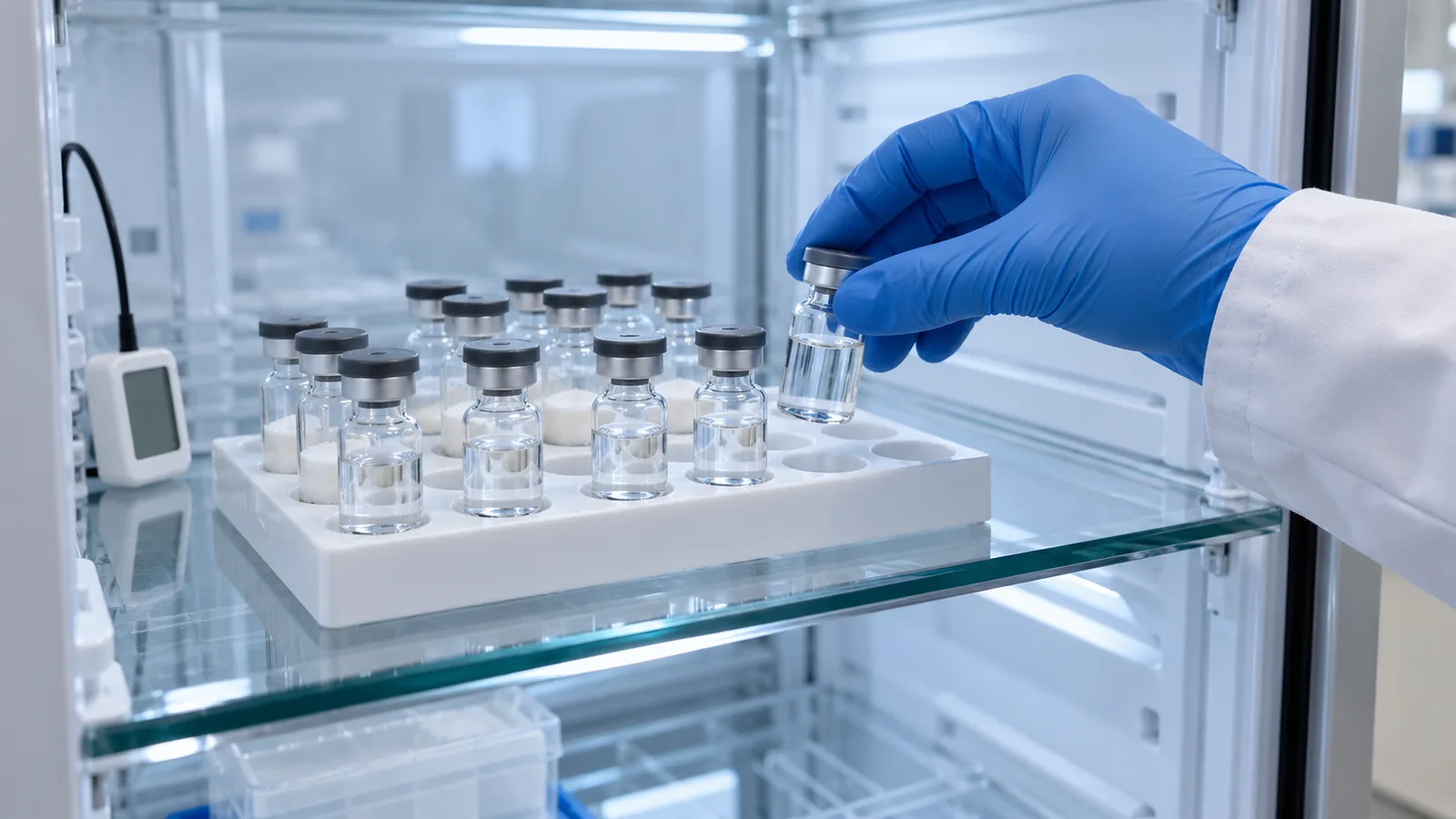
A mixed retatrutide vial keeps 28 days at 2–8°C (36–46°F), counted from the day the water goes in, not the day the vial arrived. Sealed vials wait in the fridge, or the freezer for longer stretches, until their step begins, and the retatrutide dosage guide matches each size to the step it covers. Why the limit is 28 days, and what a few hours out of the fridge does to a mixed vial, is covered in Do Peptides Need to Be Refrigerated?; Traveling With Peptides covers keeping one cold on the road.
The water vial has its own 28 days
Research Water carries the same limit: 28 days from the first puncture of its stopper. On the trial schedule retatrutide vials are mixed four weeks apart, so one 10mL water vial covers two mixes at most, however much water is still in it:
| Week | Retatrutide vial mixed | Water drawn | Research Water vial |
|---|---|---|---|
| 1 | 10mg | 1mL | Vial 1, first puncture |
| 5 | 20mg | 2mL | Vial 1, day 28 and its last use |
| 9 | 30mg | 3mL | Vial 2, first puncture |
| 13 | 30mg and 10mg | 4mL | Vial 2, day 28 and its last use |
| 17 | 60mg | 3mL | Vial 3, first puncture |
Twenty weeks of the ladder use 13mL of water across three vials. Mixing two retatrutide vials on the same day, as the 9mg step does, draws both from one.
Fixing a retatrutide mix that went wrong
Too much or too little water
Water can go into a mixed vial but never come back out, so an under-filled vial is easy to fix and an over-filled one isn’t. A 30mg vial that got 2mL instead of 3 sits at 15 mg/mL; another 1mL brings it to 10 mg/mL and the chart applies again. A 10mg vial that got 3mL instead of 1 stays at 3.33 mg/mL, which still works for 1, 2 and 3mg. Either way the strength is the milligrams in the vial divided by all the water now in it, and the peptide reconstitution calculator handles uneven totals. Adding water later doesn’t restart the 28 days.
Sterile water or saline instead of bacteriostatic water
What changes is the missing preservative. Without benzyl alcohol, nothing holds back the bacteria a needle carries in each time it passes through the stopper, so the 28-day window no longer applies. Plain sterile water is meant for a single use, while a 10mg retatrutide vial holds five weekly doses. A vial mixed that way is best treated as single-use, with the next one mixed with bacteriostatic water.
Cloudy, foamy or specked
Correctly mixed retatrutide is clear and colorless. Fine bubbles or a cap of foam come from shaking or a fast stream of water, and they rise out after a few minutes upright in the fridge. A ring of powder on the shoulder or under the stopper dissolves once the vial is tilted and rolled so the liquid washes over it. Haze that stays after a rest, or specks that won’t dissolve, mean the vial shouldn’t be used.
The mixed vial froze
The back wall of a small fridge can drop below freezing. Dry powder takes that without harm, but a mixed vial that froze and thawed should be replaced, because ice forming and melting in solution breaks peptides down. A middle shelf, away from the back wall, keeps it from happening.
Frequently asked questions
Does retatrutide need bac water?
It needs sterile water to dissolve, and bacteriostatic water is the kind that lets one vial serve several weekly doses. Its benzyl alcohol is what makes the 28-day window possible.
How long after reconstituting retatrutide can you inject?
As soon as the powder has fully dissolved and the liquid is clear. A mixed vial needs no time to settle.
How many mL is 10mg of retatrutide?
Milligrams measure the peptide and millilitres measure the water, so it depends on the mix. In a 10mg vial with 1mL, the full 1mL holds 10mg; with 2mL, 10mg is spread through 2mL and 1mL holds 5mg.
How much bac water for a 5mg, 12mg, 15mg or 50mg retatrutide vial?
For 10 mg/mL, divide the vial’s milligrams by 10: 0.5mL for 5mg, 1.2mL for 12mg, 1.5mL for 15mg and 5mL for 50mg. For 20 mg/mL, use half that. A 5mg vial is easier to read at 1mL, which makes 5 mg/mL.
Can retatrutide be mixed with other peptides in one vial?
It can’t be dosed independently once it is. Two peptides in one vial share a fixed ratio, a single strength and one 28-day clock, so a separate vial for each keeps every dose adjustable on its own.
Is retatrutide approved?
No. It is still in Lilly’s trials, and Simms Research supplies it for laboratory research only.