

Blog
Retatrutide for Fatty Liver: The Liver Fat Results and the MASH Trial Ahead

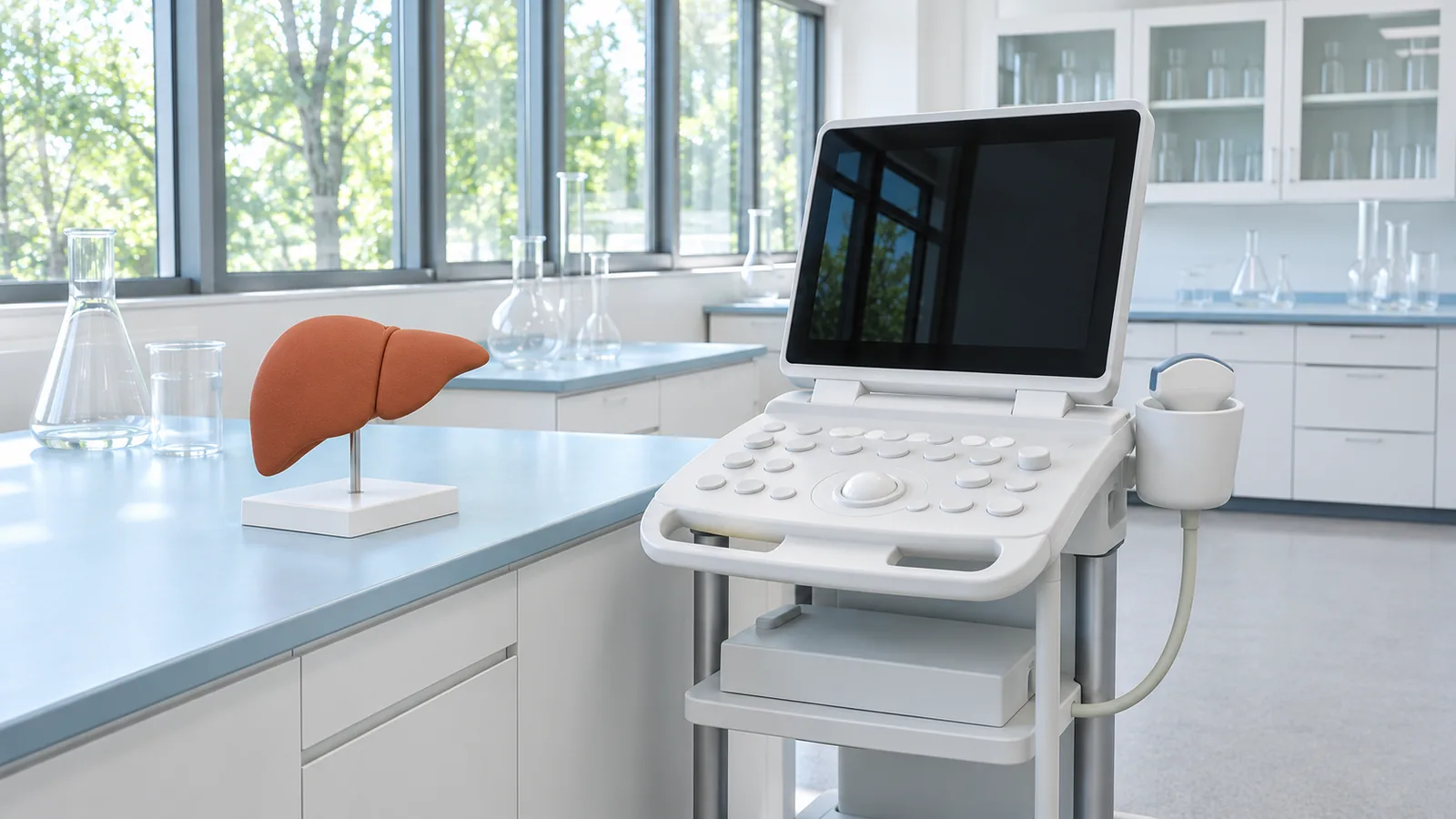
Fatty liver tends to arrive with the weight and stay quiet. Many people find out from an ultrasound or a blood panel ordered for something else, and then start asking what the new weight-loss drugs do for the liver.
Retatrutide has some of the largest liver-fat drops reported for any drug. In its Phase 2 liver study, most people on the two top doses had a normal amount of liver fat within 24 weeks, and their livers emptied faster than the rest of their bodies lost weight. The part doctors grade with a biopsy, inflammation and scar tissue, hasn’t been tested yet. That trial is enrolling now.
Simms Research sells Retatrutide (GLP-3) as freeze-dried research powder. Its latest batch tested at 99.611% purity, with 10.68mg measured in a vial labelled 10mg.
What fatty liver is, and how retatrutide reaches it
A liver counts as fatty once fat makes up 5% or more of it. When that fat comes from weight, blood sugar and blood fats rather than drinking or a virus, doctors now call it MASLD, short for metabolic dysfunction-associated steatotic liver disease; the older name was NAFLD. Around 38% of adults worldwide had it by 2016 to 2019, up from 25% in 1990 to 2006, and at least half of them live with obesity (Sanyal, Nature Medicine, 2024).
Fat on its own is the mild stage. In some people it inflames the liver and injures its cells, which is MASH (formerly NASH). Over years that injury lays down scar tissue, called fibrosis, and heavy scarring becomes cirrhosis. Liver fat is the first thing to fall when a treatment works, so early trials measure it with an MRI scan long before anyone asks for a biopsy.
Retatrutide acts on three hormone receptors, and the liver is where the third one matters most. The GLP-1 and GIP sides cut appetite and steady blood sugar, so weight comes off everywhere, the liver included. The glucagon side works on liver cells directly, pushing them to burn the fat they hold and to make less of it. In lab cells, retatrutide is about a third as strong as natural glucagon at its receptor, 0.4 times as strong as natural GLP-1, and nearly nine times as strong as natural GIP (Coskun, Cell Metabolism, 2022). The wider story of what retatrutide is, from Lilly’s lab to the TRIUMPH trials, has its own guide.
Retatrutide fatty liver study: the Phase 2 results
At 24 weeks, people on 8mg and 12mg had about 82% less fat in their livers, and the placebo group’s hadn’t moved.
The liver data come from inside retatrutide’s Phase 2 obesity trial. Of the 338 adults in it, 98 started with at least 10% liver fat on an MRI, and they were followed as a study of their own: average age 47, average weight 110 kg (about 243 lb), average liver fat 19%, and nobody with diabetes. Each took a weekly shot of 1, 4, 8 or 12mg, or a placebo, for 48 weeks. Liver fat at 24 weeks was the main measure, with a second scan at 48 (Sanyal, Nature Medicine, 2024):
| Weekly dose | Liver fat, 24 weeks | Liver fat, 48 weeks | Normal liver fat at 24 weeks | Body weight, 48 weeks |
|---|---|---|---|---|
| Placebo | 0.3% higher | 4.6% lower | 0% | 0.1% lower |
| 1mg | 42.9% lower | 51.3% lower | 27% | 8.6% lower |
| 4mg | 57.0% lower | 59.0% lower | 52% | 16.3% lower |
| 8mg | 81.4% lower | 81.7% lower | 79% | 23.8% lower |
| 12mg | 82.4% lower | 86.0% lower | 86% | 25.9% lower |
The 86% at 48 weeks is the headline figure. The column that says more is normal liver fat, meaning under 5%. Nobody on placebo got there. On 8mg and 12mg, about four in five had by week 24, and by week 48 the share among those scanned reached 89% and 93%. Fewer people had that second scan, eight or nine per group, so the 24-week results carry the weight.
Retatrutide liver fat reduction: how fast and how far
Fast, then flat. Most of the drop happened in the first 24 weeks, and the second 24 weeks held it. By week 24, between 71% and 100% of people in each retatrutide group had cut their liver fat by at least 30%, against 4% on placebo, and on the top two doses at least 80% had cut it by 70% or more. The liver shrank in volume along with it.
There is a floor. The biggest drops came once body weight was down about 20%; beyond that the liver had little left to give, since even a healthy liver holds a couple of percent fat (the median in the large UK Biobank study is 2.1%). After week 24, weight kept falling and the fat under the skin and around the organs kept shrinking, while the liver stayed near empty. The study’s authors read it as the body drawing on liver fat ahead of fat stored anywhere else (Sanyal, Nature Medicine, 2024).
For scale, the same paper points to 50 people who went on a very low-calorie diet and then had weight-loss surgery: 64% reached normal liver fat, after about 22 weeks on average. On 12mg of retatrutide, 86% were there at the 24-week scan. The weight curve, week by week, is in How Long Does Retatrutide Take to Work?
Weight loss or glucagon: what clears the liver
Both, with weight loss doing most of the work. Liver fat tracked body weight closely, a correlation of 0.8 at 24 weeks: the more someone lost, the emptier their liver. It tracked belly fat almost as closely, and insulin too. On 12mg at 48 weeks, fasting insulin was down 70.9% and triglycerides 49.4%, and adiponectin, a hormone that rises as fat tissue gets healthier, had climbed (Sanyal, Nature Medicine, 2024).
The glucagon side leaves its own fingerprint. Beta-hydroxybutyrate, a ketone the liver makes when it burns fat, rose two- to threefold on 4mg and up, peaking by week 24, the same weeks the liver fat went. No one developed ketoacidosis.
Drugs from the same family back that up. In a 24-week head-to-head, efinopegdutide, which pairs GLP-1 with glucagon, took more fat off the liver than semaglutide at every level of weight loss, 86.2% against 64.2% among people who lost more than 10% of their weight (Romero-Gómez, Journal of Hepatology, 2023). Going the other way, a drug that blocks the glucagon receptor raised liver fat in people with type 2 diabetes. Retatrutide gets both levers at once: the weight loss of a strong incretin drug and a direct push on the liver.
Retatrutide vs semaglutide and tirzepatide for fatty liver
On liver fat, retatrutide is ahead. On biopsies, the other two have results and retatrutide doesn’t yet.
Liver fat fell 32% at 24 weeks on dulaglutide, 47% at 52 weeks on tirzepatide in people with type 2 diabetes, and about 50% at 72 weeks on semaglutide, against retatrutide’s 82% at 24 weeks. Those are separate trials in different groups of people, never a head-to-head, but the gap is wide (Sanyal, Nature Medicine, 2024).
Biopsy trials ask a harder question: did the inflammation clear, and did scarring ease? Semaglutide’s Phase 3 trial, ESSENCE, took 800 people with MASH and moderate to advanced scarring. After 72 weeks, the inflammation had resolved without worse scarring in 62.9% against 34.3% on placebo, and scarring had eased in 36.8% against 22.4% (Sanyal, New England Journal of Medicine, 2025). That won Wegovy accelerated approval for MASH in August 2025, the second drug cleared for it after resmetirom (Rezdiffra) in March 2024.
Tirzepatide’s Phase 2 biopsy trial cleared MASH without worse scarring in 44% to 62% of people across its three doses at 52 weeks, against 10% on placebo (Loomba, New England Journal of Medicine, 2024). Survodutide, which pairs GLP-1 with glucagon the way retatrutide does but leaves out GIP, improved MASH in 43% to 62% against 14% at 48 weeks (Sanyal, New England Journal of Medicine, 2024). Retatrutide’s liver study took no biopsies and enrolled mostly mild disease, so its numbers can’t yet stand next to these. The drug-to-drug comparison beyond the liver is in Retatrutide vs Tirzepatide.
Retatrutide liver enzymes, fibrosis and liver damage
No liver harm turned up, and the routine liver enzymes barely moved, because they were normal to begin with.
ALT and AST, the two liver enzymes on a standard blood panel, averaged roughly 29 to 36 and 23 to 25 units per liter at the start, inside the normal range for most labs, and didn’t shift consistently against placebo. Through 48 weeks there was no hepatotoxicity signal, in the liver group or in the full 338-person trial. The side effects were the usual stomach ones, mostly mild to moderate and mostly while the dose was climbing, more often on 8mg and 12mg (Sanyal, Nature Medicine, 2024). Rates by dose are in Retatrutide Side Effects.
Retatrutide liver fibrosis
Two blood markers of active liver injury did fall. K-18, released when liver cells die, was down by up to 49.6% on 8mg and 12mg at 48 weeks. Pro-C3, a fragment shed while new scar tissue is being laid down, fell by up to 26.4%. The scarring scores, FIB-4 and ELF, held steady, but only 7 of the 98 people had scores pointing beyond mild scarring at the start, so there was little for them to show.
In animals, where the liver tissue itself can be examined, two weeks of retatrutide in a mouse model of MASH lowered ALT, liver triglycerides and markers of inflammation (Viebahn, American Journal of Physiology, 2025). People with advanced scarring or cirrhosis weren’t in the Phase 2 study, so there is no retatrutide data for them yet.
Is retatrutide being studied in MASH? The Phase 3 trial
Yes. SYNERGY-Outcomes, a Phase 3 trial that opened on October 15, 2025, is enrolling about 4,500 adults whose fatty liver puts them at higher risk of serious liver disease.
It runs two studies under one protocol: retatrutide against placebo, and tirzepatide against placebo. To join, people need liver fat of at least 8%, a stiffer-than-normal liver on an elastography scan (10 to under 20 kPa), an ELF score between 9 and 10.8, and a BMI of 25 or more. Entry runs on these non-invasive tests, with no biopsy.
It isn’t a liver-fat trial. It counts the time until the first serious liver event: progression to cirrhosis, swollen veins in the esophagus or stomach, fluid in the abdomen, confusion from a failing liver, a sharp rise in the MELD liver score, a transplant, or death. The trial runs about 224 weeks, a little over four years, with liver fat, liver stiffness and ELF rechecked at week 104. Primary results are expected around August 2030, and afterwards participants can join a two-year extension in which everyone gets retatrutide or tirzepatide.
So a liver approval for retatrutide sits years out, behind this trial. The obesity filing comes first, as laid out in When Will Retatrutide Be FDA Approved?
Does retatrutide help fatty liver?
For liver fat, yes, and by a wide margin. In people with obesity and a fatty liver, 8mg and 12mg brought liver fat into the normal range for most of them within 24 weeks and kept it there through 48, with no sign of harm to the liver.
Inflammation and scar tissue are the open question. The Phase 2 study took no biopsies and left out people with diabetes, and the trial that will settle it reports around 2030. Livers fattened by drinking are a separate case, covered in Retatrutide and Alcohol.
The doses the liver study used, and the ones Phase 3 uses, are set out in the retatrutide dosage chart. Simms Research’s Retatrutide (GLP-3) comes in 10, 20, 30 and 60mg vials, from $84 for 10mg. Their latest batch report, from an independent ISO-certified lab, shows 99.611% purity, 10.68mg measured against a 10mg label, endotoxins passed and no microbial growth; the retatrutide lab results page has the full report, and the retatrutide calculator handles the mixing.
Frequently asked questions
Can retatrutide reverse fatty liver?
It cleared the fat itself for most of the Phase 2 liver group: on 12mg, 86% had normal liver fat at 24 weeks and 93% of those scanned at 48. Whether it also reverses inflammation and scarring is what the Phase 3 trial is built to show.
Can retatrutide damage your liver?
No liver-injury signal appeared in Phase 2 through 48 weeks, in the fatty-liver group or the full trial, and ALT and AST didn’t rise against placebo. It hasn’t been tested in people with cirrhosis.
Is retatrutide approved for fatty liver?
No, it isn’t approved for anything yet. The drugs approved for MASH are resmetirom (Rezdiffra) and semaglutide (Wegovy). Retatrutide’s liver trial is scheduled to read out around 2030.
Is Simms Research legit?
Yes, and it can be checked before ordering. Their retatrutide batch report from an independent ISO-certified lab is public, orders placed before 5PM Eastern ship the same business day from Florida, and their Free Delivery Guarantee replaces or refunds a parcel that is lost, stolen or arrives damaged. Support answers at support@simmsresearch.com or 855-592-8507, Monday to Friday, 9AM to 5PM Eastern.