

Blog
Does Tirzepatide Cause Hair Loss?
What the clinical trials show about tirzepatide and hair loss: how common it is, who gets it, why it happens, when it starts and how the hair grows back.


Tirzepatide is the once-weekly peptide behind Mounjaro and Zepbound, and it activates two gut-hormone receptors, GIP and GLP-1, that turn down appetite and slow digestion. For research it is supplied as a freeze-dried powder; Simms Research lists it as Tirzepatide (GLP-2 TZ). Hair shedding comes up again and again in conversations about it, in patient forums and in dermatology research, because hair is visible and the change can be noticeable when it happens.
People preparing for tirzepatide ask the same few questions. Does tirzepatide cause hair loss? Why does it happen, when does it start, and does the hair grow back? This article answers each one with the clinical trial data and dermatology research, so it’s clear what to expect and what lowers the odds of shedding in the first place.
Does tirzepatide cause hair loss?
Not for most people. In the Zepbound weight-loss trials, SURMOUNT-1 and SURMOUNT-2, 2,519 adults took tirzepatide for up to 72 weeks, and 95–96% of them reported no hair loss. It was reported by 4–5% of people on tirzepatide against 1% on placebo, so tirzepatide added about 3 to 4 cases per 100 people. Not one person stopped tirzepatide because of it.
| Group | Tirzepatide | Placebo |
|---|---|---|
| 5mg weekly | 5% | 1% |
| 10mg weekly | 4% | 1% |
| 15mg weekly | 5% | 1% |
| Women | 7.1% | 1.3% |
| Men | 0.5% | 0% |
| Stopped treatment because of hair loss | Nobody | 1 person |
Two patterns stand out in those numbers. Hair loss was almost entirely a women’s side effect: 7.1% of women on tirzepatide reported it, against 0.5% of men. And the dose made no difference, with 5mg, 10mg and 15mg all landing at 4–5%. In the diabetes trials behind Mounjaro, hair loss was uncommon enough that it doesn’t appear among the label’s common side effects; it is listed among the reactions reported since approval.
Why does tirzepatide cause hair loss?
The Zepbound label ties the hair loss to weight reduction, and the pattern matches telogen effluvium, the temporary shedding that follows any fast weight loss or sharp drop in calories and protein. It is the same shedding seen after crash dieting, bariatric surgery, childbirth or a high fever.
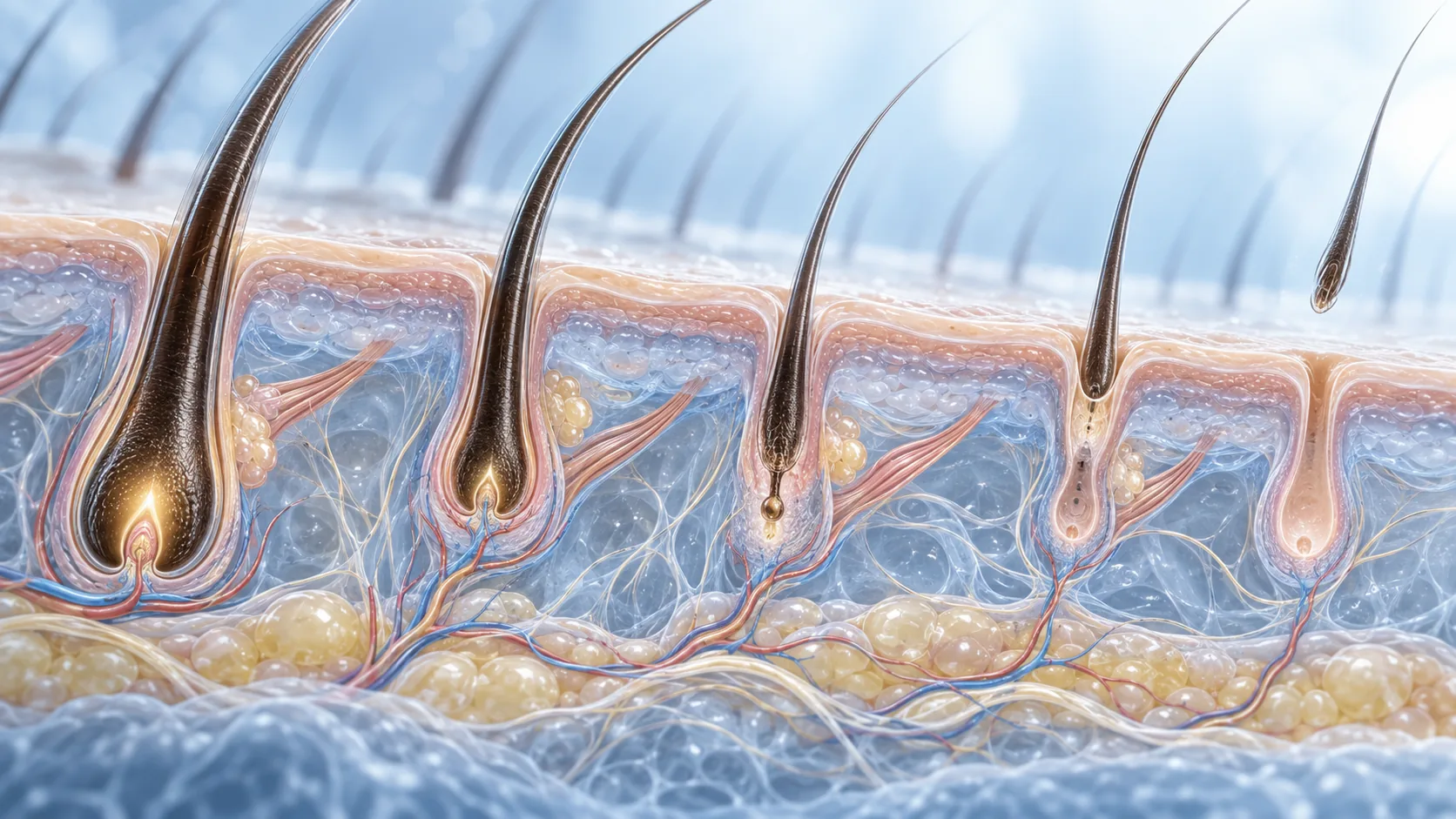
Every hair cycles between a growing phase and a resting phase, and it is normal to lose up to about 100 hairs a day as resting hairs fall out. A physical stress, such as the body adapting to far fewer calories, pushes a larger share of follicles into the resting phase at the same time. Those hairs fall out together a few months later, which is why the shedding looks sudden and arrives long after the diet changed.
Large patient-record studies point the same way. A 2025 study in the Journal of the American Academy of Dermatology found telogen effluvium more often with tirzepatide than with other weight-loss medications. A 2026 matched study of GLP-1 users found higher odds of telogen effluvium with tirzepatide at every follow-up point, lower BMI among the people who lost hair, and no link to alopecia areata, the autoimmune form of hair loss.
When does tirzepatide hair loss start?
Telogen effluvium shows up two to four months after the trigger. On tirzepatide, the trigger is the stretch when weight comes off fastest, so shedding usually appears around the third or fourth month of treatment, not in the first weeks. The typical story is more hair in the brush and the shower drain, a ponytail that feels thinner, and no bald patches.

Shedding usually peaks within a few months and then tapers as weight loss slows and the body settles into its new intake.
Does hair grow back after tirzepatide?
Yes. Telogen effluvium doesn’t damage the follicle and doesn’t cause complete baldness. In most cases shedding tapers back to normal over six to nine months, and a fine fringe of new hair along the forehead hairline is often the first sign of regrowth. The new hairs are the reason the old ones fell out: each follicle pushes out its resting hair as it starts growing again.
Occasionally, a bout of shedding uncovers pattern hair loss that was already developing. If thinning at the crown or part carries on after weight has stabilized and the shedding has stopped, that is a separate, treatable condition rather than tirzepatide hair loss.
Who is most likely to lose hair on tirzepatide?
Women. They accounted for nearly all hair loss in the trials, 7.1% against 0.5% of men.
People losing weight fastest or eating very little. Telogen effluvium tracks the physical stress of the weight loss, and in the 2026 study the people who lost hair had lower BMI at follow-up.
People low on protein, iron or other nutrients. Low protein intake and deficiencies in iron, vitamin B12, folate or thyroid hormone all add to shedding on their own.
People with a tendency toward pattern hair loss. Shedding can bring it forward.
How to prevent hair loss on tirzepatide
Eat enough protein. Hair is built from protein, and protein is easy to fall short on when appetite drops. A 2025 joint advisory from four obesity and nutrition societies notes proposed targets of 1.2–1.6 grams of protein per kilogram of body weight a day during active weight loss, above the standard 0.8, with targets for people with obesity based on an adjusted weight rather than full body weight.

Let weight come off steadily. Eating far below the body’s needs adds stress on top of the weight loss itself. Regular meals, even small ones, keep intake from crashing in the days after a dose.
Correct real deficiencies. Iron, vitamin B12, folate and thyroid levels are the ones dermatologists check when shedding runs long, and correcting a genuine shortfall helps the hair recover.
Handle hair gently. Tight styles, heat and harsh treatments don’t cause telogen effluvium, but they add breakage on top of it while the shedding phase passes.
Tirzepatide vs semaglutide hair loss
The labels aren’t a head-to-head comparison, but they give a useful reference. On Wegovy (semaglutide 2.4mg), hair loss was reported by 3.3% of people against 1% on placebo, 4% of women and 0.9% of men. On tirzepatide it was 4–5%, with 7.1% of women. The 2026 patient-record study also found higher odds of telogen effluvium with tirzepatide than with other GLP-1 drugs.
That fits the weight-loss difference. In SURMOUNT-5, the head-to-head trial, tirzepatide produced 20.2% weight loss at 72 weeks against 13.7% for semaglutide. More weight lost means more of the physical stress that sets off shedding, and the same shedding resolves the same way on either drug.
Frequently asked questions
Does Mounjaro cause hair loss?
Mounjaro is tirzepatide, so the same pattern applies. In its diabetes trials hair loss was too uncommon to make the label’s list of common side effects, and it appears among the reactions reported since approval.
Does lowering the dose stop tirzepatide hair loss?
Dose had no effect on hair loss in the trials: 5mg, 10mg and 15mg all came in at 4–5%. Shedding follows the pace of weight loss and eases as weight stabilizes.
Does biotin help with tirzepatide hair loss?
Only for people who are actually deficient, which is rare. High-dose biotin also interferes with some lab tests, including troponin tests used to diagnose heart attacks, which is why the FDA has warned about it since 2017.
Does minoxidil help with tirzepatide hair loss?
Telogen effluvium recovers on its own once the trigger passes, so minoxidil isn’t needed for it. It does treat pattern hair loss, which is where it helps when shedding has uncovered a genetic tendency.
Does research tirzepatide cause more hair loss?
The molecule is the same, so the same pattern applies. What changes is how accurately a vial matches its label: a vial that holds more peptide than stated delivers larger doses than intended. Simms Research publishes the measured content of every batch on the tirzepatide lab results page. The full list of tirzepatide side effects is in What are the side effects of tirzepatide?, and tiredness has its own article, Does tirzepatide make you tired?