

Blog
How to Reconstitute GHK-Cu
The water for 50mg and 100mg GHK-Cu vials compared volume by volume: strength, what 10 units holds, sting, what to mix it with and what strips the copper, the right colour from powder to syringe, and how long the mix keeps.

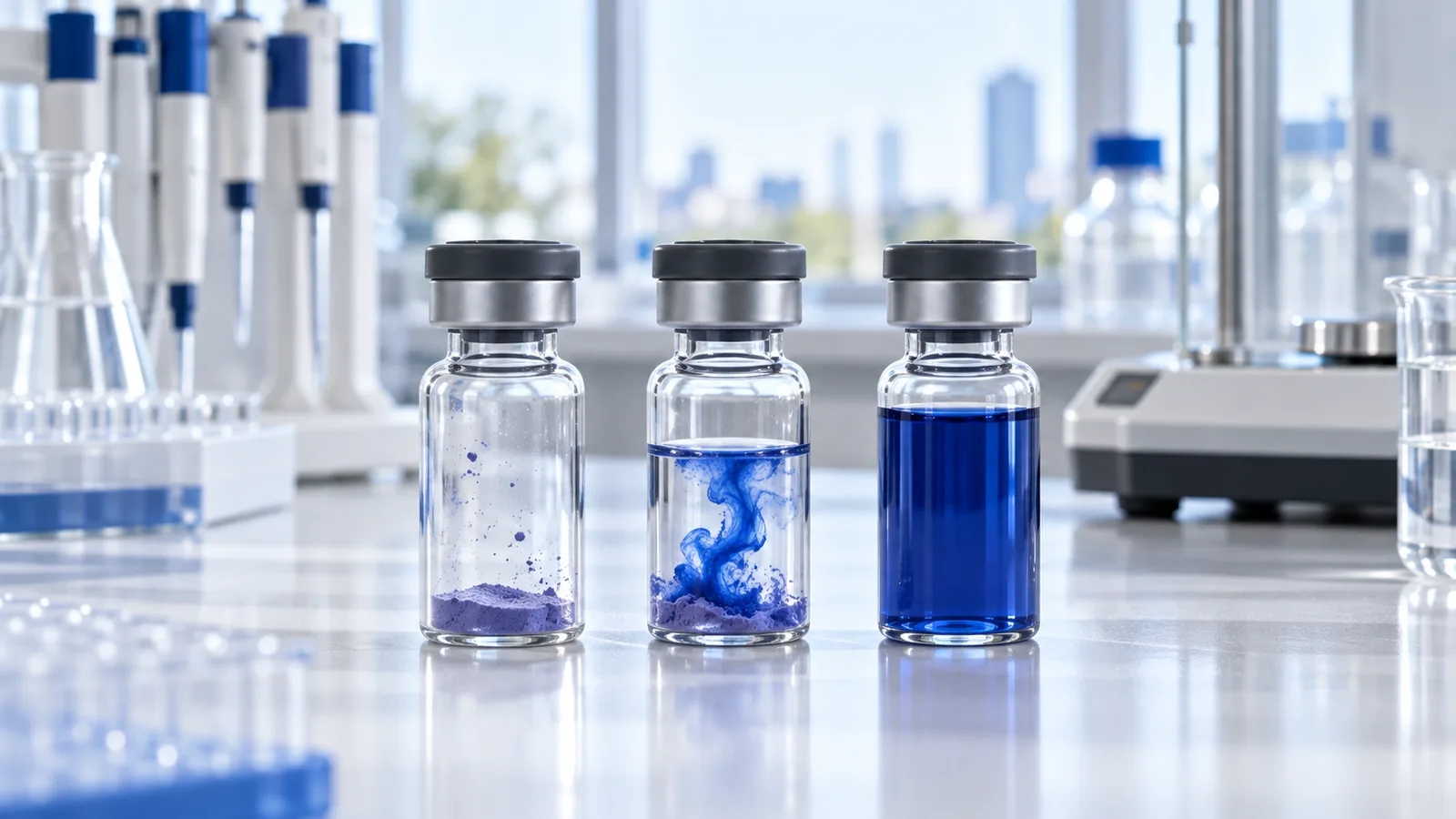
A vial of GHK-Cu arrives as a small cake of violet-blue powder, and the amount of water put into it decides almost everything that follows: how strong each unit on the syringe is, whether a small dose can be read accurately, how much the injection stings, and how many times the stopper gets pierced before the vial is empty. Simms Research offers it in two sizes, 50mg and 100mg, and the water that suits one is not the water that suits the other.
This guide covers the volumes researchers actually choose for each vial and what each one does, what to dissolve GHK-Cu in and what to keep away from it, how the colour should look from powder to syringe, how long it keeps, and how to make a topical batch. Daily amounts, units for each dose and protocol length are in the GHK-Cu dosage guide.
How much bacteriostatic water for 50mg and 100mg GHK-Cu
There is no single correct volume. The water only sets the strength, and the strength sets how much GHK-Cu sits in each unit mark. A U-100 syringe divides each millilitre into 100 units, so 10 units is 0.1mL, and the third column in each table is simply a tenth of the strength.
50mg vial
| Water added | Strength | 10 units holds | On batch 2026-GH612 (52.05mg) | Mixes per 10mL water vial | Suits |
|---|---|---|---|---|---|
| 2mL | 25mg per mL | 2.5mg | 26.0mg per mL | 5 | Fewest units per draw; small amounts are hard to read and the sting is strongest |
| 2.5mL | 20mg per mL | 2mg | 20.8mg per mL | 4 | Round numbers: every 5 units is 1mg |
| 3mL | 16.7mg per mL | 1.67mg | 17.4mg per mL | 3 | A common pick that gives uneven units; 1mg lands at 6 units |
| 5mL | 10mg per mL | 1mg | 10.4mg per mL | 2 | Easiest to read, gentlest at the site, and the 1% strength for topical batches |
For the 50mg vial, 2.5mL and 5mL are the two volumes that give clean arithmetic. The 2.5mL mix is the compact choice; 5mL doubles every unit count, which makes low amounts easier to draw. The batch column uses the measured content of the current lot, 52.05mg averaged over three vials, so the real strength runs about 4% above the label at every volume.
100mg vial
| Water added | Strength | 10 units holds | Mixes per 10mL water vial | Suits |
|---|---|---|---|---|
| 3mL | 33.3mg per mL | 3.33mg | 3 | Too strong for most uses: 1mg is 3 units, the smallest readable mark on many syringes |
| 4mL | 25mg per mL | 2.5mg | 2 | The same strength as a 50mg vial with 2mL |
| 5mL | 20mg per mL | 2mg | 2 | Matches a 50mg vial with 2.5mL, so units carry over between sizes |
| 10mL | 10mg per mL | 1mg | 1 | A 1% solution for topical work, in a vial with room for 10mL |
The 100mg vial holds twice the powder, so it takes twice the water to reach the same strength: 5mL here equals 2.5mL in the 50mg vial, and 10mL equals 5mL. Keeping those pairs means the unit counts read the same whichever size is on the bench. Every certificate Simms Research has published so far is for the 50mg vial, so the 100mg table uses the labeled amount.
A 10mL vial of Research Water covers four 2.5mL mixes or two 5mL mixes. Once its stopper is pierced, the water itself has a 28-day window, so date it the day it is opened. For any volume not listed, the peptide calculator works out the strength and units.
Why the volume matters more for GHK-Cu
With most peptides the water volume is a matter of convenience. GHK-Cu adds two reasons to think about it. The first is the dose range: research protocols run GHK-Cu in milligrams, not micrograms, so the vial empties in weeks and every mix is used across many draws. A strength that turns the usual amount into 4 or 5 units leaves little room for error on the syringe, while the same amount at 10mg per mL spreads across 10 units.
The second is the sting. GHK-Cu is known among researchers for a brief burning at the injection site, and it tracks concentration. The same milligram delivered in more liquid is milder, which is why the 5mL mix in a 50mg vial, or 10mL in a 100mg vial, is the usual answer. The other ways researchers ease it are in the sting section of the dosage guide.
Against that sits the size of each draw. A 5mL mix puts twice the liquid into every dose of a 2.5mL mix, so it comes down to readability and comfort on one side and smaller volumes on the other. For a 50mg vial used for injection, 2.5mL and 5mL are the two settings that cover almost every protocol.
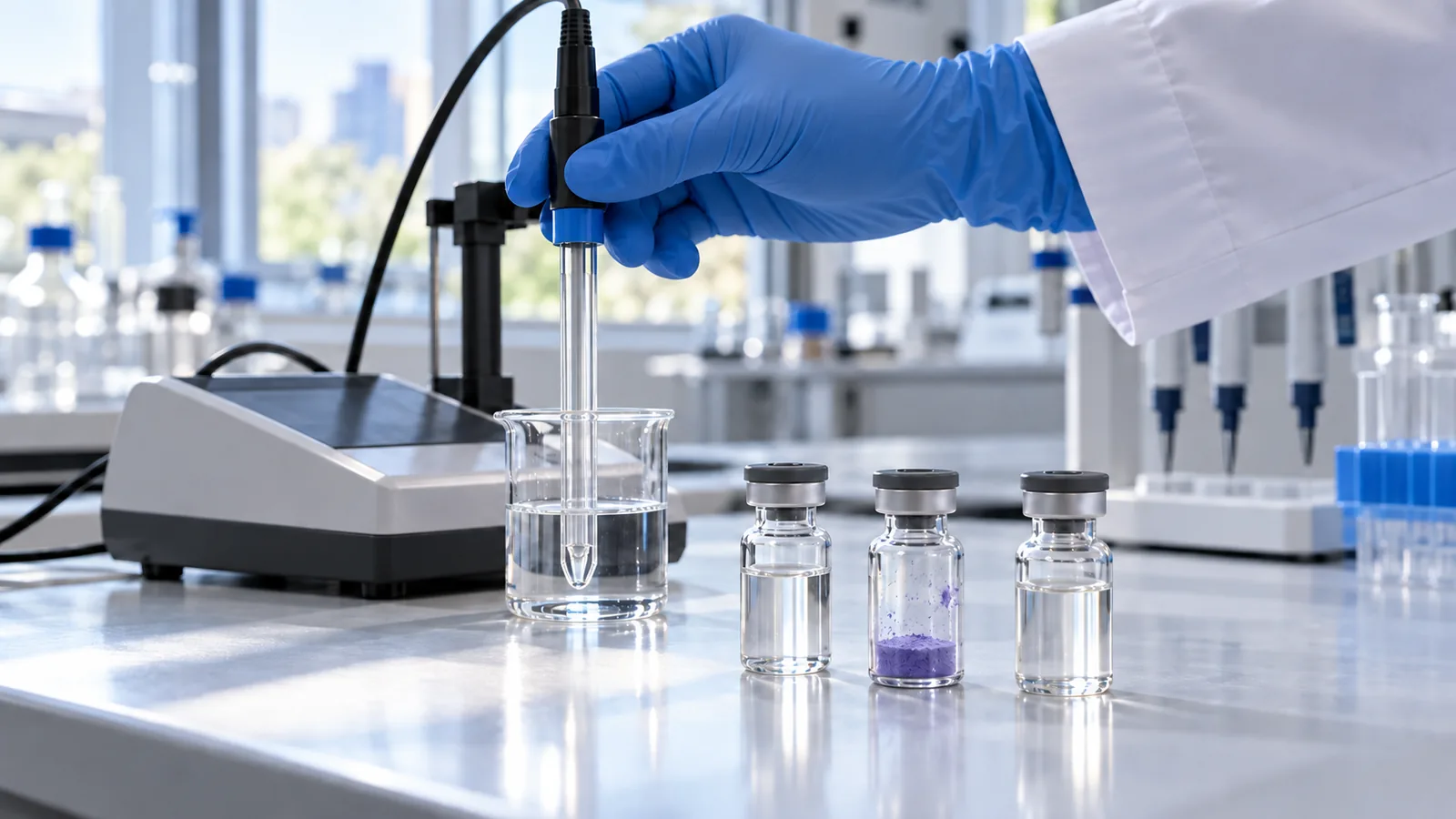
What to mix GHK-Cu powder with
GHK-Cu is a small, water-loving molecule, three amino acids holding one copper ion, and it dissolves in plain water without help. What matters is what else is in the liquid, because the copper is held by the peptide rather than locked into it.
| Liquid | Works for GHK-Cu? | What it means for the mixed vial |
|---|---|---|
| Bacteriostatic water (0.9% benzyl alcohol) | Yes, the standard | The preservative lets the stopper be pierced again and again for 28 days |
| Sterile water | Yes | No preservative, so it suits a batch used at once, such as a topical solution made in one go |
| Dilute acetic acid | Not needed | Acid is for peptides that will not dissolve in water. GHK-Cu dissolves readily, and a low pH loosens the copper |
| Anything holding EDTA or vitamin C | No | EDTA strips the copper from the peptide and vitamin C chemically reduces it |
The copper bond is strong but not unbreakable. GHK binds copper with a constant of about 1016, slightly tighter than albumin, the copper carrier in blood, according to a review led by Loren Pickart, who discovered the peptide (BioMed Research International, 2015). EDTA, a chelator added to many cosmetic bases and some solutions, holds copper a few hundred times more tightly, so it pulls the metal away. Acid works differently: the peptide grips copper through nitrogen atoms that pick up hydrogen ions as the pH drops, and once they do, the copper is let go. That is why the acid-based mixing some guides suggest for stubborn peptides has no place with GHK-Cu.
Plain bacteriostatic water is the default because GHK-Cu is drawn from over weeks. The benzyl alcohol in it has no effect on the copper complex, and it is the reason the vial can be pierced repeatedly.
Mixing the vial and what dissolving looks like
Freeze-dried GHK-Cu dissolves faster than most peptides. Water run gently down the inside of the glass reaches the cake, the cake collapses, and a slow swirl turns the whole vial an even blue within about a minute. Shaking is unnecessary and only raises foam that takes a while to settle.
The one thing that makes GHK-Cu look as if it is not mixing is powder on the glass above the liquid. Freeze-drying often leaves violet specks or a thin smear on the shoulder of the vial and the underside of the stopper, where the water never reaches. They are GHK-Cu, not an impurity. Tilting the vial and rolling it slowly so the liquid washes over the shoulder dissolves them; with the 2mL and 2.5mL volumes the liquid sits lower, so this step matters more in the 50mg vial than in the 100mg.
The mix is ready as soon as it is clear and evenly blue, with nothing resting on the bottom. There is no need to wait before the first draw, and no need to warm or cool the water first; the vial goes into the refrigerator once it is mixed.
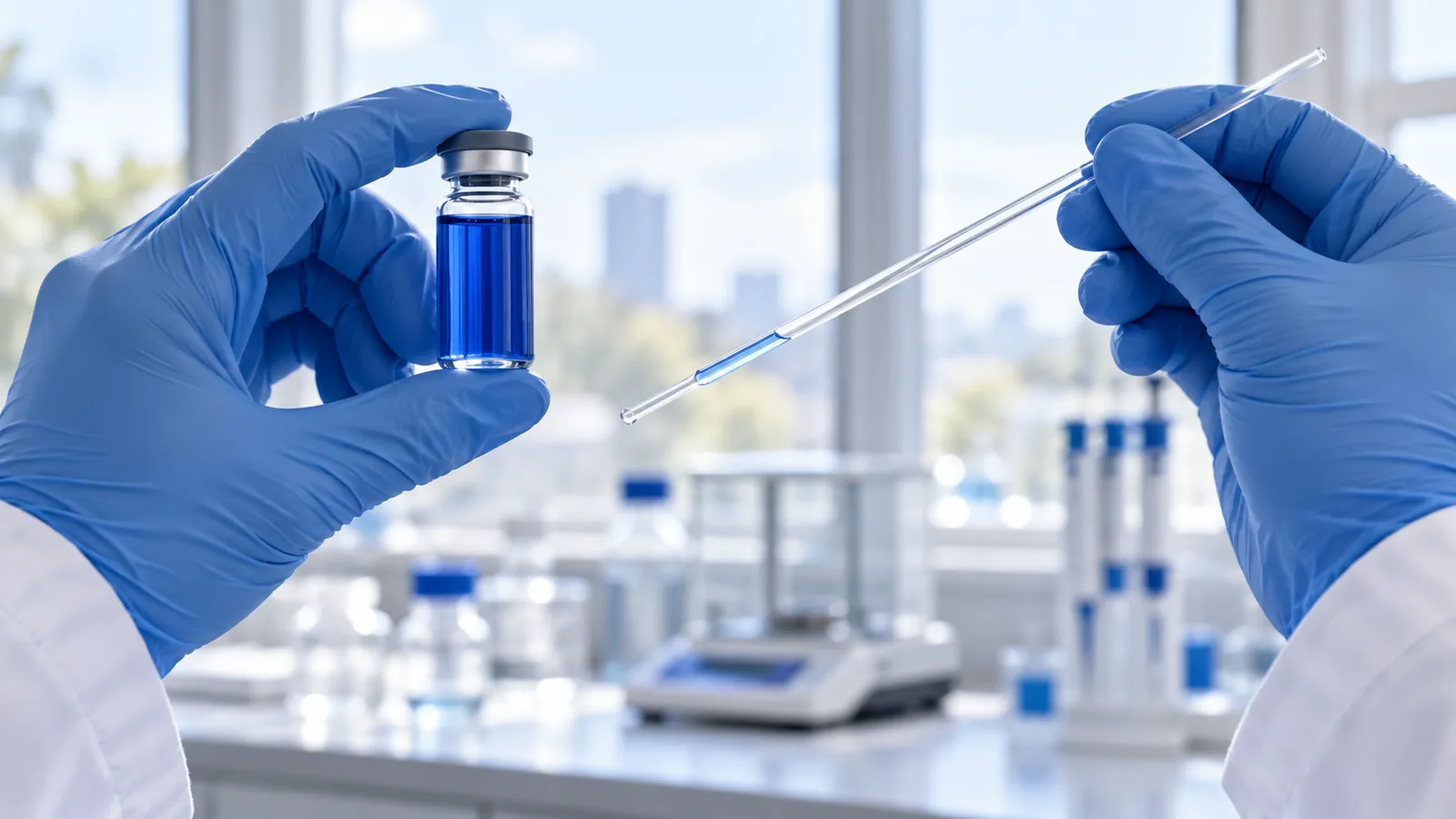
What colour GHK-Cu should be
Colour is the quickest check a researcher has on GHK-Cu, because the copper is what makes it coloured at all. Copper(II) bound to the peptide soaks up the orange and red end of the spectrum, leaving the blue that the eye sees. GHK without copper is a white powder, which answers one of the most common questions about it: a vial sold as GHK-Cu that is white or only faintly tinted is carrying little copper.
| Stage | What a good vial shows | What it means if it differs |
|---|---|---|
| Sealed powder | A violet-leaning indigo cake, periwinkle in daylight, often with violet specks on the glass shoulder | White or off-white powder carries little or no copper |
| Freshly mixed | Clear royal blue with no haze, within a minute of swirling | Haze, flakes or a green or brown cast mean the copper complex has changed |
| In the vial over 28 days | The same clear blue, unchanged | Fading, clouding or settling particles mark a mix to discard |
| In the syringe | Pale blue, close to colourless at 5mL strength | Normal: the barrel holds only a few millimetres of liquid |
The sealed powder reads more violet than the liquid. On the vial photographed for batch 2026-GH612’s certificate, the cake is a periwinkle indigo; once dissolved it becomes a deep, clear royal blue. Every GHK-Cu certificate Simms Research has published records the appearance as blue lyophilized powder; all four are posted with the lab results for GHK-Cu.
Why GHK-Cu looks blue in the vial but nearly clear in the syringe
How deep a colour looks depends on two things: how concentrated the solution is and how much of it the light passes through. A vial puts a couple of centimetres of liquid between the eye and the light; the barrel of an insulin syringe holds only a few millimetres. The same solution therefore looks pale in the syringe, and a 5mL mix, at half the strength of a 2.5mL mix, can look almost colourless there. That is optics, not a weak batch. The same logic explains why a 2mL mix looks darker than a 5mL mix of the same vial.
Green, brown or cloudy
A clear blue that stays clear is the whole standard. A green or brown cast, haze, or flakes that do not dissolve mean the copper is no longer sitting in the peptide the way it should, most often after contact with something from the table above, an alkaline liquid, or long exposure to heat or light. A mix that turns is replaced rather than used.
How long mixed GHK-Cu stays good
Simms Research gives a mixed GHK-Cu vial 28 days in the refrigerator, between 36 and 46°F, kept out of light. The light part matters more for GHK-Cu than for a colourless peptide, since the copper complex is what absorbs it; the vial’s box or a drawer in the refrigerator door is enough. The 28 days match the opened life of the bacteriostatic water, so dating the vial on mixing day covers both.
Before mixing, the powder is far hardier. Sealed GHK-Cu is stored at 2–8°C, or at −20°C for long-term storage, and it tolerates room temperature for weeks, which is why it ships without ice. Reconstituting only when a vial is about to be used keeps the 28-day clock from starting early. For storage before and after mixing, see Do Peptides Need to Be Refrigerated?
The vial size decides whether 28 days is enough. A 50mg vial drawn at the top of the usual daily range finishes inside the window; at lower amounts, or with a 100mg vial mixed for injection, the mix outlasts it, which is why the 100mg size is so often mixed for topical work, where the volume goes faster. Days per vial at each daily amount are in the GHK-Cu dosage guide.
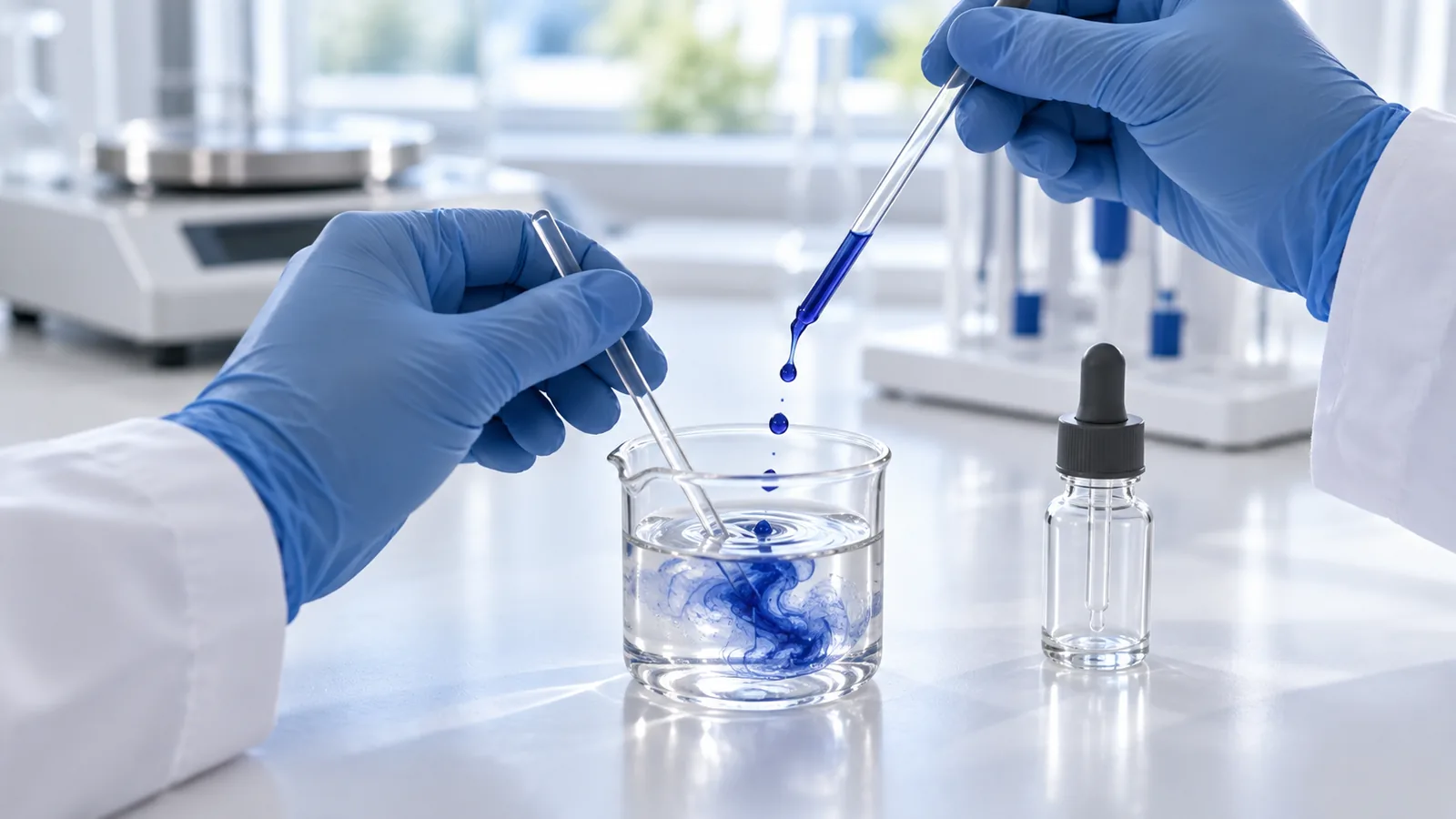
Reconstituting GHK-Cu for topical use
For skin and scalp research, GHK-Cu is mixed to a percentage rather than a dose. A 1% solution is 10mg per mL, which is exactly the 50mg vial with 5mL or the 100mg vial with 10mL from the tables above, so one mix can serve both routes. Other strengths are in the topical strength table.
Bacteriostatic water keeps a topical solution usable for the same 28 days. Sterile water works too, but without a preservative it suits a small batch used within days. When GHK-Cu goes into a gel or serum base rather than water, the ingredient list decides it: a plain hyaluronic acid gel is a common carrier, but many ready-made serums contain disodium EDTA, vitamin C or exfoliating acids (glycolic, lactic, salicylic), and each of those takes the copper out of the peptide. A base that turns the blue to green or grey has done exactly that.
Can GHK-Cu share a vial with other peptides?
Some pairings are made that way on purpose. Glow Peptide Blend is GHK-Cu with BPC-157 and TB-500 in one vial, and Klow Peptide Blend adds KPV. Their certificates measure each peptide separately, batch by batch, so those combinations are tested as combinations; Glow vs Klow compares the two.
Other pairings researchers search for, such as GHK-Cu with epithalon or with retatrutide, have no published testing in a shared vial. Mixed separately, each peptide keeps its own strength, its own unit count and its own 28-day clock, and a change of plan for one does not mean discarding the other. Researchers who want both in one injection draw them into the same syringe at the moment of use instead.
Frequently asked questions
How much BAC water for 100mg of GHK-Cu?
5mL gives 20mg per mL, the same strength as a 50mg vial with 2.5mL. 10mL gives 10mg per mL, a 1% solution, if the vial has room for it. 3mL makes it so strong that a single milligram is only 3 units.
Is 3mL of bac water right for 50mg of GHK-Cu?
It works, at 16.7mg per mL, but the units come out uneven: 1mg is 6 units and 0.5mg is 3. With 2.5mL or 5mL every common amount lands on a whole mark.
How long does it take to reconstitute GHK-Cu?
Usually under a minute of gentle swirling. Specks that remain are almost always dry powder on the vial’s shoulder, which dissolves once the liquid is rolled over it.
Can GHK-Cu be mixed with sterile water?
Yes. It dissolves the same way, but sterile water has no preservative, so it suits a batch used within days. Bacteriostatic water is the one for a vial drawn from over four weeks.
How long after reconstituting GHK-Cu can it be used?
Straight away, once the solution is clear and evenly blue. It then keeps 28 days in the refrigerator.
Why is my GHK-Cu not blue?
If it is pale only in the syringe, that is the short light path through a thin barrel. If the powder or the mixed vial itself is white or colourless, the vial holds little or no copper.
Is all GHK-Cu blue?
All genuine GHK-Cu is: violet-blue as a powder and royal blue in solution. Plain GHK, the peptide without its copper, is white.
Is GHK-Cu approved?
No. Simms Research sells GHK-Cu for laboratory research use only.