

Blog
The Definitive GHK-Cu Dosage Guide 2026: Units, Chart and Protocol
GHK-Cu dosing in mg and units: the 1–2mg daily range, water for 50mg and 100mg vials, how long a vial lasts, copper per dose, and the Glow and Klow math.

What is GHK-Cu?
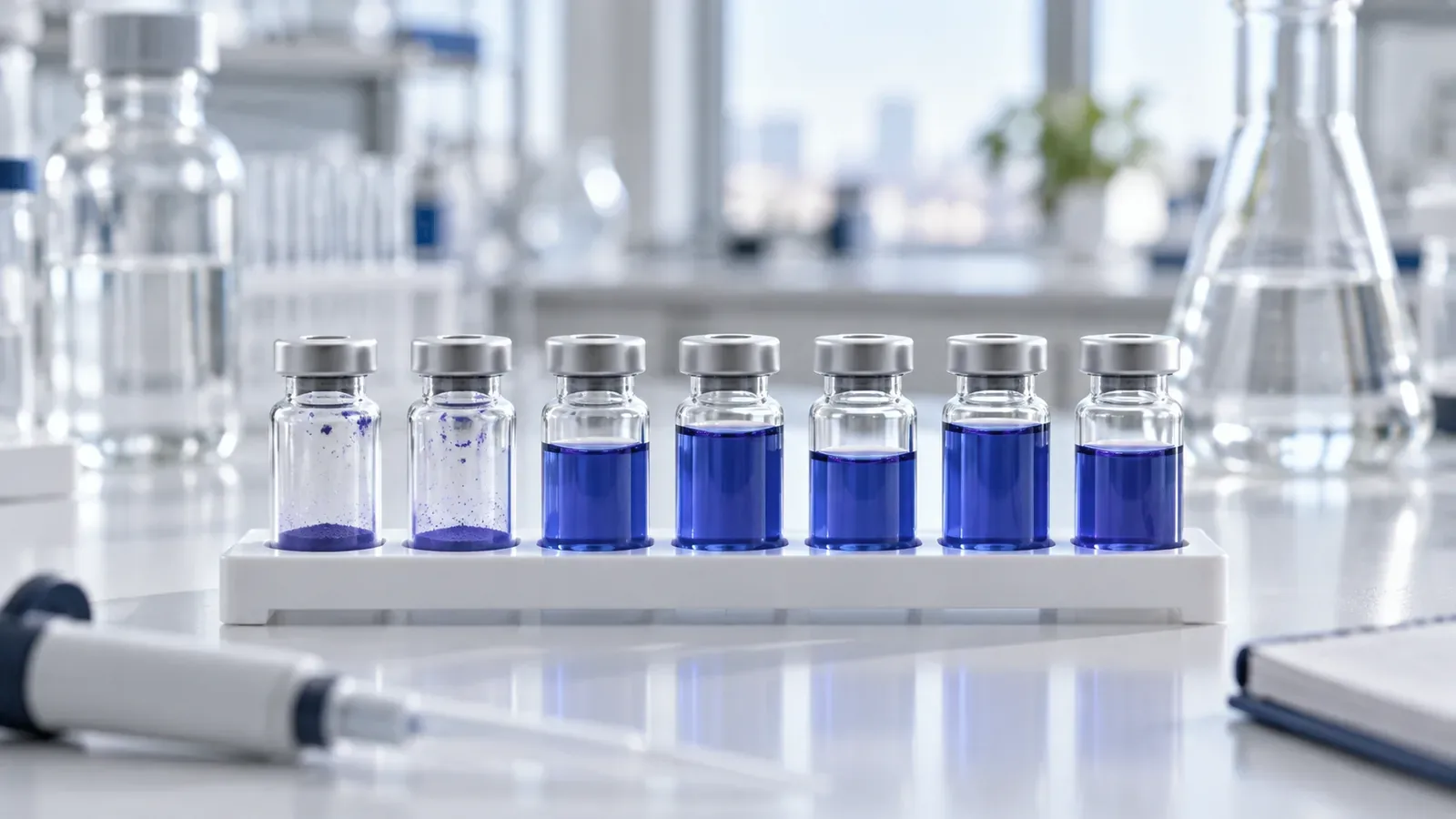
GHK-Cu is a three-amino-acid peptide, glycine, histidine and lysine, holding a single copper ion. Loren Pickart isolated it from human plasma in 1973, and the body still makes it: plasma carries about 200 ng/mL of GHK at age 20, falling to about 80 ng/mL by 60. The copper is what makes it blue, both as a freeze-dried powder and once it is dissolved.
It is one of the most studied repair peptides in skin research. Simms Research sells GHK-Cu in 50mg and 100mg vials, and it is the largest ingredient in two blends, Glow Peptide Blend and Klow Peptide Blend.
This guide covers the daily amounts research protocols use and where they come from, the units for both vial sizes, how many days each vial covers, how much copper each dose carries, the human studies behind the compound, and the blend math for Glow and Klow.
GHK-Cu dosage chart
Research protocols inject GHK-Cu under the skin at 1 to 2mg a day, starting at the low end. That is 7 to 14mg a week. The chart gives each daily amount in units at the three strengths the next sections use:
| Daily amount | Per week | At 10mg per mL | At 20mg per mL | At 25mg per mL |
|---|---|---|---|---|
| 0.5mg | 3.5mg | 5 units (0.05mL) | 2.5 units (0.025mL) | 2 units (0.02mL) |
| 1mg | 7mg | 10 units (0.10mL) | 5 units (0.05mL) | 4 units (0.04mL) |
| 1.5mg | 10.5mg | 15 units (0.15mL) | 7.5 units (0.075mL) | 6 units (0.06mL) |
| 2mg | 14mg | 20 units (0.20mL) | 10 units (0.10mL) | 8 units (0.08mL) |
The 10mg per mL column is the easiest to read, since every 0.1mg is one unit mark. At 20 and 25mg per mL a half-milligram dose is only 2 to 2.5 units, hard to draw accurately, so the stronger mixes suit protocols at 1mg and above.
Where the 1–2mg range comes from
No human trial has set an injected GHK-Cu dose. Every published human study applied it to the skin, as a cream. The 1–2mg daily range is the convention research protocols settled on, and the natural level in the body shows its scale.
An adult carries about 3 liters of plasma. At 200 ng/mL, that is roughly 0.6mg of GHK in the whole bloodstream at age 20, and about 0.24mg at 60. One milligram of GHK-Cu holds a little over 0.8mg of GHK, so a single 1mg dose adds more than the entire circulating supply of a 20-year-old, and more than three times that of a 60-year-old.
The only published estimate of an effective human amount comes from Pickart himself. In a 2015 review with Anna Margolina, working from animal studies in which injected GHK healed wounds throughout the body, he put it at about 100–200mg of GHK and wrote that even this may be more than needed. The same review describes a rat bone-healing study that used GHK with two other small peptides, at a combined dose that scales to about 140 micrograms per injection for a person. The published figures span roughly a thousandfold, and the 1–2mg daily range sits inside it.
GHK-Cu dosage in units for 50mg and 100mg vials
A vial of GHK-Cu is dry powder. The strength, and so every unit count, is set by the water added. On a U-100 insulin syringe 100 units make 1mL, so the units for any dose are the dose in mg, times 100, divided by the strength in mg per mL.
| Vial | Water added | Strength | 1mg is | 2mg is |
|---|---|---|---|---|
| 50mg | 2mL | 25mg per mL | 4 units | 8 units |
| 50mg | 2.5mL | 20mg per mL | 5 units | 10 units |
| 50mg | 5mL | 10mg per mL | 10 units | 20 units |
| 100mg | 4mL | 25mg per mL | 4 units | 8 units |
| 100mg | 5mL | 20mg per mL | 5 units | 10 units |
Both vial sizes reach 20mg per mL, 2.5mL in the 50mg and 5mL in the 100mg, and at that strength each milligram is 5 units. The 50mg vial mixed with 5mL gives 10mg per mL, which doubles every unit count and makes small doses easier to measure. For any other combination, the Simms Research peptide calculator runs the same arithmetic.
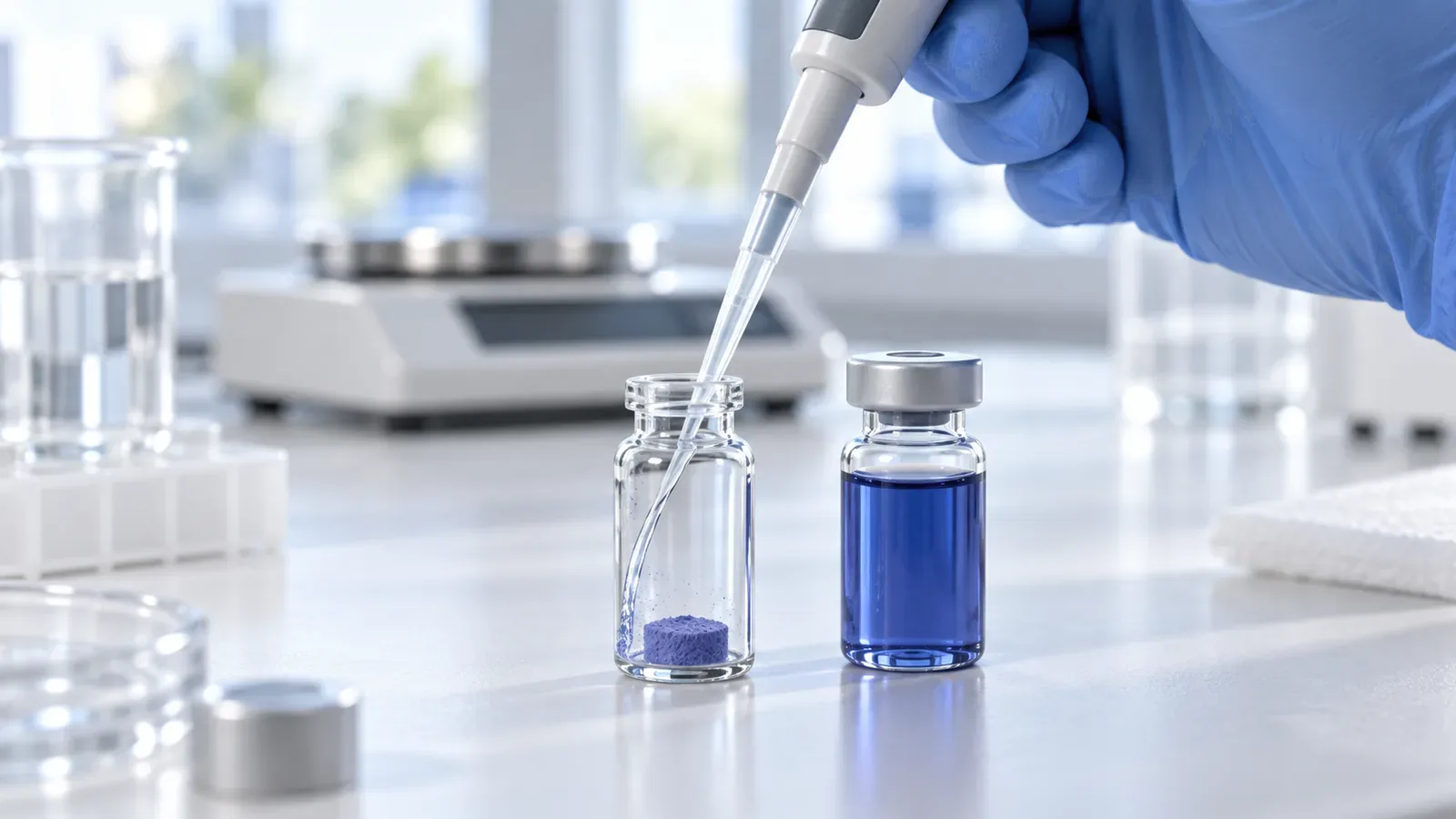
Let the water trickle along the glass instead of hitting the powder directly, then swirl until the liquid is an even clear blue. The mixed vial goes in the refrigerator at 2–8°C (36–46°F). Simms Research sells bacteriostatic water in 10mL vials, and Do Peptides Need to Be Refrigerated? covers storage on either side of mixing.
How long a GHK-Cu vial lasts
Daily dosing empties a vial quickly, and the math depends only on the vial size and the daily amount:
| Vial | At 0.5mg a day | At 1mg a day | At 1.5mg a day | At 2mg a day |
|---|---|---|---|---|
| 50mg | 100 days | 50 days | 33 days | 25 days |
| 100mg | 200 days | 100 days | 66 days | 50 days |
Simms Research’s storage guidance gives a mixed vial 28 days in the refrigerator. The 50mg vial at 2mg a day is the pairing that finishes inside that window, in 25 days, or 26 on the current batch’s measured 52mg. At 1mg a day, 28 days uses 28mg, a little over half a 50mg vial. The 100mg vial runs 50 days even at 2mg a day, so for daily injection the 50mg vial is the size that matches one mix, and the 100mg vial has the volume for a topical solution, covered below.
How much copper each dose carries
Copper is 63.5 of GHK-Cu’s 400.9 molecular weight, so 15.9% of every dose by weight is copper. The U.S. recommended daily allowance for adults is 900mcg, and the tolerable upper limit is 10,000mcg a day, according to the NIH Office of Dietary Supplements.
| GHK-Cu dose | Copper in it | Share of the 900mcg RDA | Share of the 10,000mcg upper limit |
|---|---|---|---|
| 0.5mg | 79mcg | 9% | 0.8% |
| 1mg | 159mcg | 18% | 1.6% |
| 1.5mg | 238mcg | 26% | 2.4% |
| 2mg | 317mcg | 35% | 3.2% |
Food already supplies most adults with more than the RDA: an average of 1,400mcg a day for men and 1,100mcg for women. A 2mg dose of GHK-Cu on top of an average diet comes to at most about 1,700mcg a day, under a fifth of the upper limit. Reaching the limit from GHK-Cu alone would take about 63mg a day, over 30 times the top of the research range.
How often and for how long
Research protocols give GHK-Cu once a day, every day. The human skin studies used the same rhythm: creams applied once or twice daily, every day of the study. Nothing ties GHK-Cu to a time of day. It isn’t a growth hormone secretagogue timed against a hormone pulse, and food has no bearing on a dose given under the skin. Morning or night comes down to keeping one consistent time.
For length, the human data marks two points. Biopsies showed collagen production up after one month, and the visible changes in skin were measured at 12 weeks. Those are the only human benchmarks for how long to run GHK-Cu, and both line up with the 28-day life of a mixed vial: one 50mg vial per four-week block at 2mg a day.
What the human studies used
The clinical record for GHK-Cu is in skin. Pickart and Margolina’s 2015 review collects the controlled studies, most of them in women around 50:
| Study | Who took part | Length | What changed |
|---|---|---|---|
| Collagen biopsy study, creams on the thigh | Women | 1 month | Collagen production rose in 70% of the GHK-Cu group, against 50% on vitamin C cream and 40% on retinoic acid |
| GHK-Cu facial cream | 71 women with mild to advanced photoaging | 12 weeks | Better laxity, clarity and appearance; fewer fine lines and shallower wrinkles; denser, thicker skin |
| GHK-Cu eye cream against placebo and a vitamin K cream | 41 women | 12 weeks | Beat both on lines and wrinkles, overall appearance, and skin density and thickness |
| GHK-Cu facial cream twice a day | 67 women aged 50 to 59 | 12 weeks | Firmer, clearer skin; fewer fine lines, coarse wrinkles and mottled pigmentation; denser, thicker skin |
In cell studies GHK-Cu works at very low concentrations. Collagen and glycosaminoglycan synthesis rose at 1 to 10 nanomolar, about 0.4 to 4 nanograms per mL, below the natural plasma level. The review also notes that no safety issues had arisen in its use as a skin cosmetic or in human wound-healing studies.
Topical strength from a vial
Creams are dosed by strength rather than by milligrams. A percentage is grams per 100mL, so 1% is 10mg per mL, and the water or base needed for any strength follows from the vial size:
| Strength | GHK-Cu per mL | From a 50mg vial | From a 100mg vial |
|---|---|---|---|
| 0.5% | 5mg | 10mL | 20mL |
| 1% | 10mg | 5mL | 10mL |
| 2% | 20mg | 2.5mL | 5mL |
A 50mg vial mixed with 5mL is a 1% solution, the same liquid as the 10mg per mL injection mix. The 100mg vial gives twice the volume at each strength, which is where its size is most useful.
GHK-Cu in Glow and Klow
Both blends are built around 50mg of GHK-Cu. Glow Peptide Blend adds 10mg each of BPC-157 and TB-500, for 70mg in the vial. Klow Peptide Blend adds 10mg of KPV on top, for 80mg. The ratio is fixed at five parts GHK-Cu to one part of each other peptide, so every milligram of GHK-Cu comes with 0.2mg of each of the others.
Mixed with 2.5mL of water, either blend runs at 20mg per mL of GHK-Cu and 4mg per mL of each partner. Dosing is set by the GHK-Cu, and the others follow:
| Units | GHK-Cu | BPC-157 | TB-500 | KPV (Klow only) |
|---|---|---|---|---|
| 5 units (0.05mL) | 1mg | 0.2mg | 0.2mg | 0.2mg |
| 7.5 units (0.075mL) | 1.5mg | 0.3mg | 0.3mg | 0.3mg |
| 10 units (0.10mL) | 2mg | 0.4mg | 0.4mg | 0.4mg |
With 5mL of water every unit count doubles for the same amounts. A 2mg daily GHK-Cu protocol on either blend delivers 2.8mg of BPC-157 and 2.8mg of TB-500 a week, and the vial covers 25 days, the same as a 50mg vial of GHK-Cu alone. Whether Klow’s extra peptide is worth it over Glow is covered in Glow vs Klow Peptide Blend: Is One Peptide Worth The Upgrade?
Why GHK-Cu stings, and the fix
A brief sting at the injection site is the complaint researchers raise most with GHK-Cu, more than with most peptides, and it is worst with concentrated mixes.
The fix is dilution. The same 1mg is 4 units at 25mg per mL and 10 units at 10mg per mL, so the 5mL mix spreads it through two and a half times the liquid. Letting the drawn dose reach room temperature and moving the site each day help too.
What each batch really holds
Every unit count above assumes a 50mg vial holds 50mg. The certificate of analysis gives the measured amount as net content, and Simms Research has published four GHK-Cu batches:
| Batch | Tested | Measured GHK-Cu | Purity | 10 units really holds, mixed with 2.5mL |
|---|---|---|---|---|
| 2026-GH612 | July 16, 2026 | 52.05mg, averaged over 3 vials | 99.819% | 2.08mg |
| GH556 | April 13, 2026 | 56.54mg | 99.67% | 2.26mg |
| GH287 | January 13, 2026 | 51.20mg | 99.94% | 2.05mg |
| GH203 | November 4, 2025 | 57.82mg | 99.815% | 2.31mg |
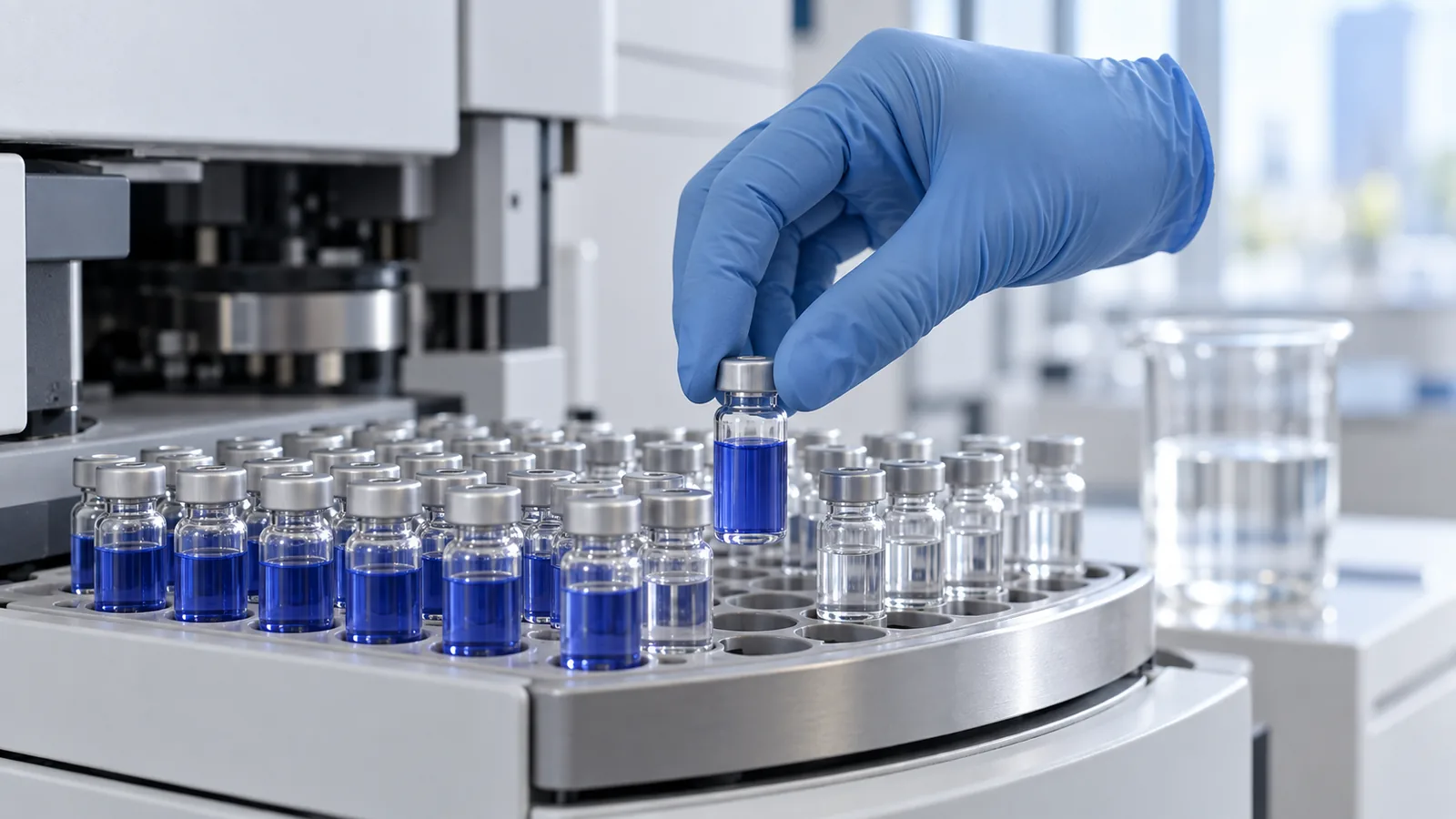
Every batch measured above its label, by 2% to 16%. On the current batch, 2026-GH612, 10 units of a 2.5mL mix holds 2.08mg, so a 2mg dose is closer to 9.6 units. The correction is the same for any batch: divide the measured content by the water added for the real strength, then work the units from that.
Batch 2026-GH612 was tested across three vials: purity by RP-HPLC, identity by LC-MS, and endotoxins, heavy metals and sterility, all passing. Every certificate is on the GHK-Cu lab results page, and How to Read a Peptide Certificate of Analysis explains each line.
Frequently asked questions
How many units is 1mg of GHK-Cu?
5 units at 20mg per mL, which is a 50mg vial with 2.5mL of water or a 100mg vial with 5mL. It is 10 units in a 50mg vial with 5mL, and 4 units at 25mg per mL.
How much bacteriostatic water goes in a 50mg vial of GHK-Cu?
2.5mL for 20mg per mL, where 1mg is 5 units. 5mL gives 10mg per mL, which is easier to measure at small doses and gentler at the injection site.
How long does a 50mg vial of GHK-Cu last?
25 days at 2mg a day and 50 days at 1mg a day. Once mixed, the vial is good for 28 days in the refrigerator.
Can GHK-Cu be injected every day?
Daily is how research protocols run it, and the human skin studies applied GHK-Cu every day, once or twice, for up to 12 weeks.
What is the maximum dose of GHK-Cu?
No trial has set one. Copper gives the outer bound: reaching the 10,000mcg daily upper limit would take about 63mg of GHK-Cu a day. The research range tops out at 2mg.
Is GHK-Cu dosed by body weight?
No. Protocols use fixed daily amounts, the same for women and men.
Is topical GHK-Cu better than injections?
They answer different questions. Every human study so far is topical and measures the skin where the cream went. Injections deliver GHK-Cu into circulation and are the route research protocols use for effects beyond one patch of skin.
Why is GHK-Cu blue?
The copper ion. Copper(II) complexes absorb orange-red light, so the powder and the mixed solution both look blue. An even, clear blue solution is what a good mix looks like.
Is GHK-Cu approved?
Not as an injectable drug. Simms Research sells GHK-Cu for laboratory research use only.