

Blog
Glow vs Klow Peptide Blend: Is One Peptide Worth The Upgrade? (2026)
Klow is Glow plus 10mg of KPV for $14 more. What KPV adds that the other three peptides do not, how much of it each dose carries, the cost per day, and the research where the upgrade pays off.

Glow vs Klow: the upgrade is one peptide
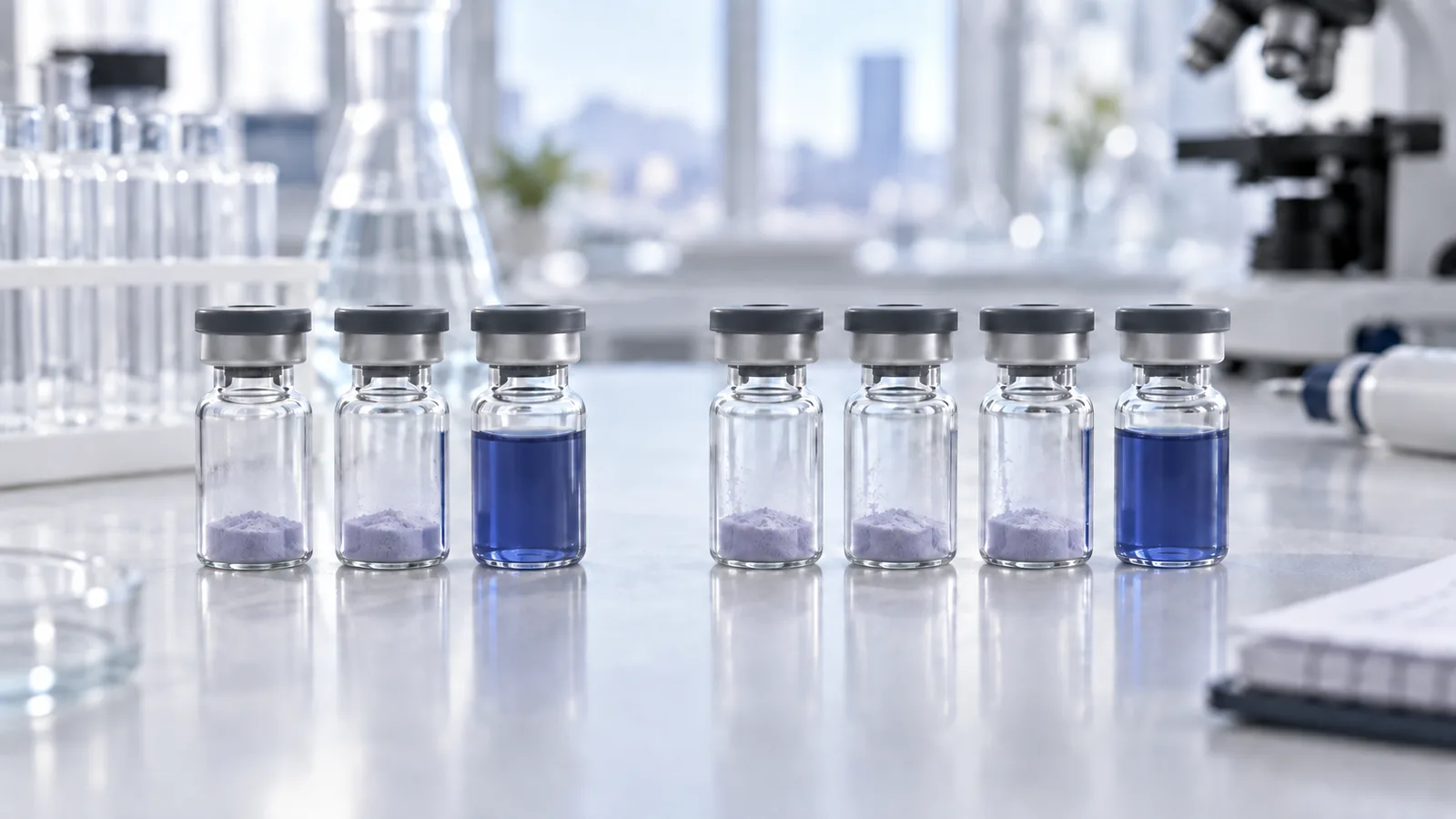
Glow and Klow are the same blend with one difference. Both are freeze-dried vials built on 50mg of GHK-Cu, 10mg of BPC-157 and 10mg of TB-500. Klow adds 10mg of KPV, which takes the vial from 70mg to 80mg and the price from $96 to $122. Both powders are blue from the copper in GHK-Cu, and once mixed the two look the same in the vial.
That makes this a narrower question than most comparisons. Nothing in Glow gets smaller in Klow, so the only thing to decide is whether a fourth peptide earns its $26 and its place in the research. The three shared peptides are studied for building and repair: GHK-Cu, a copper-binding tripeptide, in skin and collagen remodelling; BPC-157, a 15-amino-acid sequence from a gastric protein, in tendon, ligament and gut healing; TB-500, a synthetic peptide built on the actin-binding region of thymosin beta-4, in cell migration and wound closure. KPV is the anti-inflammatory tail of the hormone alpha-MSH.
Simms Research sells both, the Glow Peptide Blend and the Klow Peptide Blend. This comparison works through what KPV does that the other three don’t, whether Klow carries enough of it to matter, what it costs per dose, the research it pays off in and the research it doesn’t, and how to switch from one blend to the other.
What the upgrade adds, and what it leaves alone
Side by side, the two vials differ in a single row:
| Glow | Klow | |
|---|---|---|
| Peptides | 3: GHK-Cu, BPC-157, TB-500 | 4: GHK-Cu, BPC-157, TB-500, KPV |
| Vial total | 70mg | 80mg |
| GHK-Cu | 50mg | 50mg |
| BPC-157 | 10mg | 10mg |
| TB-500 | 10mg | 10mg |
| KPV | None | 10mg |
| Ratio | 5 : 1 : 1 | 5 : 1 : 1 : 1 |
| Look | Blue powder, clear blue once mixed | Blue powder, clear blue once mixed |
| Price | $96 | $122 |
| Latest batch | GL281, 99.28% purity | 2026-KW189, 99.647% purity |
| Mixed vial keeps | 28 days at 2–8°C | 28 days at 2–8°C |
Everything Glow delivers, Klow delivers in the same amount. A dose holding 2mg of GHK-Cu holds 400mcg each of BPC-157 and TB-500 in either vial, mixed with the same water and drawn to the same unit mark. Storage, the 28-day life of a mixed vial and the brief sting GHK-Cu can cause are the same too. The upgrade takes nothing away. It adds 400mcg of KPV to that dose.
What KPV does that the other three don’t
KPV is lysine-proline-valine, the last three amino acids of alpha-melanocyte-stimulating hormone (alpha-MSH). The full hormone is 13 amino acids long, SYSMEHFRWGKPV, and does two jobs: it calms inflammation, and it darkens skin through the melanocortin-1 receptor. The part that switches on pigment, His-Phe-Arg-Trp, sits at positions 6 to 9. KPV is positions 11 to 13, and a 2008 review in Endocrine Reviews describes it as keeping the hormone’s anti-inflammatory effect without its pigmentary action.
Its mechanism is its own. A 2008 Gastroenterology study found KPV is carried into gut and immune cells by PepT1, a transporter for small peptides that the colon switches on during inflammation. Inside, nanomolar amounts blocked NF-κB and MAP kinase signalling, two of the main switches for inflammatory cytokines. In mice without a working melanocortin-1 receptor, KPV still protected against colitis, so it doesn’t depend on the receptor behind tanning.
That is the capability the upgrade buys. The other three peptides are studied mainly for building tissue back: collagen, blood vessels, tendon and migrating repair cells. KPV is studied mainly for turning the inflammatory signal down and for infection.
What the research shows KPV adds
The KPV record is in cells, mice and rabbits:
| Study | Model | What KPV did |
|---|---|---|
| Dalmasso et al., Gastroenterology, 2008 | Human gut and immune cells; mice with DSS and TNBS colitis, KPV in their drinking water | Blocked NF-κB and MAP kinase signalling at nanomolar amounts, cut inflammatory cytokines, and reduced colitis in both models |
| Kannengiesser et al., Inflammatory Bowel Diseases, 2008 | Mice with DSS colitis and T-cell transfer colitis, including mice without a working MC1R receptor | Faster recovery, body weight regained, fewer inflammatory cells in the colon; every treated mouse without a working MC1R survived DSS colitis |
| Bonfiglio et al., Experimental Eye Research, 2006 | Rabbits with the corneal surface scraped away, KPV eye drops for four days | Every KPV-treated cornea had fully resurfaced by 60 hours; none of the placebo corneas had |
| Cutuli et al., Journal of Leukocyte Biology, 2000 | Staphylococcus aureus and Candida albicans cultures | Inhibited S. aureus colony formation and reduced Candida viability and germ-tube formation, down to picomolar amounts |
| Schaible et al., PLoS One, 2013 | Mice after a traumatic brain injury, one 1mg/kg injection | Smaller brain lesions and less microglial activation |
Read together, the studies put KPV’s value in three places: inflamed gut and barrier tissue; surfaces healing under inflammation or infection, from a scraped cornea to chemotherapy-damaged mouth lining in a later hydrogel study; and inflammation that spreads after an injury. The gut studies mostly gave KPV by mouth, where the inflamed colon takes it up through PepT1. The brain-injury study showed a single injection working far from the gut.
Two limits matter for the upgrade decision. No human trial of KPV is registered, and neither blend has been tested as a whole. And no published KPV study has looked at hair, while its skin work is about inflammation and wound surfaces rather than collagen. On those endpoints the research belongs to GHK-Cu, which both blends carry at 50mg.
Is there enough KPV in Klow to matter?
The ratio inside the vial is fixed at five parts GHK-Cu to one part of each other peptide, so one peptide sets the dose and the rest follow. That peptide is GHK-Cu, run at 1 to 2mg a day in research protocols (the GHK-Cu dosage guide covers where that range comes from). Each milligram of GHK-Cu brings 0.2mg each of BPC-157, TB-500 and, in Klow, KPV:
| GHK-Cu a day | BPC-157 | TB-500 | KPV (Klow only) | Each partner per week |
|---|---|---|---|---|
| 1mg | 200mcg | 200mcg | 200mcg | 1.4mg |
| 1.5mg | 300mcg | 300mcg | 300mcg | 2.1mg |
| 2mg | 400mcg | 400mcg | 400mcg | 2.8mg |
On its own, KPV is run at 200 to 500mcg a day in research protocols. Klow’s standard dose delivers 200 to 400mcg, a full KPV amount rather than a trace. The vial holds what the label says: the current batch, 2026-KW189, measured 10.32mg of KPV, so 10 units from a 2.5mL mix carries 0.41mg.
The fixed ratio also sets KPV’s ceiling. Reaching the 500mcg top of KPV’s own range would take 2.5mg of GHK-Cu, above its 2mg research range, so Klow covers the lower and middle of KPV’s range. Research that needs KPV at the top of that range, or dosed apart from the GHK-Cu, needs it in a separate vial.
What the upgrade costs per dose
Glow is $96 and Klow is $122. The $26 difference is the whole price of the upgrade: 10mg of KPV per vial.
At 2mg of GHK-Cu a day, either vial runs 25 days on its label amount. That is $3.84 a day for Glow and $4.88 for Klow, so the upgrade costs $1.04 a day, or $7.28 a week, for 400mcg of KPV a day.
A mixed vial keeps 28 days in the refrigerator, and 2mg a day is the dose that empties a vial inside that window. Below about 1.8mg a day the 28 days run out first, so at lower doses the cost is one vial per four weeks: $96 or $122, and the upgrade comes to $26 a month.
When one peptide is worth the upgrade
Klow earns its fourth peptide when inflammation, infection or a damaged barrier is part of what the research measures.
Gut and barrier models. Colitis and intestinal-permeability work is where KPV’s evidence is deepest: two mouse models of colitis, and a transporter the inflamed colon switches on to take it up. Klow adds that on top of BPC-157, the blend’s other gut-studied peptide.
Inflamed or infected skin and wound surfaces. KPV cut S. aureus and Candida growth in culture and sped the resurfacing of scraped corneas. Wounds under a bacterial or yeast challenge, irritated skin and mucosal injury all sit inside that record.
Inflammation as an endpoint. Models that read cytokines, NF-κB activity or inflammatory cell counts alongside repair get both from one dose. The repair peptides and KPV move together at a fixed ratio, so every draw carries the same mix.
When Glow is the better buy
Glow is the better buy when the research is about building and remodelling tissue and inflammation isn’t measured: collagen density, photoaged skin, hair, tendon and ligament repair, clean wound closure. In those models Klow’s KPV is a fourth active peptide that nothing reads, which also makes it harder to say which peptide drove a result. Glow keeps the design to three peptides and costs $26 less per vial.
If the question is narrower still, a simpler vial fits better than either blend:
| Product | In the vial | Price | What sets the dose |
|---|---|---|---|
| Wolverine Peptide Stack | BPC-157 10mg, TB-500 10mg | $79 | BPC-157 and TB-500 directly |
| Glow Peptide Blend | GHK-Cu 50mg, BPC-157 10mg, TB-500 10mg | $96 | GHK-Cu |
| Klow Peptide Blend | GHK-Cu 50mg, BPC-157 10mg, TB-500 10mg, KPV 10mg | $122 | GHK-Cu |
| GHK-Cu | GHK-Cu 50mg or 100mg | $38 or $56 | GHK-Cu |
Where GHK-Cu alone is the subject, as in most skin and hair work, the plain GHK-Cu vial holds the same 50mg as either blend. Where BPC-157 and TB-500 are the subject, the Wolverine Peptide Stack lets them set the dose directly. A Wolverine vial with 2mL of water holds 5mg per mL of each, so 500mcg of each is 10 units, while the same 500mcg of BPC-157 from Glow or Klow would bring 2.5mg of GHK-Cu with it.
Adding KPV to Glow instead of upgrading
A separate KPV vial next to Glow gets KPV into the research without Klow, and it trades simplicity for control. It is a second vial with its own water, its own draw and its own 28-day clock once mixed, and its share of each dose is whatever the two draws add up to. In return, KPV can run on its own schedule, up to the top of its 200–500mcg range, and start or stop without touching the Glow.
Klow is the other way round. KPV rides in the same draw at one part to five of GHK-Cu, so every dose carries the same mix from one vial. For research that wants KPV throughout at a steady share, Klow is the simpler design. For research that wants to vary KPV on its own, the separate vial is.
So, is one peptide worth the upgrade?
For research where inflammation, infection or a damaged barrier is part of the model, yes. $26 a vial buys 10mg of a peptide with a mechanism none of the other three share, delivered at 200 to 400mcg a day, inside KPV’s own working range, from the same draw, with nothing else in the blend reduced.
For skin, collagen, hair and clean repair work, no. The peptide behind those results, GHK-Cu, is the same 50mg in both vials, and Glow delivers it with one fewer variable for $26 less.
Switching from Glow to Klow: water and units
Moving from Glow to Klow mid-protocol changes nothing about the draw, as long as both vials are mixed by their GHK-Cu and not by the vial total. With the same water in each, the GHK-Cu, BPC-157 and TB-500 per unit match, and the Klow dose simply carries KPV as well. Units are on a U-100 insulin syringe, where 100 units make 1mL:
| Water added | GHK-Cu per mL, both blends | 1mg of GHK-Cu | 2mg of GHK-Cu | Total peptide per mL |
|---|---|---|---|---|
| 2.5mL | 20mg | 5 units | 10 units | Glow 28mg, Klow 32mg |
| 5mL | 10mg | 10 units | 20 units | Glow 14mg, Klow 16mg |
Mixing each vial to the same total strength does the opposite. 3.5mL in Glow and 4mL in Klow both give 20mg per mL of total peptide, but the GHK-Cu falls from 14.3mg per mL in the Glow vial to 12.5mg per mL in the Klow vial. The same 10 units then holds 1.43mg of GHK-Cu from one and 1.25mg from the other, 12.5% less, with the BPC-157 and TB-500 cut by the same share.
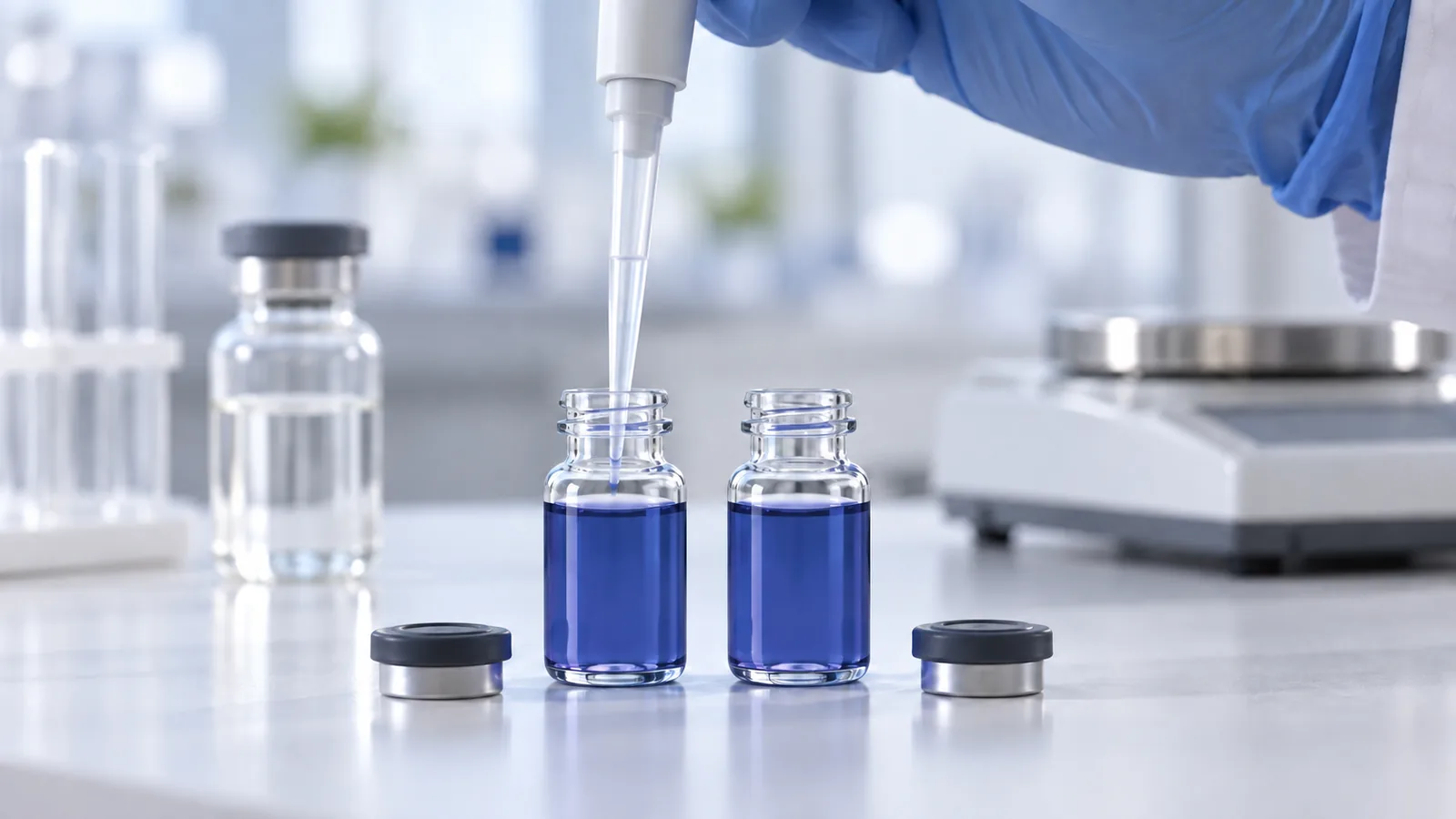
The 5mL mix doubles every unit count and spreads each dose through twice the liquid, which also eases the GHK-Cu sting (why it stings, and the fix). The Simms Research peptide calculator works out any other volume. Add the water slowly along the glass, swirl rather than shake, and store the mixed vial cold, 2–8°C (36–46°F). Bacteriostatic water comes in 10mL vials from Simms Research.
What each batch measured
Simms Research’s certificates list each peptide in a blend separately, so the KPV and the shared base can both be checked batch by batch:
| Batch and test date | GHK-Cu, 50mg label | BPC-157, 10mg | TB-500, 10mg | KPV, 10mg |
|---|---|---|---|---|
| Klow 2026-KW189, Jul 17, 2026 | 55.84mg | 11.17mg | 10.82mg | 10.32mg |
| Klow KW126, May 19, 2026 | 49.61mg | 10.12mg | 9.79mg | 11.09mg |
| Glow GL281, Apr 14, 2026 | 55.14mg | 12.32mg | 11.59mg | None |
| Glow GL133, Feb 13, 2026 | 54.12mg | 13.94mg | 11.18mg | None |
Both Klow batches measured more KPV than the 10mg on the label, 10.32mg and 11.09mg, and the shared base in the Glow and Klow batches lines up within a few milligrams. Twelve of the fourteen measurements came in above the label, and the two below it were within 2.1%. On the current batches, 10 units from a 2.5mL mix holds about 2.2mg of GHK-Cu rather than 2mg, 2.21mg from Glow GL281 and 2.23mg from Klow 2026-KW189, so a 2mg GHK-Cu dose on either is closer to 9 units.
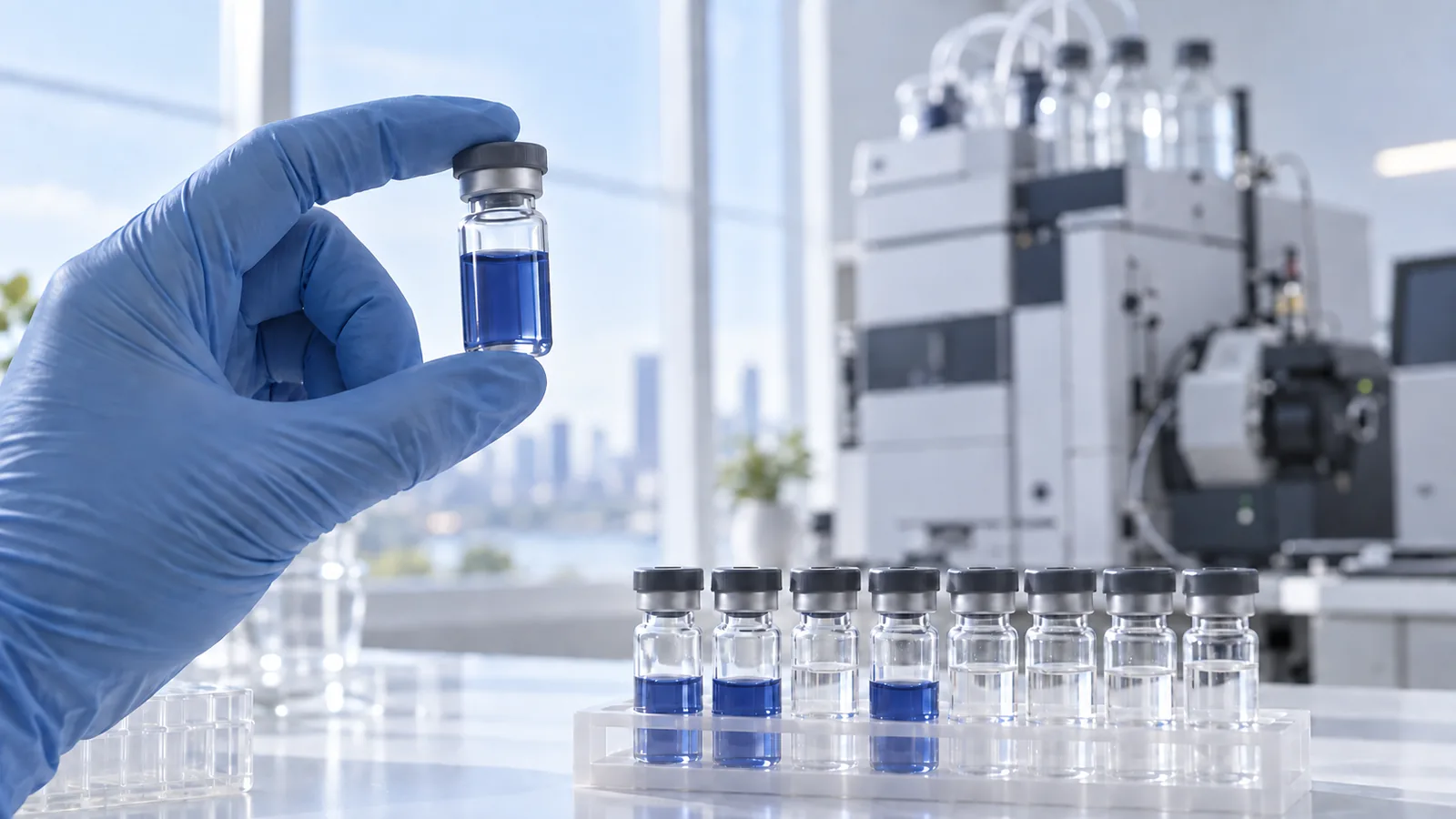
Klow’s latest batch, 2026-KW189, went through the fuller panel: purity and content measured on three separate vials, identity confirmed by LC-MS, and clean endotoxin, heavy-metal and sterility screens. Glow’s latest, GL281, was measured for purity by HPLC-UV and for the content of each peptide, with identity confirmed by LC-MS and a clean endotoxin screen. The certificates sit on the Glow and Klow lab results pages, with a line-by-line walkthrough in How to Read a Peptide Certificate of Analysis.
Frequently asked questions
What is the difference between Glow and Klow?
KPV. Klow is Glow plus 10mg of KPV, 80mg against 70mg. The GHK-Cu, BPC-157 and TB-500 are the same 50mg, 10mg and 10mg in both.
Does Klow have KPV in it?
Yes, 10mg per vial. The current batch, 2026-KW189, measured 10.32mg.
Is Klow stronger than Glow?
Not in the shared peptides: the GHK-Cu, BPC-157 and TB-500 are identical in both. Klow is broader rather than stronger, with a fourth peptide that works on inflammation.
Can you use Glow and Klow together?
There is no reason to. Klow already holds everything in Glow at the same amounts, so running both would double the GHK-Cu, BPC-157 and TB-500 in each day’s dose and push the GHK-Cu past its 1–2mg range.
Does Klow do more than Glow for hair growth?
No. Both hold the same 50mg of GHK-Cu, the peptide studied in hair follicles, and KPV has no published hair research, so for hair the upgrade adds nothing measured.
Does Klow make you tan?
No. Tanning comes from the His-Phe-Arg-Trp core in the middle of alpha-MSH, the part the Melanotan peptides are built around. KPV is the hormone’s last three amino acids and does not contain it.
Does Glow make you lose weight?
No. None of its three peptides is studied for fat loss; they are repair and remodelling peptides.
Do Glow and Klow sting?
The brief sting some researchers notice comes from GHK-Cu, and both blends hold the same amount. Mixing with 5mL of water instead of 2.5mL halves the strength and eases it.
How much water should go in a Glow or Klow vial?
With 2.5mL the GHK-Cu runs at 20mg per mL and 2mg of it is 10 units; with 5mL it is 10mg per mL and 20 units. Use the same volume in both blends so the units carry over.
Are Glow and Klow approved?
No. Simms Research sells both for laboratory research use only.