

Blog
Traveling With Peptides: Storage, TSA, Cooling Tips
Traveling with peptides: storage on the road, TSA rules for vials, water and syringes, cooling mixed vials, car heat, hotel fridges and dose days across time zones.

Traveling with peptides: what changes on the road
Traveling with peptides comes down to one distinction: whether water has gone into the vial yet. A sealed vial of lyophilized powder is a small, dry, solid object. It holds up at room temperature for weeks, it isn’t a liquid at airport security, and it needs no cooler. Mixed with bacteriostatic water, the same vial becomes a refrigerated liquid with 28 days of use, and it belongs in the cold between doses.
Every Simms Research peptide ships as lyophilized powder, and each product page lists the same storage: 2–8°C (36–46°F) for powder and for mixed vials, −20°C for keeping powder long term, and 28 days of use once mixed. Travel leaves those numbers alone. What it adds are conditions a home fridge never meets: a security checkpoint, hours in a bag or a car, a fridge of unknown temperature at the other end, and a dosing schedule that crosses time zones.
This overview covers storage on the road, what TSA allows at the airport and how mixed vials are kept cold, then dose days across time zones, shipping to the destination and what a typical travel kit holds.
Storing peptides while traveling
Storage decides most of what a trip involves, and it starts with the form the peptide travels in.
Powder or a mixed vial
Most trips can be made with sealed powder alone. Whether a mixed vial has to come along depends on how often the compound is dosed and how long the trip runs:
| Situation | What travels | Cold storage in transit |
|---|---|---|
| Weekly compound, no dose day during the trip | Nothing; the vials stay in the fridge at home | None |
| Weekly compound, one dose day during the trip | Usually nothing, by moving the dose day; otherwise the mixed vial | A gel-pack case for a mixed vial |
| Daily compound, trip of a few days | The mixed vial already in use | A gel-pack case rated past the whole journey |
| Trip longer than the mixed vial has left | Sealed vials and water, mixed on arrival | None in transit; a fridge on arrival |
| No reliable fridge at the destination | Sealed vials, mixed once cold storage is sorted | A hard cooler kept topped up with ice |
The 28-day clock is the number that matters. A vial mixed three weeks before departure has about a week left, so a ten-day trip needs a fresh vial mixed on the road, and that vial travels more easily sealed. Weekly compounds often need nothing at all: a five-day trip between two dose days leaves the vials at home, and the dose day itself can move.
Heat in parked cars
A parked car is the hottest place a vial meets on most trips. In a 2005 study published in Pediatrics, a dark sedan parked in the sun on a 72°F day reached 117°F inside within an hour. Across outside temperatures from 72 to 96°F the interior climbed about 40°F in that hour, 80% of the rise came in the first 30 minutes, and cracking the windows made no difference.
117°F is 47°C, hotter than the 40°C (104°F) condition drug makers use to stress products in accelerated stability testing. Sealed powder rides comfortably in an air-conditioned cabin. A parked car, a trunk and a glovebox are where travel storage goes wrong, which is why vials go inside at any stop longer than a few minutes.
Hotel and rental fridges
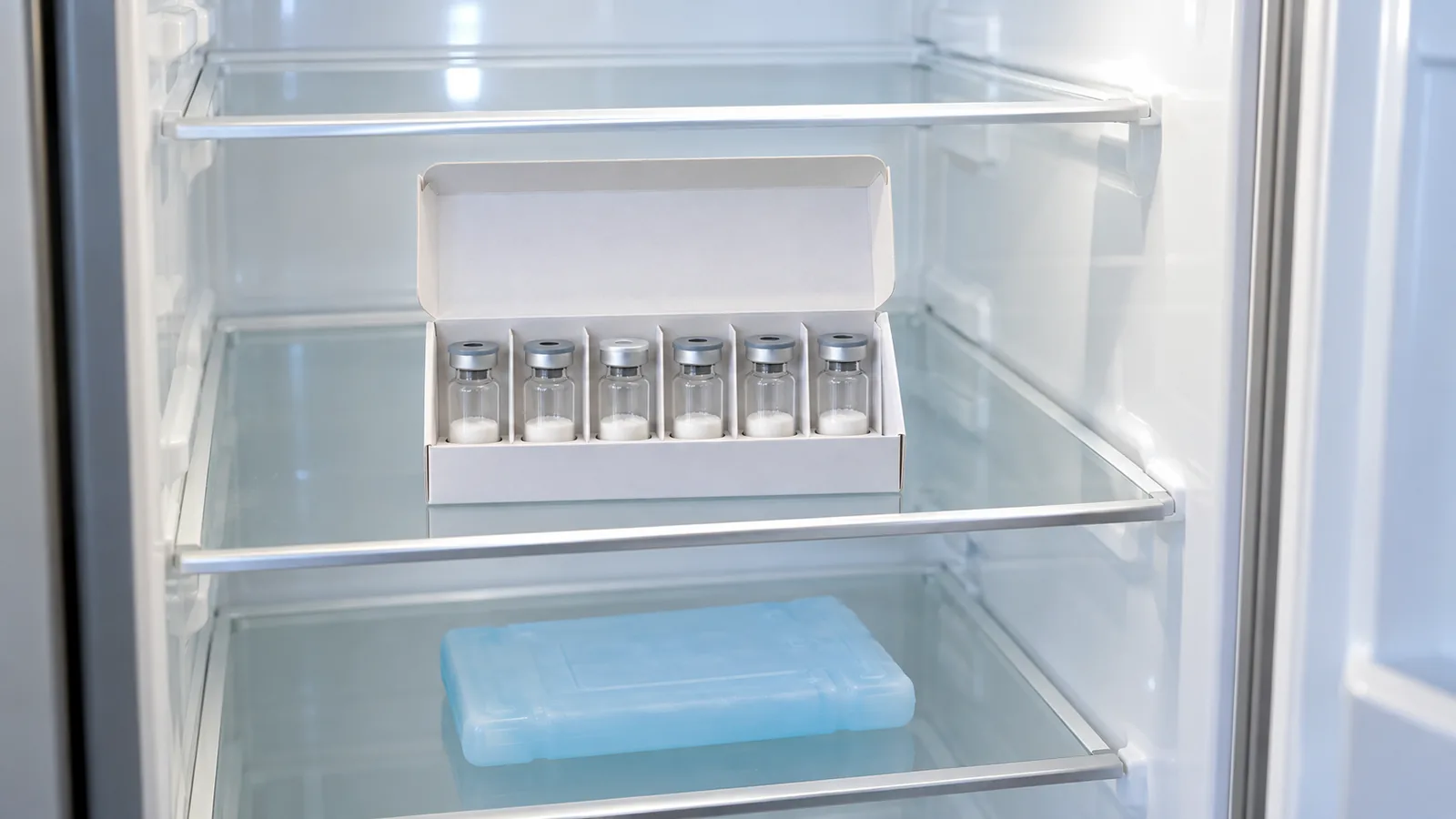
A hotel room fridge is built for drinks, and nothing on it shows what temperature it holds. A small fridge thermometer left overnight where the vials will sit settles it. Between 2 and 8°C, the fridge is fine. Warmer calls for a colder setting or another unit from the front desk. At or below freezing, the vials belong further forward, away from the back wall, which is the coldest spot in small fridges.
Mixing at the destination
Mixing on arrival follows the same routine as at home: both stoppers wiped, the water run down the inside wall of the vial, a gentle swirl, and the date written on the label so the 28 days count from that day. The detail that matters on the road is the water volume. The same volume as at home gives the same strength, so every dose stays on the same syringe mark. The Simms Research peptide calculator works out any other combination, and the dosage guides for retatrutide, tirzepatide, GHK-Cu and CJC-1295 with ipamorelin give the units for each vial size.
TSA rules for peptides
TSA publishes its screening rules item by item in its What Can I Bring list. These entries cover everything in a peptide kit:
| Item | Carry-on bag | Checked bag |
|---|---|---|
| Sealed vials of powder | Yes. Screened as solids; only powders over 12oz need their own bin | Yes |
| Bacteriostatic water and mixed vials | Yes, in the quart-size liquids bag, each container 3.4oz (100mL) or less | Yes |
| Unused syringes | Yes, when they travel with injectable medication; declared at the checkpoint | Yes |
| Used syringes | Yes, in a sharps container or other hard-sided case | Yes, the same way |
| Gel packs and ice packs | Yes if frozen solid; packs cooling medically necessary items pass in any state, declared | Yes |
The sizes make the liquids rule easy. A 10mL vial of bacteriostatic water is a tenth of the 100mL limit, and a mixed peptide vial holds only the few milliliters of water it was mixed with, so a week’s supply fits in a corner of the quart bag.
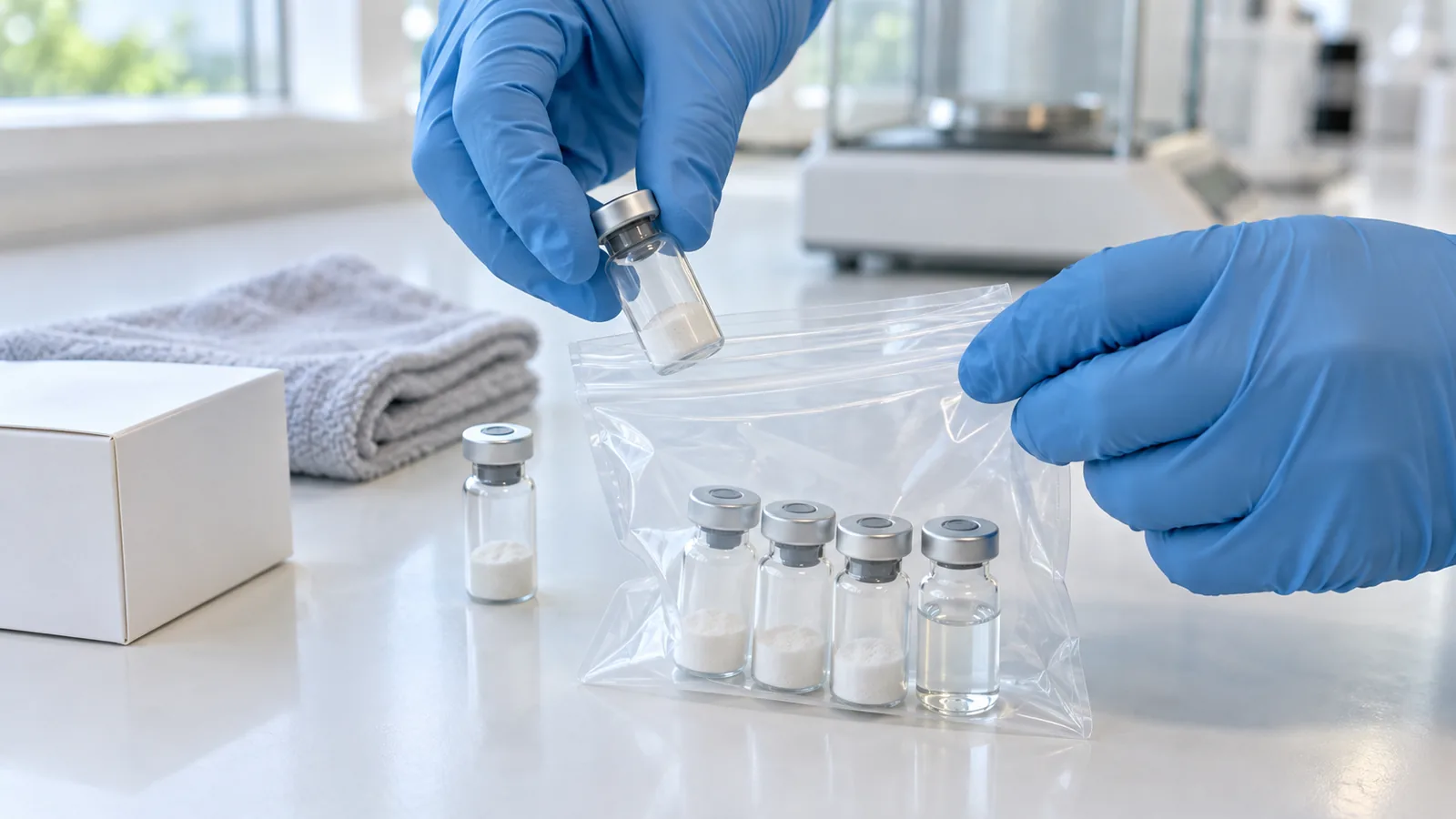
Screening goes quickest with the whole kit in one clear pouch, in a bin on its own. Officers may open or test liquids, and TSA lets a traveler ask for liquids to be inspected by hand instead of X-rayed, in exchange for extra screening. The X-ray itself is harmless to peptides: a carry-on scanner delivers about 15% of one day’s natural background radiation. Syringes are the one item TSA asks travelers to declare, and they are also allowed in checked bags, capped and in their box.
Carry-on or checked bag
Vials travel best in the carry-on. The reason isn’t that the hold would ruin powder. A checked bag spends the whole journey out of reach, and bags go missing: airlines worldwide mishandled 6.3 bags for every 1,000 passengers in 2024, according to the air transport IT provider SITA. A delayed bag full of clothes is an inconvenience. A delayed bag holding the only vials is a missed dose.
The usual split puts the vials and the cold case in the carry-on, the bacteriostatic water in the liquids bag, and syringes, swabs and the sharps container wherever there’s room, the checked bag included. Labeled vials kept together in one pouch or box answer the question if an officer asks what they are.
Cooling tips for mixed vials
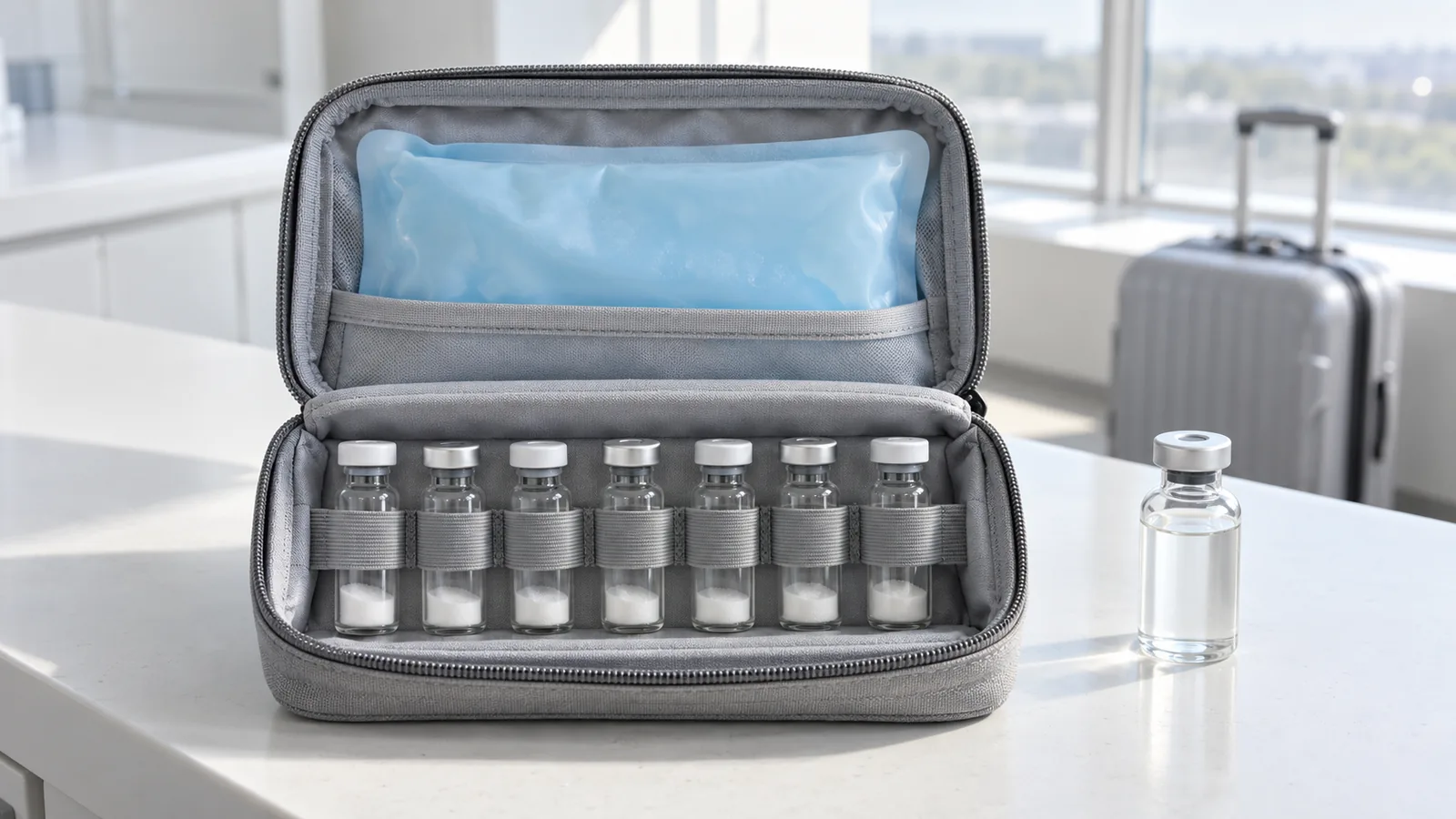
A mixed vial needs 2–8°C (36–46°F) from one fridge to the next. Travel cases hold that range with frozen gel packs and insulation, and their makers rate them by hours:
| Case | Rated hold | Suits |
|---|---|---|
| Small insulated pouch, one gel pack | About 12 to 16 hours | One or two vials on a domestic flight |
| Larger insulated case, bigger gel packs | About 24 to 30 hours | Long-haul flights and connections |
| Larger medicine cooler, several gel packs | Up to 72 hours | Road trips and several vials |
| Evaporative cooling wallet | 45 hours or more at 18–26°C (64–79°F), even at 100°F outside | Sealed powder in hot places, not mixed vials |
The rating that matters covers the whole journey, not just the flight: the ride to the airport, security, connections and the trip from the arrival gate to the next fridge. Evaporative wallets work differently. They stay cool for days without a freezer, but 18–26°C is room temperature, so they suit sealed powder in a hot climate rather than a mixed vial.
Two details matter more than the case itself. Gel packs frozen solid overnight clear TSA with no conditions attached. And a layer between pack and vial, a sleeve or a folded cloth, keeps the vial from freezing: a pack straight from the freezer is far below 0°C, and a mixed peptide shouldn’t go through a freeze and thaw.
Cooling on a road trip
On the road, the cooler rides in the cabin, on the floor and out of the sun, never in the trunk. Gel packs go back into a hotel freezer each night, and bagged ice from a gas station works as a refill when it stays sealed in a zip bag, so melt water can’t soak the vial box. For vials that arrive by mail in hot weather, the Miami and Florida guide has the delivery side.
Dose days across time zones
Weekly compounds have the most room. Tirzepatide’s approved label lets the weekly dose day move as long as two doses stay at least 72 hours apart, and allows a missed dose up to 4 days late; after that, the dose is skipped and the schedule resumes on the usual day. Retatrutide is still investigational, and every one of its trials dosed once a week, so tirzepatide’s label is the closest published rule.
Those two rules cover most trips without packing a vial. With a Sunday dose day and a trip from Friday to Tuesday, the dose can move to Thursday before leaving, four days after the last one, or it can be given on Tuesday evening after landing, two days late and inside the 4-day window.
Daily compounds follow the local clock. Protocols timed to sleep, such as the bedtime dose of CJC-1295 with ipamorelin, move with the sleep schedule, so the first night’s dose goes in at local bedtime.
Shipping peptides to the destination
For a long stay, the vials don’t have to travel with anyone. Simms Research ships from Miami, the same day on orders placed before 5PM Eastern and otherwise the next business day, excluding Sundays and public holidays. FedEx 2-Day Express, free on orders over $200, arrives two business days after dispatch, and UPS Standard in three to five. Every order carries the free Delivery Guarantee: a package that is lost, stolen or damaged is replaced or refunded, with no carrier claim to file.
Deliveries to a hotel go under the guest’s name and check-in date, with the front desk told to expect them, and rentals work best with delivery timed for after check-in. Sealed powder handles the carrier network at ambient temperature, the same way it handles a carry-on, and bacteriostatic water ships in 10mL vials alongside it. Simms Research also ships internationally, with customs duties and holds outside the guarantee.
What a peptide travel kit holds
A typical kit, and the bag each item travels in:
| Item | How many | Where it travels |
|---|---|---|
| Sealed peptide vials, in their box | Enough for every dose on the trip | Carry-on |
| Mixed vial in use, if it comes along | One | Carry-on, in the cold case |
| Bacteriostatic water, 10mL | One vial covers three to five mixes at 2–3mL each | Carry-on liquids bag |
| Insulin syringes | One per injection, plus a few spares | Carry-on, declared, or checked bag |
| Alcohol swabs | Two per injection, one for the stopper and one for the site | Either bag |
| Travel sharps container | One | Either bag |
| Cold case and gel packs | One case, packs frozen solid | Carry-on |
| Fridge thermometer | One | Either bag |
Frequently asked questions
Can you bring peptides on a plane?
Yes. Sealed vials of powder screen as solids in a carry-on or checked bag, and bacteriostatic water and mixed vials fit inside the quart-size liquids bag.
Can you fly with peptides and needles?
TSA allows unused syringes in carry-on bags when they travel with injectable medication and are declared at the checkpoint, and allows them in checked bags. Used syringes need a sharps container or another hard-sided case.
Do peptides need to be refrigerated when traveling?
Sealed powder doesn’t. It travels at room temperature and goes into a fridge on arrival. Mixed vials need 2–8°C (36–46°F) the whole way, which a gel-pack case rated past the journey provides. Do Peptides Need to Be Refrigerated? covers storage at home.
How long can peptides stay out of the fridge on a trip?
Sealed powder handles weeks at room temperature, so a travel day doesn’t register. A mixed vial tolerates hours, not days, out of the cold, which is the job of the gel-pack case.
Can peptides go in checked baggage?
Yes, TSA allows it. The carry-on is still the better place for vials, because a checked bag can be delayed or lost while the dosing schedule keeps running.
Do airport X-rays damage peptides?
No. A carry-on scanner delivers about 15% of one day’s natural background radiation, and a checked-bag CT scan less than a year’s worth. Ten passes through an airport scanner left living blood stem cells, far more sensitive to radiation than a peptide, with no effect on their survival or growth.
Does shaking during travel damage peptides?
Not as powder, since a dry cake has no liquid to foam. A mixed vial riding upright in a padded case sees nothing like the hard shaking that the swirl-don’t-shake rule for mixing is about.
Is a peptide travel case TSA approved?
TSA doesn’t approve cases; it screens what’s inside them. The gel packs are what count: frozen solid at screening, or declared as cooling for medically necessary items.
Does bacteriostatic water need to stay cold on a trip?
No. Sealed bacteriostatic water is stored at 20–25°C (68–77°F), room temperature, so it rides in the liquids bag with no cooling. Once the stopper is punctured, it’s good for 28 days.
Can you travel with peptides internationally?
Each country sets its own import rules, separate from TSA, so the destination’s customs authority is the place to check before flying.