

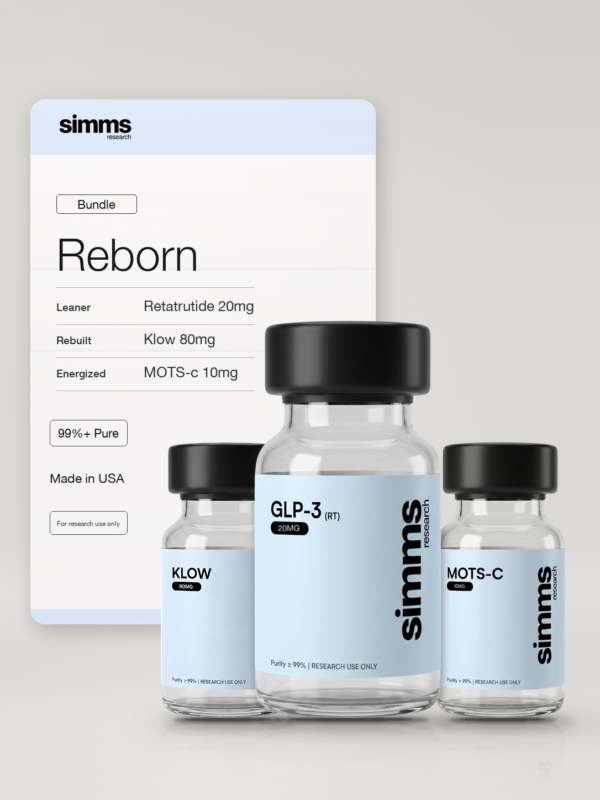
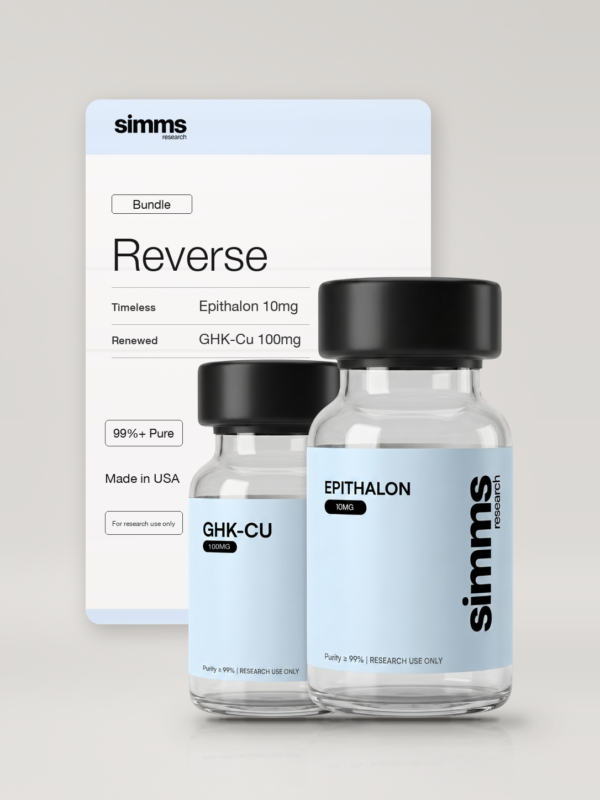
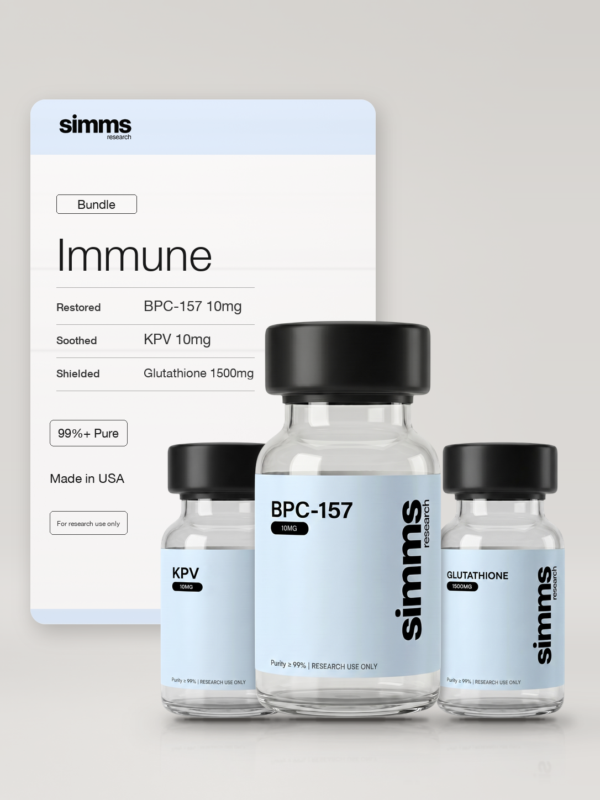
Blog
BPC-157 vs GHK-Cu: Injury Repair or Skin and Collagen
BPC-157 vs GHK-Cu compared: what each peptide is, the skin and injury research behind each, side effects, running them together, dosing in units, cost per month and which fits which research.

BPC-157 and GHK-Cu both get filed under healing peptides. They share shelf space, they turn up in the same stacks, and two popular blends, Glow and Klow, hold both in a single vial. Beyond that label they have little in common: one is a 15-amino-acid fragment of a stomach protein, the other a three-amino-acid copper complex the body makes itself, and their evidence comes from different parts of the body.
Simms Research stocks BPC-157 as 10mg and 20mg vials, GHK-Cu as 50mg and 100mg vials, and the pair together in the Glow Peptide Blend. Which one fits depends on what is being repaired: skin and collagen, or tendon, ligament and gut.
What is BPC-157, and what is GHK-Cu?
BPC-157 is a synthetic chain of 15 amino acids, GEPPPGKPADDAGLV, taken from body protection compound, which the stomach releases into its juices. It holds together in stomach acid, so rats have been given it in drinking water as well as by injection. A 2025 systematic review of its musculoskeletal research counted 36 studies published up to 2024: 35 in animals or cells and one in people.
GHK-Cu is far smaller: glycine, histidine and lysine wrapped around one copper ion. GHK was first isolated from blood plasma by Loren Pickart in 1973, and production continues throughout life, though blood levels drop by more than half between 20 and 60. The copper gives it its blue colour and much of its job. It has been a skin-care ingredient for decades, which is why it is the one of the two with controlled human trials, all of them with creams.
What is the difference between BPC-157 and GHK-Cu?
The stage of repair each one works on. BPC-157 acts on the response to damage. It activates VEGFR2, the receptor behind new blood vessel growth, acts on nitric oxide signalling, and when rat tendon tissue was cultured with it, cells grew out of the explants faster and kept migrating. The picture its studies paint is blood supply and repair cells arriving faster at an injury.
GHK-Cu acts on what the repair is built from. It carries copper to lysyl oxidase, the enzyme that cross-links collagen and elastin into strong fibres, and in fibroblasts it raises collagen, elastin, decorin and glycosaminoglycans. It also switches on the enzymes that break old collagen down, along with their inhibitors, so it remodels rather than simply piles on. Pickart’s 2015 review puts its reach at more than 4,000 human genes turned up or down, a figure drawn from cell-line gene data rather than living tissue.
Both encourage new blood vessels, so the line between them is not absolute. The practical split is this: BPC-157’s record is in deep tissue that has been injured, GHK-Cu’s is in the quality of skin and the collagen laid down in a wound. They are not two versions of the same peptide, and neither one stands in for the other.
BPC-157 vs GHK-Cu comparison chart
The two compared point by point, with Simms Research’s prices and latest batch figures:
| BPC-157 | GHK-Cu | |
|---|---|---|
| Size | 15 amino acids | 3 amino acids holding one copper ion |
| Origin | Stomach juice, as part of a larger protein | Human plasma, saliva and urine |
| In the vial | White powder, colourless once mixed | Blue-violet powder, clear blue once mixed |
| What it drives | New blood vessels and repair-cell movement | Collagen and elastin, built and remodelled |
| Where the research is | Tendon, ligament, muscle and gut | Skin, wounds and hair follicles |
| Tested as a cream | In mice and rats, on burns and laser wounds | In people, on the face, eye area and thigh |
| Human data | Three small pilots since 2021 | Controlled cream trials of up to 12 weeks |
| Usual research amount | 250–500mcg a day | 1–2mg a day |
| Price at Simms Research | $69 for 10mg, $109 for 20mg | $48 for 50mg, $76 for 100mg |
| Latest lab result | 10.19mg measured in a 10mg vial, 99.65% pure | 52.05mg measured in a 50mg vial, 99.82% pure |
BPC-157 vs GHK-Cu for skin
GHK-Cu, and it holds the only human evidence. In a one-month biopsy study on the thigh, a GHK-Cu cream raised collagen production in 70% of women, ahead of vitamin C cream at 50% and retinoic acid at 40%. Three 12-week trials on the face and eye area, in groups of 41 to 71 women, measured firmer, denser, thicker skin with fewer fine lines. For wounds, a 2003 University of Florida study spread a GHK-Cu gel on open wounds in rat skin with a starved blood supply: by day 13 the treated wounds had shrunk by 64.5%, against 45.6% on the plain gel and 28.2% untreated.
BPC-157 has a skin record of its own, all of it in animals. University of Zagreb researchers spread it as a cream on deep burns in mice in 2001 and on carbon dioxide laser wounds in 2005, and healing improved both times. In a 2015 study in rats, BPC-157 applied to chemical burns closed them faster, with more collagen in the new skin and more VEGF, its blood-vessel signal. It is a burn and wound result, not an ageing-skin one: no study has measured BPC-157 against fine lines, laxity or skin density.
Hair follows the same split. GHK-Cu and its close cousin AHK-Cu have follicle studies; BPC-157 has none. A GHK-Cu vial can also be diluted for skin work, and the GHK-Cu guide sets out the topical strengths a vial makes. Whether injecting it does more than a cream is a separate question, taken up in injectable copper peptides.

BPC-157 vs GHK-Cu for injury and gut healing
BPC-157, by a wide margin. Its animal studies span the main kinds of musculoskeletal injury: Achilles tendons cut through or torn from the heel bone, a severed knee ligament that healed whether the peptide was injected, drunk or rubbed on as a cream, a thigh muscle cut across and followed for 72 days, and bone gaps in rabbits. The 2025 review found it improved function, structure and load-bearing strength across muscle, tendon, ligament and bone models.
The gut is where BPC-157 began. Researchers have used it against colitis, fistulas, bowel surgery joins and painkiller damage to the stomach lining, often dissolved in the animals’ drinking water, and it reached early human trials as a treatment for bowel inflammation. Its pairing with TB-500 for tendon work is covered in BPC-157 vs TB-500.
GHK-Cu’s record below the skin is real but thin by comparison. Pickart’s reviews list faster healing in bone, the stomach lining and dogs’ foot pads, and GHK injected at one site sped wound healing elsewhere on the body in rats, mice and pigs. There is no GHK-Cu tendon or ligament study to set beside BPC-157’s, and no gut programme.
BPC-157 and GHK-Cu side effects
The usual experience with either is uneventful. GHK-Cu’s one common complaint is a short sting where the dose goes in, stronger in concentrated mixes; more water eases it, as the GHK-Cu guide explains under why it stings. A 2mg dose carries about 0.3mg of copper, a third of an adult’s daily allowance, and Pickart reports no safety problems from its long use in cosmetics or in human wound studies.
BPC-157’s 2020 toxicology programme in mice, rats, rabbits and dogs found no serious toxicity, and neither of its recent human pilots, 12 women given it in the bladder wall and two adults given it by infusion, recorded an adverse event. Brief redness at the site is the report heard most from people running it.
Can you take BPC-157 and GHK-Cu together?
Yes, and many protocols do: the pair sits at the centre of Glow and Klow. No study has tested the pair, either against each other or combined, and a 2026 review of both for wound healing could only assess each on its own. The case for running them together comes from the difference above. BPC-157 opens the blood supply and brings repair cells in; GHK-Cu shapes the collagen those cells lay down.
They also mix. Glow freeze-dries both into one powder that dissolves in a single volume of water, and its certificates measure each peptide separately, every one above its label.
Running both takes one of two forms. The Glow Peptide Blend ($96) holds 50mg of GHK-Cu plus 10mg of BPC-157 and 10mg of TB-500, a fixed five-to-one ratio, so the GHK-Cu sets the dose: a 10-unit draw from a 2.5mL mix gives 2mg of GHK-Cu and 400mcg of each partner, as the Glow peptide dosage chart lays out. Klow adds KPV for inflamed tissue, and Glow vs Klow covers when that is worth it. Separate vials drop the TB-500 and let each peptide run at its own amount, BPC-157 at a full 500mcg and GHK-Cu anywhere from 1 to 2mg, with either one free to stop early.
BPC-157 and GHK-Cu dosage
Both land at 5 to 10 units a day on a U-100 syringe with the water below, although BPC-157 is counted in micrograms and GHK-Cu in milligrams:
| BPC-157 | GHK-Cu | |
|---|---|---|
| Research range | 250–500mcg a day | 1–2mg a day |
| Water per vial | 2mL in a 10mg vial, 4mL in a 20mg vial | 2.5mL in a 50mg vial, 5mL in a 100mg vial |
| What a draw holds | 5 units holds 250mcg, 10 units holds 500mcg | 5 units holds 1mg, 10 units holds 2mg |
| How long a vial runs | A 10mg vial runs 20 days at 500mcg | A 50mg vial runs 25 days at 2mg |
Each has its full chart, the BPC-157 dosage chart and the GHK-Cu dosage guide, and the peptide calculator handles any other vial or water amount, with the mixing itself walked through in how to reconstitute peptides. One bottle of Research Water, $20 for 10mL, mixes a 10mg BPC-157 vial and a 50mg GHK-Cu vial twice over, and the peptide storage guide covers the 28 days a mixed vial keeps in the fridge.
BPC-157 vs GHK-Cu cost
GHK-Cu costs just over half as much to run. At the top of each range, a 50mg vial of GHK-Cu ($48) lasts 25 days at 2mg a day, about $58 per 30 days, while a 10mg vial of BPC-157 ($69) lasts 20 days at 500mcg, about $104. Both from separate vials comes to about $162 per 30 days. Glow at 10 units a day lasts 25 days for $96, about $115 per 30 days, with TB-500 included and BPC-157 at 400mcg.
The 20mg BPC-157 ($109) and 100mg GHK-Cu ($76) vials cost less per milligram, but at these daily amounts the 28 days a mixed vial keeps run out before the powder does, which puts them at about $117 and $81 per 30 days. The 20mg vial suits 1mg-a-day BPC-157 protocols, and the 100mg vial suits GHK-Cu skin work.
Is GHK-Cu or BPC-157 better?
Each is better at its own job, and the jobs barely overlap. The choice comes down to the tissue.
Choose GHK-Cu for skin, collagen, wound surfaces and hair. It is the only one of the two with controlled human results, it beat vitamin C and retinoic acid on collagen in the one study that set them side by side, and at about $58 per 30 days it is the cheaper of the two to run.
Choose BPC-157 for tendon, ligament, muscle, bone and gut. Its animal record in injured deep tissue is broad and consistent, and GHK-Cu has nothing comparable there.
Choose both when the research spans the two, skin quality alongside injury repair. Glow runs them from one vial with TB-500 included; separate vials keep BPC-157 at a full 500mcg.
BPC-157 and GHK-Cu lab results
Both came in above their labels. Each current batch went to an independent ISO-certified lab in July 2026, which measured three vials of each: the BPC-157 averaged 10.19mg per 10mg vial at 99.65% purity, the GHK-Cu 52.05mg per 50mg vial at 99.82%, with LC-MS identity and clean endotoxin, heavy-metal and sterility screens for both. All five BPC-157 batches and all four GHK-Cu batches published so far sit above label. Every certificate opens from the BPC-157 and GHK-Cu pages of the lab results library, with each field decoded in the certificate reading guide.
Frequently asked questions
What is better than GHK-Cu?
Within skin research, the compounds it has been tested against have come off worse: in the one-month biopsy study it raised collagen in more women than vitamin C or retinoic acid did. For tendon, ligament or gut research, BPC-157 has the studies GHK-Cu lacks.
Is BPC-157 hard on your liver?
The evidence runs the other way. The liver breaks BPC-157 down, and in rats it limited the liver injury caused by high doses of paracetamol, diclofenac and ibuprofen. In the 2025 infusion pilot, 10mg and then 20mg left two adults’ liver markers unchanged.
Is it safe to inject GHK-Cu every day?
Research protocols dose it daily, and the human cream studies applied it every day for 12 weeks. At 2mg the copper is about 3% of the NIH’s upper daily limit, and the sting from strong mixes is the one common complaint.
Are BPC-157 and GHK-Cu FDA approved?
Neither is an approved drug. GHK-Cu is sold in cosmetics, and Simms Research supplies both strictly for laboratory research.