

Blog
How to Reconstitute Tirzepatide at Home: Bac Water Calculator and Mixing Chart (2026)

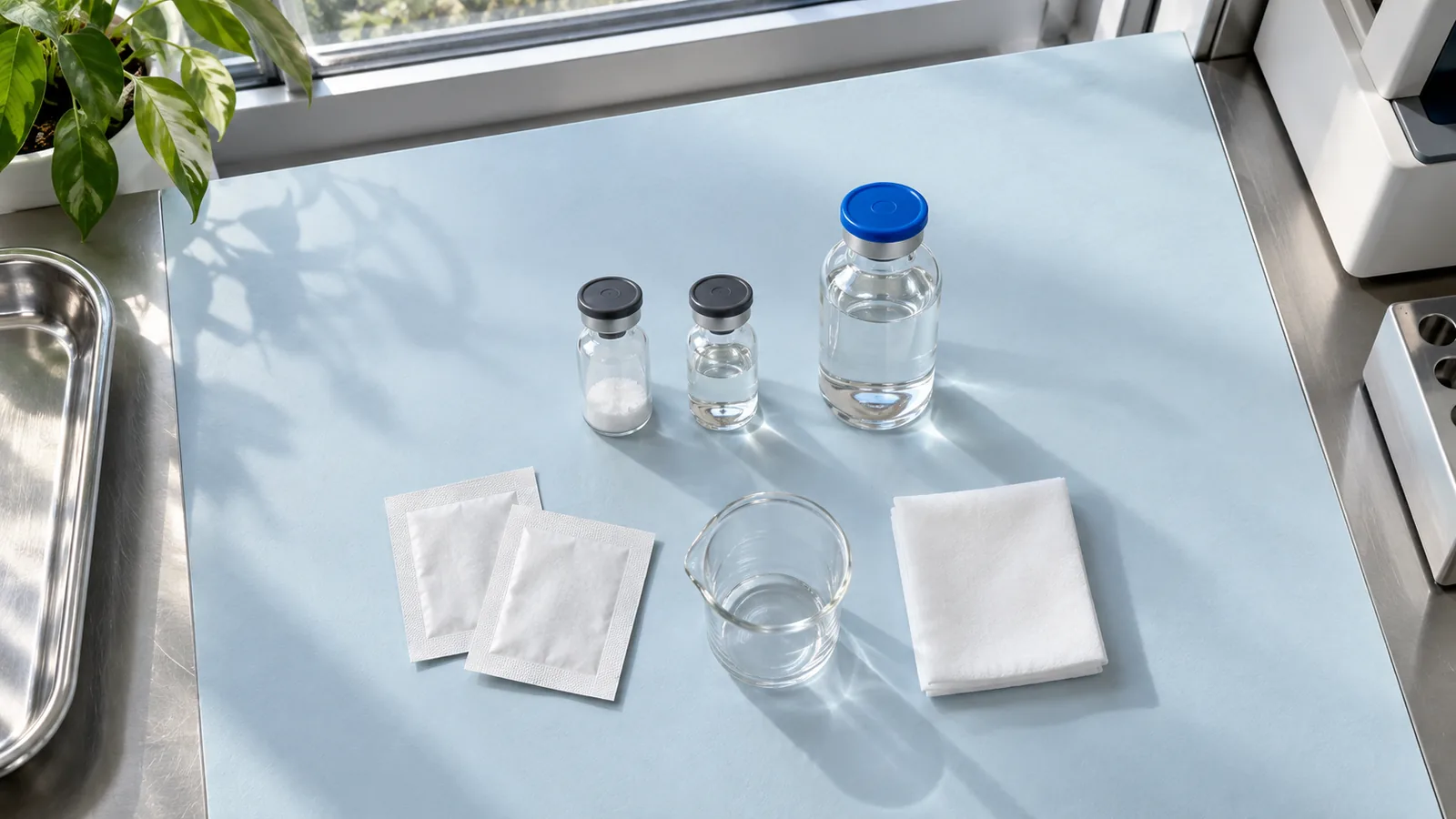
To reconstitute tirzepatide, let the sealed vial reach room temperature, wipe both rubber stoppers with alcohol, run bacteriostatic water slowly down the inside of the glass and roll the vial until the liquid is clear. It takes about five minutes. The amount of water is the one choice that lasts: it sets how many syringe units every dose takes for the life of the vial.
Simms Research’s Tirzepatide (GLP-2) comes in four sizes, 10mg for $65, 20mg for $95, 30mg for $155 and 60mg for $186, and its bacteriostatic water, Research Water, is a 10mL vial for $20. The tirzepatide ladder climbs in equal 2.5mg steps from 2.5mg to 15mg a week (Zepbound label, FDA, 2026), and each vial size lines up with part of it, so each size gets its own amount of water below. The weekly schedule itself is laid out in the tirzepatide dosage guide.
Tirzepatide reconstitution calculator
Tirzepatide water by vial, as of November 10, 2026: 2mL for a 10mg or 20mg vial and 2.4mL for a 30mg or 60mg vial. Mixed that way, the 2.5mg starting dose from a 10mg vial is 50 units, 5mg from a 20mg vial is 50 units, 7.5mg from a 30mg vial is 60 units and 15mg from a 60mg vial is 60 units. Simms Research sells all four sizes.
Pick the vial, the water and the dose, and the calculator gives the units to draw on a U-100 insulin syringe. It opens on a 10mg vial with 2mL and a 2.5mg dose: 50 units.
The full free tool with a units chart for every vial size is on the tirzepatide calculator page.
Why technique matters when mixing tirzepatide
Tirzepatide carries a 20-carbon fatty acid chain on lysine 20, which holds it on albumin and gives it a half-life of about five days (Zepbound label, FDA, 2026). That chain also draws the molecule to the surface where water meets air, which is where rough handling does its damage.
In a Merck lab study of liraglutide, another GLP-1 peptide with a fatty acid chain, gentle agitation left it almost unchanged, while hard shaking with plenty of air in the container turned it into fibrils, clumps that don’t go back into solution (Hamada, Molecular Pharmaceutics, 2026). Clumped peptide is missing from every dose drawn after it.
What you need to reconstitute tirzepatide
The tirzepatide vial, a vial of bacteriostatic water, alcohol pads, a U-100 insulin syringe and a pen for the label. A 1mL syringe covers every volume here; anything over 1mL goes in as more than one fill.
The syringe’s fixed 29 to 31 gauge needle suits both jobs, mixing and dosing. What Size Syringe for Peptides covers the barrels.
Bac water, sterile water or saline for tirzepatide
Bac water. It is sterile water preserved with 0.9% benzyl alcohol, which keeps bacteria carried in on a needle from multiplying, and that is what lets one mixed vial be drawn from for four weeks. Simms Research’s Research Water is exactly that, kept at room temperature and good for 28 days once its stopper is first pierced.
The preservative is a known match for tirzepatide: Lilly preserves its own four-dose vials and pens with the same 9mg of benzyl alcohol per mL, plus a little phenol (Zepbound label, FDA, 2026).
Plain sterile water and 0.9% saline both dissolve tirzepatide but carry no preservative, so they only suit a vial used up the day it is mixed. The salt itself is no problem: Lilly’s own solution is made with sodium chloride (Zepbound label, FDA, 2026). Tap, bottled and distilled water are not sterile, and homemade bacteriostatic water has no way to be checked.
Step 1: Set up a clean workspace
Wash your hands or put on nitrile gloves, wipe down a flat surface and lay the whole kit out first, so nothing needs fetching once a stopper is clean.
Step 2: Let the tirzepatide vial reach room temperature
Take the sealed vial out of the fridge 10 to 15 minutes before mixing, a little longer from the freezer, and never heat it. A cold vial gathers condensation around the stopper, and its cake dissolves slowly, which tempts a harder shake.
Step 3: How much bac water to add to tirzepatide
The vial’s milligrams divided by the millilitres of water give the strength in mg per mL. A dose divided by that strength, times 100, is its units on a U-100 syringe. The amounts below put every step of the ladder on a printed line:
| Vial | Bac water | Strength | 2.5mg reads as | Step it matches |
|---|---|---|---|---|
| 10mg | 2mL | 5mg per mL | 50 units | 2.5mg, weeks 1 to 4 |
| 20mg | 2mL | 10mg per mL | 25 units | 5mg, weeks 5 to 8 |
| 30mg | 2.4mL | 12.5mg per mL | 20 units | 7.5mg, weeks 9 to 12 |
| 60mg | 2.4mL | 25mg per mL | 10 units | 10mg to 15mg, from week 13 |
How much bac water for 10mg tirzepatide
2mL. With that, a 10mg vial comes to 5 mg/mL and the first 2.5mg dose is 50 units. Half of that, 1.25mg, is 25 units, and 5mg is the full 100.
This size matches the 2.5mg step, weeks 1 to 4, and holds exactly four starting doses. The popular 1mL mix works too, but 2.5mg then lands on 25 units, between the 2-unit lines of a 1mL syringe, so it needs a 0.3mL or 0.5mL syringe to read.
2.4mL also works and matches Lilly’s own 10mg multi-dose vial, four doses of 0.6mL (Zepbound label, FDA, 2026): 2.5mg is then 60 units, the mix behind the tirzepatide dosage chart.
How much bac water for 20mg tirzepatide
2mL, which makes 10 mg/mL, the easiest strength to read: the units are the milligrams times ten, so the 5mg dose is 50 units, 2.5mg is 25 and 10mg is the full 100.
It matches the 5mg step, weeks 5 to 8. With 2.4mL, as in Lilly’s 20mg vial, 5mg is 60 units.
How much bac water for 30mg tirzepatide
2.4mL. Every 2.5mg then reads as 20 units, so the 7.5mg dose is 60 units; 5mg is 40, 10mg is 80 and 12.5mg is 100.
This size matches the 7.5mg step, weeks 9 to 12. 3mL is the amount most often used, but it puts the 7.5mg dose on 75 units, between the printed lines.
How much bac water for 60mg tirzepatide
2.4mL as well. Every 2.5mg is then 10 units: 10mg is 40 units, 12.5mg is 50 and 15mg is 60.
The 60mg vial carries the three top doses, from week 13 on. 3mL is the amount most often suggested for it, but then 12.5mg needs 62.5 units, a half unit no syringe prints. The 2.4mL mix isn’t unusually strong for tirzepatide: Lilly’s own single-dose pens deliver up to 15mg in 0.5mL (Mounjaro prescribing information).
Starting doses belong to the smaller vials: opened for 2.5mg a week, a 60mg vial still has 47.5mg left on day 28.
Step 4: Wipe both stoppers
Flip the plastic caps off both vials, leaving the rubber stoppers in place, then wipe each stopper with a fresh alcohol pad and let it air-dry. The same swab comes before every later draw; a mixed vial is pierced five times or more.
Step 5: Draw the bac water
With a new syringe, turn the bac water vial upside down, keep the needle tip in the liquid and pull just past the mark, then tap the bubbles up and push back to the line.
Measuring the water in units
Insulin syringes are marked in units, and 100 units is 1mL, so the water is measured the same way as a dose: 2mL is two full syringes, and 2.4mL is two full syringes plus 40 units.
A needle that has been in the tirzepatide vial never goes back into the bac water, which has to stay clean for 28 days.
Step 6: Add the water down the side of the vial
Push the needle through the tirzepatide stopper, angle the tip against the glass and press slowly, so the water runs down the wall and pools under the cake instead of hitting the powder.
After each fill, ease the plunger back a few units before pulling out, to let some air leave.
Step 7: Roll the vial until it clears
Roll the vial gently between your palms, or tilt it in slow circles, until no white remains. Never shake it: shaking whips air into the liquid, the stress that clumps fatty-acid peptides. Most cakes clear within a few minutes, the heavier 30mg and 60mg cakes a little later.
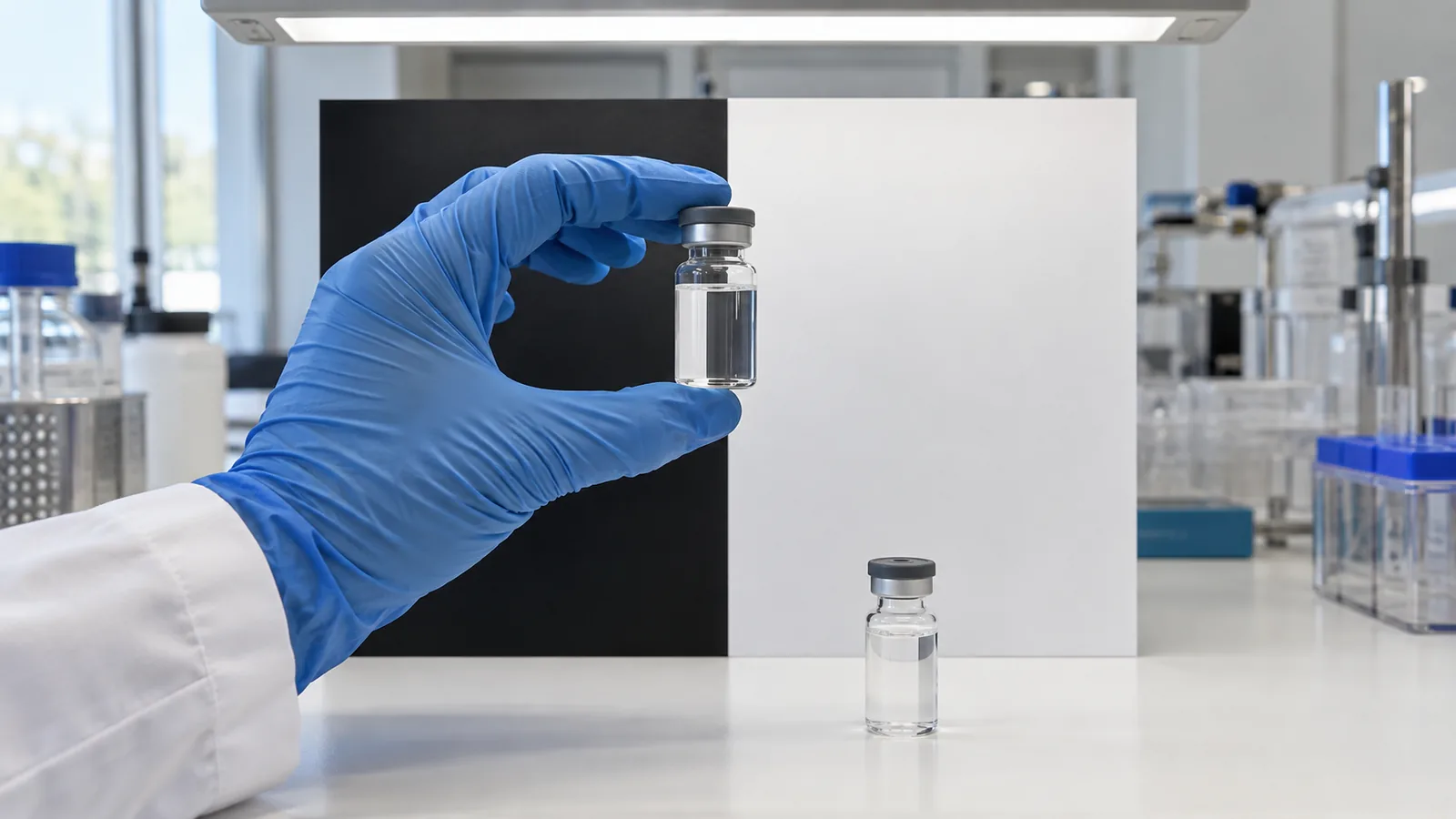
Step 8: Check that the tirzepatide is clear
Clear and colorless, like the water that went in, with no haze and nothing resting on the bottom. Lilly describes its own tirzepatide solution as clear and colorless to slightly yellow, and says not to use it if particles or discoloration appear (Zepbound label, FDA, 2026). The vial is ready to draw from as soon as it is clear.
| What you see | What it usually is | What to do |
|---|---|---|
| Foam or a layer of fine bubbles | Air from a hard shake or water pushed in too fast | Stand it upright in the fridge; the bubbles clear on their own |
| A white ring on the neck or under the stopper | Dry powder the water never touched | Tilt and roll until the liquid rinses it off |
| A few flecks after five minutes | Cake still wetting through | Rest it upright for 10 to 15 minutes, then roll again |
| Haze still there after resting | Peptide that has not stayed in solution | Add 0.5mL more water and rest it |
| Particles, strings or a yellow-brown tint | Contamination or breakdown | Do not use the vial |
Cloudiness is not normal, except for fine bubbles right after mixing and fridge haze that clears in a closed hand. Extra water changes the strength; the calculator gives the new units.
Once it is clear, write the strength and the date on the vial and put it in the fridge. The date starts its 28 days.
How long reconstituted tirzepatide lasts
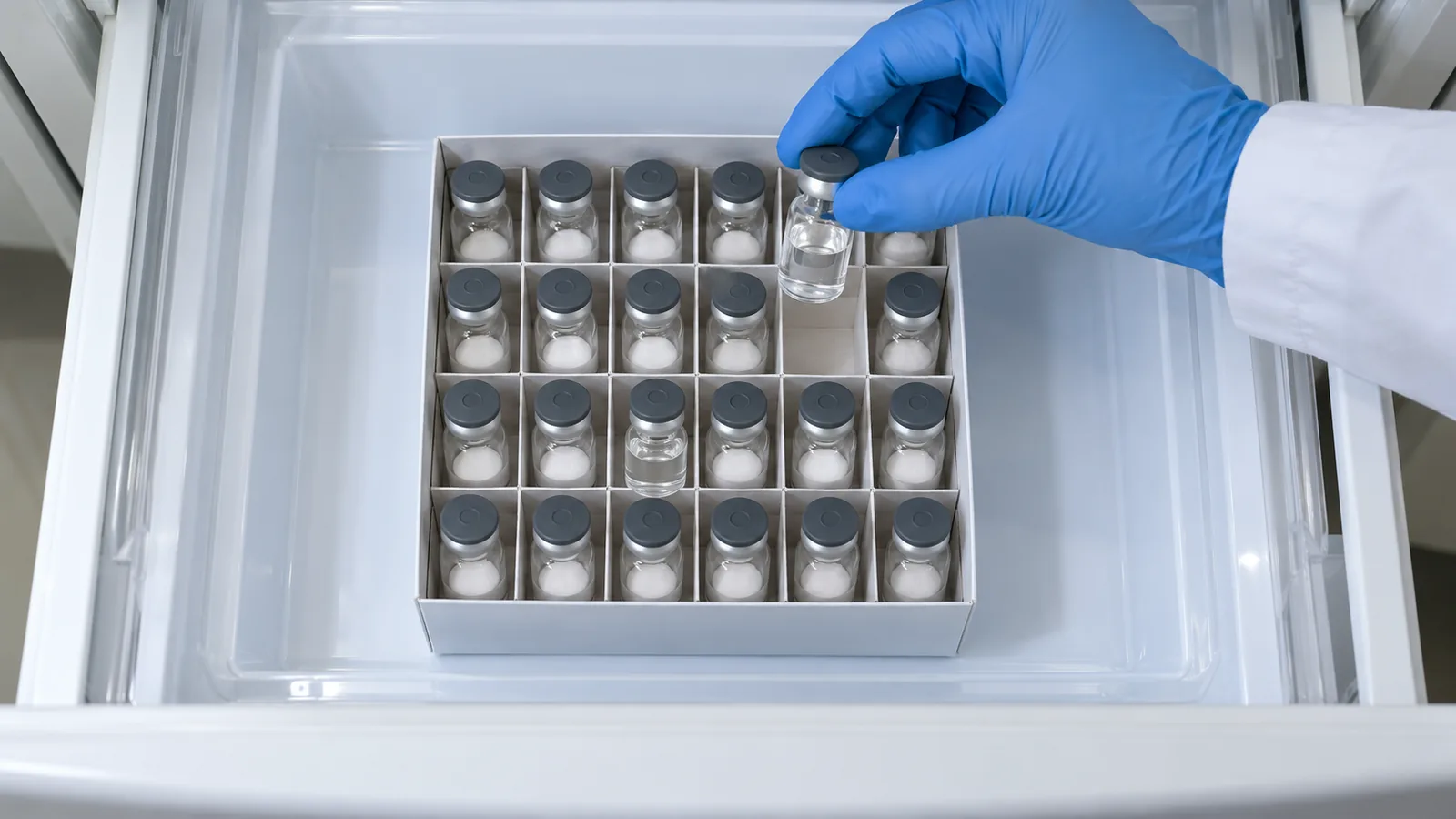
Once mixed, it keeps 28 days refrigerated at 2–8°C (36–46°F). The clock starts on mixing day, not delivery day, and the vial stays out of the light.
Sealed powder ships without ice and waits for its step in the fridge, dry and dark, or at −20°C for long stretches. A mixed vial stays in the fridge in its box, never the freezer: Lilly’s labels say not to use tirzepatide that has frozen. Opened Research Water keeps at room temperature for 28 days.
Day-by-day limits, the prescription pens included, are in How Long Does Tirzepatide Last in the Fridge?, and a vial left out overnight in Do Peptides Need to Be Refrigerated?
Tirzepatide stability: what the data show
The freeze-dried cake is the stable form: with almost no water in it, the peptide rides out transit and keeps for long stretches at −20°C.
Dissolved, it runs on a clock. Lilly’s single-dose pens may go 21 days unrefrigerated, and its buffered four-dose vials, preserved with phenol and benzyl alcohol, get 30 days of use (Zepbound label, FDA, 2026). A research vial in bac water lacks the buffer, so it keeps the colder rule: 28 days at 2–8°C.
Common tirzepatide mixing mistakes
Aiming the water at the powder
A stream onto the cake foams it. Running the water down the glass avoids that.
Shaking instead of rolling
Shaking is the stress that turned liraglutide into fibrils. Rolling dissolves tirzepatide just as fully.
Using too little water
A 60mg vial in 1mL puts 15mg in 25 units, so every unit off the line is 0.6mg.
Carrying the units over to a new vial
50 units is 2.5mg from a 10mg vial with 2mL, but 5mg from a 20mg vial with 2mL. Each vial’s units come from its own strength.
Reusing a syringe
Every mix and every draw gets a new one. A used needle is duller and no longer sterile.
Matching the water to the batch certificate
Labels round. The tirzepatide certificate Simms Research has posted is for batch 2026-TZ295, a 10mg vial that averaged 10.57mg across the three vials tested. Mixed by the label with 2mL, a TZ295 vial gives close to 6% more per draw than its unit count suggests.
To work from the measured amount, type the certificate’s figure into the calculator’s vial field, 10.57 instead of 10, and it returns the units for the vial actually on the bench. To keep 2.5mg at 50 units, add 2.11mL instead of 2mL: two full syringes and 11 units. Until a 20mg, 30mg or 60mg batch is posted, those sizes are mixed by label.
The same certificate, from an independent ISO-certified lab, measured 99.777% purity, confirmed identity by mass spectrometry, passed endotoxin, and found no heavy metals and no microbial growth.
Each certificate opens from the tirzepatide lab results, and net content is one of the lines explained in the guide to reading a peptide certificate of analysis.
Frequently asked questions
How many units is 10mg of tirzepatide?
100 units in a 20mg vial made up with 2mL, 80 in a 30mg vial with 2.4mL and 40 in a 60mg vial with 2.4mL. In a 10mg vial with 2mL it would be the whole vial, 200 units, two full syringes.
How do I reconstitute 50mg of tirzepatide?
The same way as any size, with the water picked for the units: 2mL makes every 2.5mg 10 units, and 4mL makes it 20 units. For a 15mg vial the same pair is 0.6mL and 1.2mL, and for a 40mg vial 1.6mL and 3.2mL. A 5mg vial is simplest with 1mL, which puts 2.5mg at 50 units.
How much bac water for 2.5mg of tirzepatide?
The water follows the vial, not the dose. With the amounts above, 2.5mg is 50 units from a 10mg vial, 25 from a 20mg vial, 20 from a 30mg vial and 10 from a 60mg vial.
Do you add more bac water when the dose goes up?
No. The water goes in once, and the strength it makes holds for the life of the vial, so moving from 2.5mg to 5mg means drawing twice the units. The units only change with a new vial: 5mg is 50 units from a 20mg vial and 40 from a 30mg vial.
How many mL is 100 units of tirzepatide?
1mL. On a U-100 syringe 100 units is always 1mL and 50 units is 0.5mL. The milligrams inside depend on the mix: 100 units is 5mg from a 10mg vial with 2mL, 10mg from a 20mg vial with 2mL and 12.5mg from a 30mg vial with 2.4mL.
Is 10 units 1mg?
Only in a 20mg vial made up with 2mL. In a 10mg vial with 2mL, 10 units is 0.5mg; in a 30mg vial with 2.4mL it is 1.25mg; and in a 60mg vial with 2.4mL it is 2.5mg.
Is 2.5mg equal to 25 units?
In a 20mg vial made up with 2mL, yes. In a 10mg vial it is 50 units with 2mL and 25 with 1mL.
How long does it take to reconstitute tirzepatide?
About five minutes from swab to label, most of it rolling.
What needle gauge is best for reconstituting tirzepatide?
The 29 to 31 gauge needle on an insulin syringe. Thin needles spare the stopper: 22 gauge needles rarely cut rubber loose over 100 punctures, while 18 gauge needles often did (Ponto, Journal of the American Pharmacists Association, 2013).
Do you reconstitute tirzepatide the same as semaglutide?
The technique and the water are the same; the volumes differ. Semaglutide’s ladder runs from 0.25mg to 2.4mg and tirzepatide’s from 2.5mg to 15mg, so tirzepatide is mixed stronger to keep each dose inside one syringe.
Can tirzepatide be mixed with B12 or retatrutide in one vial?
Each is better in its own vial. B12 is deep red and would hide the clarity check, and no testing has been published on tirzepatide and retatrutide sharing a vial. Retatrutide vs tirzepatide covers how the two differ, and How to Reconstitute Retatrutide the other vial.
Is tirzepatide approved?
Lilly’s tirzepatide is approved as Mounjaro and Zepbound. The tirzepatide Simms Research supplies is for laboratory research only.