

Blog
What Size Syringe for Peptides? Insulin Syringes, Needles and Units Explained

The vial comes in the box, and so does the bac water if it was ordered. The syringe almost never does, so the first dose tends to begin at a pharmacy counter or at an online medical-supply store, in front of a row of boxes that look the same.
They differ in four ways that matter: how much the barrel holds, how far apart its lines sit, how thick and long the needle is, and which scale is printed on the side. Three barrel sizes cover every peptide dose. The wrong one turns a 7.5-unit draw into a guess, and a red-capped U-40 syringe from the pet aisle reads every number at two and a half times the volume.
Simms Research publishes a water amount for every vial it sells, so the units of each dose are settled before the syringe is bought. At those amounts most of its catalog is drawn in the smallest barrel, and the rest splits cleanly between the other two.
What size syringe for peptides?
A U-100 insulin syringe in the smallest barrel that holds the whole dose: 0.3mL for draws up to 30 units, 0.5mL up to 50 and 1mL up to 100, on a 29 to 31 gauge needle 6 or 8mm long. On any U-100 barrel one unit is 0.01mL, so a mark means the same volume whichever size it is printed on. What the size changes is the spacing of the lines, and with it how exactly a dose can be read. The 0.3mL and 0.5mL barrels carry a line for every unit, half-unit models of the 0.3mL a line for every half, and the 1mL is marked every 2 units.
Insulin syringes became the standard for three reasons. The needle is fused into the barrel, so almost nothing stays behind in a hub when the plunger bottoms out, which matters when a whole dose is a tenth of a millilitre. The scale is in units, the number every peptide calculator and dosage chart gives. And they sell in boxes of 100 at nearly any pharmacy. A general 3mL syringe, marked every 0.1mL, puts ten units between lines: fine for water, no use for a 5-unit dose.
0.3mL vs 0.5mL vs 1mL insulin syringes
The right barrel holds the largest dose on the schedule with room to spare, and is no bigger than that. A 20-unit draw fits all three. On the 0.3mL barrel it sits two-thirds of the way along a scale with a line at every unit; on the 1mL barrel it sits a fifth of the way along a scale with a line at every second unit.
0.3mL insulin syringe (30 units)
The default for most peptides. Daily draws of 2 to 20 units land on widely spaced lines, and the half-unit versions, which BD and other makers sell for small insulin doses, add a line at 7.5 and 12.5: the in-between numbers that copper blends and strong mixes tend to land on. Its only limit is the 30-unit ceiling, so a dose that grows past it needs the next size.
0.5mL insulin syringe (50 units)
For draws of 31 to 50 units, still with a line at every unit, so 45 reads as cleanly as 5. It fits doses that start in the 20s and climb, such as the first steps of a weekly GLP schedule, and loading doses in the 40s.
1mL insulin syringe (100 units)
For 51 to 100 units, marked every 2 units: 60 and 90 sit on lines, while 45 or 75 fall halfway between two. Filled to 100 it holds exactly 1mL, which is why mixing guides use it to measure water. A dose over 100 units becomes two draws, or the vial is mixed stronger so the same milligrams take fewer units, and the peptide calculator shows both options for any vial.
When the dose rises over the weeks, the barrel follows the step rather than the vial. A schedule that runs from 20 units to 90 is drawn on a 0.5mL syringe early and a 1mL later, so buyers on a climbing dose keep a box of each.
Which syringe for each peptide
For 12 of the 20 peptides and blends Simms Research sells, the usual draws all come to 20 units or less at the water amount it publishes, so a 0.3mL barrel takes the largest with a third of the scale to spare. The 0.5mL barrel covers the middle doses, and the 1mL takes the weekly GLP doses later in a schedule and the two large-cake compounds, NAD+ and glutathione:
| Peptide | Usual draws | Barrel |
|---|---|---|
| BPC-157 10mg | 5 to 20 units | 0.3mL |
| Wolverine Peptide Stack | 5 to 20 units | 0.3mL |
| GHK-Cu 50mg, Glow and Klow | 5 to 10 units, often 7.5 | 0.3mL with half-unit lines |
| KPV, Ipamorelin, CJC-1295 / Ipamorelin | 3 to 10 units | 0.3mL |
| Semax and Selank | 4 to 20 units | 0.3mL |
| Melanotan I and Melanotan II | 2 to 20 units | 0.3mL |
| Epithalon | 10 to 20 units | 0.3mL |
| MOTS-c | 10 to 20 units daily; 50 to 100 for 2.5 to 5mg | 0.3mL, or 1mL for the large doses |
| TB-500 | 10 to 20 units daily; 40 to 50 when loading | 0.3mL, or 0.5mL for loading |
| Tesamorelin 10mg | 20 to 40 units | 0.5mL |
| Retatrutide (GLP-3) 10, 20 or 30mg | 20 to 90 units as the dose steps up | 0.5mL to 40 units, then 1mL |
| Tirzepatide (GLP-2), all four sizes | 40 to 60 units | 0.5mL to 50 units, then 1mL |
| NAD+ 500mg | 50 to 100 units | 1mL |
| Glutathione 1,500mg | 40 to 80 units | 1mL |
The water decides the column, and the column decides the barrel. The same milligrams in twice the water take twice the units, which can push a dose into the next size, while a stronger mix pulls it back: the top retatrutide dose is 120 units from a vial mixed at 10mg per mL, more than one syringe holds, and 60 units from the 60mg vial in 3mL, as the retatrutide dosage chart sets out. The units for any other mix come from the peptide calculator, and the full milligram-to-unit tables by vial and water amount are in Peptide Syringe Units Chart: Convert mg and mcg to U-100 Units.
U-100 vs U-40 syringes
U-100, every time. The number is the strength the syringe was made for: a U-100 barrel reads 100 units to the millilitre, a U-40 barrel 40. U-40 exists for veterinary insulins such as Vetsulin, which is made at 40 IU per mL and comes with instructions to use U-40 syringes only.
A peptide has no strength of its own in units. Every chart, calculator and Simms Research guide counts in U-100 units, where one unit is 0.01mL. On a U-40 barrel one unit is 0.025mL, so a 10-unit dose read off a U-100 chart and drawn on a U-40 syringe is 0.25mL instead of 0.1mL: two and a half times the peptide.
The two look nearly alike in the hand. U-40 syringes usually carry a red needle cap and U-100 an orange one, and the scale is printed on both the box and the barrel. U-40 boxes sit on the shelves of pet pharmacies and farm-supply stores, which is where most mix-ups begin.
What size needle for peptides
29 to 31 gauge, 6 or 8mm long, the range most insulin syringes come in. The needle is part of the syringe, so it is chosen with the box, and every box gives the same three numbers in the same order: barrel, gauge, length, as in 0.3mL, 31G, 6mm.
What gauge needle for peptides
Gauge is thickness, and the scale runs backwards: the higher the number, the thinner the needle. 31G is the thinnest on most insulin syringes, with 30G and 29G a little thicker and stiffer. A mixed peptide is close to water and passes through 31G without effort, so for small draws the choice comes down to comfort and what the pharmacy has. Gauge shows only with the big volumes: a full 1mL draw of NAD+ or glutathione fills noticeably faster through 29G than through 31G.
What length needle for peptides
6mm or 8mm. Insulin syringes are made in 6mm (15/64 inch), 8mm (5/16 inch) and 12.7mm (1/2 inch). The international injection recommendations start from the shortest needle that works and name 6mm as the shortest on a syringe, given at 90 degrees into a lifted pinch of skin (Frid, Mayo Clinic Proceedings, 2016). Nothing in them argues for starting at 12.7mm.
Pen needles run shorter, down to 4mm, and are a separate part: they screw onto a pen and never fit a syringe. They are covered in How to Use a Peptide Injection Pen: Load, Prime and Set the Units.
What size syringe for peptide reconstitution
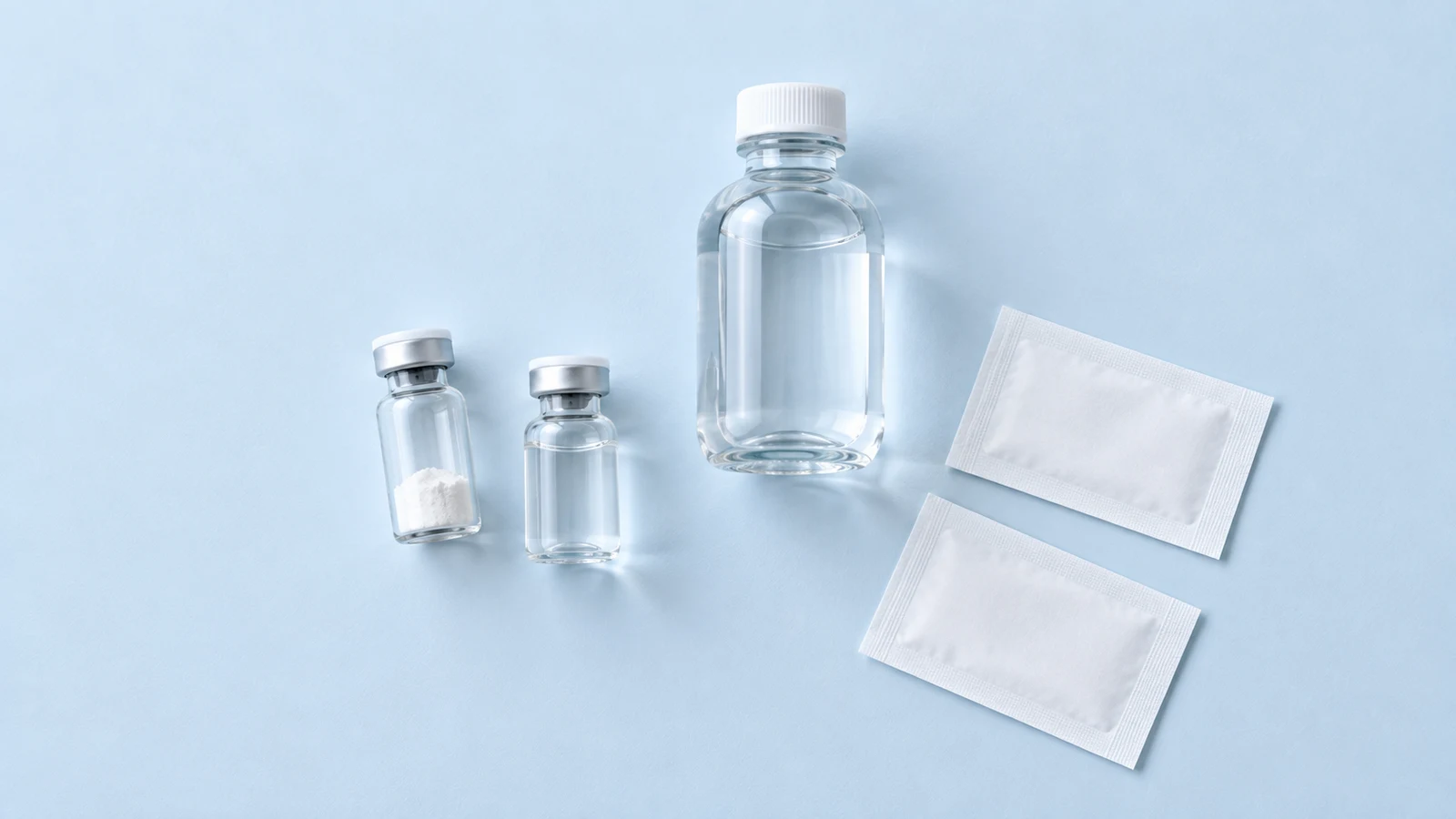
For 1 to 3mL of water, the same 1mL insulin syringe, filled once for each millilitre. For 4mL and more, a 3mL or 5mL syringe with its own needle.
Only five of the 30 vial sizes Simms Research sells take more than 3mL at its published amounts: BPC-157 20mg with 4mL, GHK-Cu 100mg and NAD+ 500mg with 5mL each, glutathione 1,500mg with 6mL and NAD+ 1,000mg with 10mL. Everything else is one to three fills of an insulin syringe, and amounts such as 2.4mL or 2.5mL are two full fills and a third read on the 2-unit lines.
The larger syringes are the general kind, marked every 0.1mL, with a separate twist-on needle; 23G and 25G are the usual pairings, and finer is gentler on a stopper pierced for weeks. The NAD+ injection dosage chart and the glutathione 1500mg reconstitution guide cover those big mixes step by step.
The water syringe is a fresh one every time, because it goes into the water vial that every later mix draws from. Research Water, Simms Research’s bacteriostatic water with 0.9% benzyl alcohol, is $20 for a 10mL vial, and the mixing steps and the full water table are in How to Reconstitute Peptides.
Where to buy insulin syringes for peptides
From a pharmacy counter or an online medical-supply store, by the box of 100, asked for by the three numbers on the label. Pharmacies keep them behind the counter rather than on the shelf. Most states allow the sale without a prescription and each pharmacy sets its own policy, so “U-100 insulin syringes, 0.3mL, 31 gauge, 6mm” gets a quicker answer than a request for peptide syringes. Supply stores and the big marketplaces sell the same boxes by the case, and whatever the source, the box says U-100.
Simms Research doesn’t sell syringes. Its Peptide Injection Pen measures each dose on a dial instead, 1 to 60 units in single clicks, with standard screw-on pen needles; the pen alone is $97, and the $119 Starter Kit adds five cartridges, 50 pen tips and a case. For one compound drawn every day, it takes the place of the box.
Frequently asked questions
Can you reuse an insulin syringe for peptides?
No. Each one is made for a single use: after one pass the point is blunter, its coating thinner and the needle no longer sterile. At one per draw plus one for each mix, a box of 100 covers about four vials drawn 20 times each.
Can you use a tuberculin syringe for peptides?
It measures the same volumes, since its 0.01mL lines match U-100 units one for one. Most come with a detachable needle, though, whose hub keeps a little liquid back, and every dose has to be read in millilitres. An insulin syringe avoids both.
Is Simms Research legit?
Its lab results pages hold batch reports from an independent ISO-certified lab. Weekday orders placed before 5PM Eastern go out from Florida the same day, a box lost or damaged on the way is replaced free, and the support line, 855-592-8507, is staffed Monday to Friday.
Is any syringe brand here paid placement?
No. No brand, shop or link on this page pays Simms Research anything, and there is no discount code attached to it.