

Blog
Retatrutide Not Working? 6 Causes, From the Dose to the Vial


A few weeks into retatrutide, a scale that barely moves raises one question: is the drug failing, or is something else going on? The trials make the drug the least likely suspect. In the Phase 2 obesity trial, every participant on 8mg or 12mg a week had lost at least 5% of their weight by week 48 (Jastreboff, New England Journal of Medicine, 2023).
The people who fell short were on the low doses. Outside a trial, a weak result usually traces to one of six things: too little time, a dose still on the bottom rungs, arithmetic between the vial and the syringe, a vial kept badly after mixing, the slowdown every weight-loss curve reaches, or what was in the vial to begin with. Most can be ruled in or out with a calculator, the fridge and a lab report.
At Simms Research it is sold as Retatrutide (GLP-3), a freeze-dried research powder whose batch certificate anyone can read. How its three receptors split the work is explained in What Is Retatrutide? How the Reta Peptide Works
Does retatrutide work for everyone?
Nearly everyone at the doses that finish the trial schedule, and fewer people below them. The Phase 2 trial counted how many participants crossed each weight-loss mark after 48 weeks on a fixed weekly dose:
| Weekly dose | Lost 5% or more | Lost 10% or more | Lost 15% or more |
|---|---|---|---|
| Placebo | 27% | 9% | 2% |
| 1mg | 64% | 27% | 16% |
| 4mg | 92% | 75% | 60% |
| 8mg | 100% | 91% | 75% |
| 12mg | 100% | 93% | 83% |
Read down the first column. On 1mg, about one participant in three had not reached 5% after a full year, the usual line for a drug that is working. On 4mg it was fewer than one in ten, and from 8mg up, nobody. The placebo row shows what diet and activity counseling did alone; every group had the same advice.
Above that line the spread is wide. Phase 3 showed it at 80 weeks: on 12mg, 62.5% of TRIUMPH-1 participants lost a quarter of their starting weight or more and 27.2% lost 35% or more, which also means more than a third finished below 25% on the very same dose (Lilly, May 21, 2026). Sex and diabetes move people along that spread. On 8mg in Phase 2, women averaged 28.5% and men 19.8%, and type 2 diabetes lowered the 12mg result to 20.8% in TRIUMPH-2. A smaller number than the headline average is often a normal result for that person.
Retatrutide not working after 2 weeks or 4 weeks
At two weeks there is nothing to judge yet. Four weeks gives a first look, and three months gives the verdict.
Each weekly shot stacks on what remains of the last one, so blood levels keep climbing for four to five weeks at the same dose, as the retatrutide half-life page shows. The first month is also spent on 2mg, a rung chosen for the stomach rather than the scale. A normal first month is a few pounds, and the full week-by-week curve is in How Long Does Retatrutide Take to Work?
The yardstick for the verdict comes from obesity medicine: a weight-loss drug counts as working if it has taken off 5% of body weight at three months, and as not working if it hasn’t (Apovian, Journal of Clinical Endocrinology and Metabolism, 2015). On a 220 lb start that is 11 lbs. Three months is week 12, when the trial schedules had only just reached 6mg or 8mg, so a flat scale before then says little.
Why am I gaining weight on retatrutide?
Usually water and a fuller gut, not fat. Salt, a heavy meal or a slower stomach, which is part of how retatrutide works, can put two or three pounds on a morning weigh-in. Weighing at the same hour and comparing four-week averages smooths that out. A tape measure helps too: over the Phase 2 year the waist shrank by 6.5cm on 1mg and up to 19.6cm on 12mg, against 2.6cm on placebo.
Reta not working at 2mg or 4mg
2mg is a starting rung, not a treatment dose, and 4mg works for most people but not all of them.
In the Phase 2 and Phase 3 schedules, 2mg lasts four weeks before the first step up. The lowest dose held for a whole year was 1mg, the weakest row in the table above. At 4mg the Phase 2 results split by how people got there: 87% of those who stepped up from 2mg reached 5% at 48 weeks, against 97% of those who started at 4mg. In TRIUMPH-1, 4mg averaged 19.0% at 80 weeks, yet only 27.8% of that group lost a quarter of their weight, against 62.5% on 12mg.
The trials also show what a higher dose does for someone who has stalled low. In the TRIUMPH-1 extension, people with a BMI of 35 or more who had spent 80 weeks on 4mg were moved up to 9mg or 12mg. By week 104 they were 27.9% below their starting weight, close to the 30.3% of those on 12mg from the start.
The Phase 3 steps run 2, 4, 6, 9 and 12mg, four weeks apart at the least, and 12mg is the top of every trial; the retatrutide dosage chart lays out each step in milligrams and units. Someone holding at 2mg or 4mg because the side effects are mild has room to climb. Someone holding there because each step brought nausea is trading speed for comfort, and the slower result is the expected one.
Is the mix giving the dose you think?
Not always. A dose is a number of milligrams, but a syringe only counts units, and how many milligrams sit in each unit depends on how much water went into that particular vial.
A chart written for a 10mg vial mixed with 1mL puts 2mg at 20 units. Mix the same vial with 2mL and 20 units holds 1mg; with 3mL, about 0.7mg. Following that chart unit for unit leaves the real dose a full step or more below the one on paper, week after week, and it looks exactly like a drug that doesn’t work. Any change of vial size or water needs fresh numbers from the retatrutide calculator.
Retatrutide not dissolving
Freeze-dried retatrutide should vanish into the water within a few minutes of gentle rolling. Powder still clinging under the stopper or on the vial’s shoulder is part of the dose that never reaches the syringe, and a slow roll that bathes those spots brings it in. Haze that stays after a rest is its own problem, covered in Cloudy Peptide After Reconstitution; the full method is in how to reconstitute retatrutide.
Retatrutide stored wrong after mixing
Sealed powder forgives a lot. A mixed vial forgives much less, and it loses strength without looking any different.
Once water goes in, the vial has 28 days in the fridge. A full day on the counter, an afternoon in a hot car or a night frozen against the back wall of the fridge ends it early, and a vial past day 28 is done however clear it looks. The detail for each case is in How Long Does Retatrutide Last in the Fridge?
When a vial is in doubt, a fresh one settles it. Mix a new vial, keep the same dose, and compare: if the old vial had gone weak, the difference usually shows in appetite within a week or two, well before the scale.
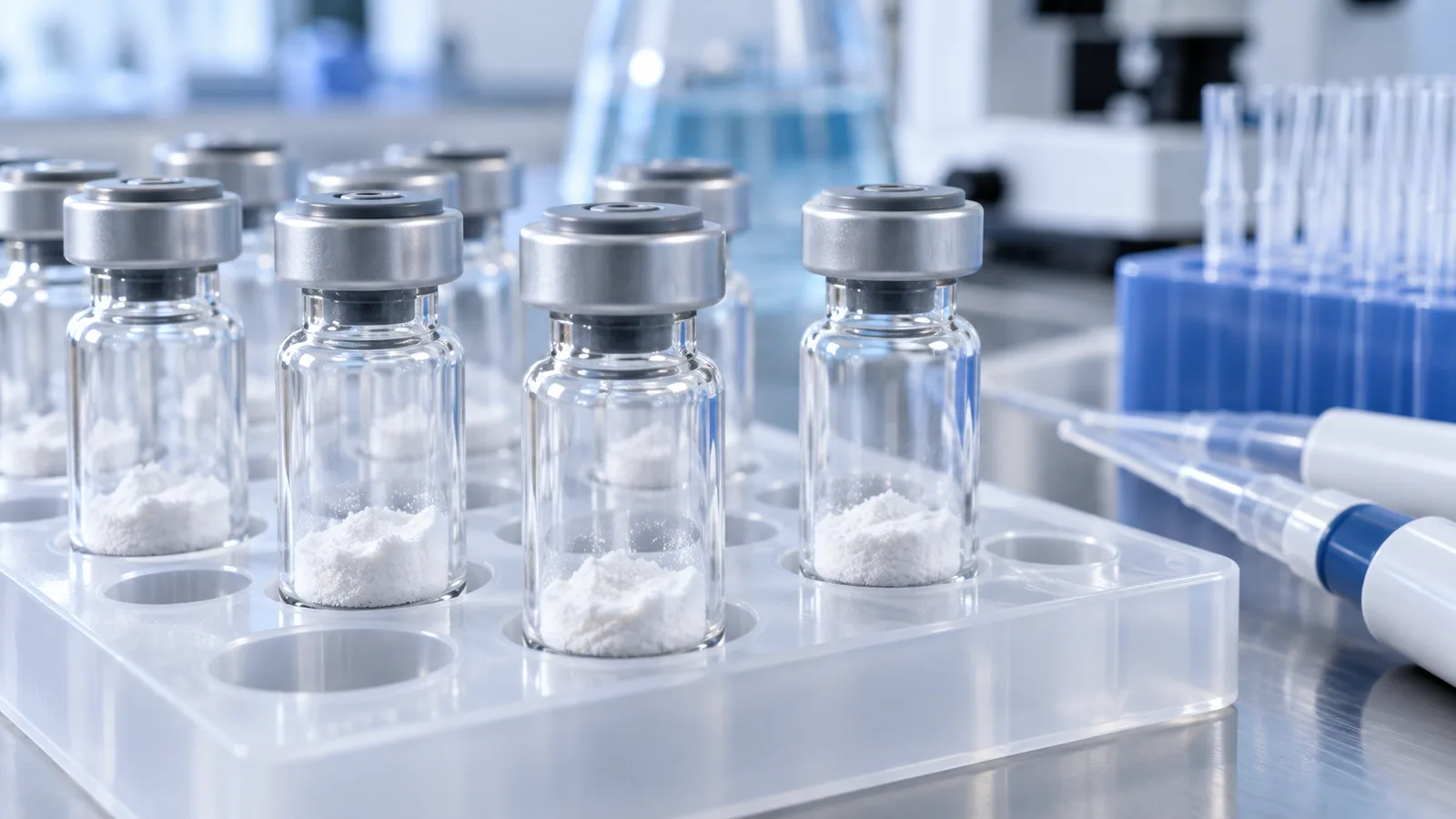
Is it real retatrutide? Reading the lab report
The batch certificate answers it, as long as the certificate belongs to the vial in hand.
Four lines matter for a vial that seems to do nothing. Identity, usually by mass spectrometry (LC-MS), confirms the peptide is retatrutide and not something cheaper. Net content gives the real milligrams: a vial labelled 10mg that holds 7mg turns every 4mg dose into 2.8mg, nearer the starting rung than the dose on the chart. Purity, by HPLC, is the share of the powder that is the peptide. The batch number and test date tie the paper to the vial, and a certificate for another batch describes another vial.
Simms Research posts its retatrutide certificate from an independent ISO-certified lab. The current batch, tested on July 16, 2026, measured 99.611% purity across three 10mg vials and an average of 10.68mg of retatrutide per vial, with identity confirmed by RP-HPLC and LC-MS, endotoxins passed, heavy metals negative and no microbial growth. Every field is on the retatrutide lab results page, and How to Read a Peptide Certificate of Analysis explains them.
Retatrutide not suppressing appetite
Weight can keep falling while hunger feels only a little quieter, because part of retatrutide’s effect runs through energy use rather than appetite.
Its glucagon arm raises the energy the body spends and draws fat out of the liver, which a drug acting on GLP-1 alone doesn’t do. The appetite effect itself grows with the dose, so a lively appetite on 2mg is normal, and some people feel hunger creep back late in the week as levels dip before the next shot. Calories that need no hunger to get in, sweet drinks and alcohol above all, are the usual leak, and retatrutide and alcohol covers the drinking side.
Retatrutide not working as well as tirzepatide
On the bottom rungs it isn’t meant to. Someone moving from tirzepatide 10mg or 15mg onto the 2mg retatrutide starter is stepping down for the first month or two, and appetite often returns until the dose climbs. In separate trials, tirzepatide 15mg averaged 22.5% at 72 weeks (Jastreboff, New England Journal of Medicine, 2022), while retatrutide 4mg averaged 19.0% at 80 weeks and 9mg 25.9%. Where to start after tirzepatide is covered in switching from tirzepatide to retatrutide.

Retatrutide stopped working after months
A slowdown after several good months is the curve doing what every weight-loss curve does, not the body wearing the drug out.
As weight comes off, a smaller body burns less and hunger pushes back, so each month adds a little less until weight settles at a new level for that dose. That level sits lower the higher the dose, which is why a stall on 4mg and a stall on 12mg mean different things. Some people do make antibodies to retatrutide, 18% of the 12mg group in Phase 2, yet every one of that group still lost at least 5%, so the trial data hold no sign of antibodies switching it off.
When the scale stops after steady losses, look first at what changed: a new vial, new water, a vial past day 28. If nothing did and the dose is below 12mg, the next step is the move the TRIUMPH-1 extension made. At 12mg after a year or more, the plateau is the result.
So why is retatrutide not working?
Most often because it hasn’t had long enough at a high enough dose. The misses in the trials sat on the low doses.
Run the checks in order. Under three months, give it time and go by four-week averages and the waist. On 2mg or 4mg, the dose has room to climb. If the units came from a chart built for other water, redo them. If the mixed vial is past day 28 or spent time warm or frozen, mix a fresh one. If none of that explains it, read the batch certificate: identity, net content, batch number.
For research, Retatrutide (GLP-3) from Simms Research runs from $8.40 per mg in the 10mg vial down to $4.32 per mg in the 60mg.
Frequently asked questions
Is GLP-3 not working the same as retatrutide not working?
Yes. GLP-3 is the name research suppliers give retatrutide, so every check above applies. Where the label comes from is in What Is GLP-3 (Retatrutide)?
Can you take more than 12mg of retatrutide?
12mg a week is the highest dose in every Phase 2 and Phase 3 trial, and there is no weight data above it. The trials never went past it; their longest runs kept people on 12mg and added time.
Is Simms Research legit?
Simms Research ships from Florida, and a business-day order in by 5PM Eastern leaves that day. A parcel lost or stolen after a delivery scan, or arriving damaged, is replaced under the Free Delivery Guarantee with no carrier claim. The retatrutide certificate is public, and support takes calls on 855-592-8507 and email at support@simmsresearch.com on weekdays, 9AM to 5PM Eastern.
Does this article use affiliate links or codes?
No. Nothing here pays a commission, and the prices quoted are regular ones.