

Blog
The Essential Wolverine Stack Dosage Guide (2026)
Wolverine stack dosing for the 20mg BPC-157 and TB-500 vial: units at 2mL and 4mL, the 1:1 vial against the loading schedule, the 28-day window, which TB-500 is in the vial, and the published human doses.

What is the Wolverine stack?
The Wolverine stack is BPC-157 and TB-500 used together. BPC-157 is a 15-amino-acid peptide taken from a protein in human gastric juice. TB-500 is a seven-amino-acid peptide copied from the stretch of thymosin beta-4 that binds actin, the protein cells use to move and rebuild. The name borrows the comic-book character’s fast healing, and it stuck because these are the two most studied peptides in tissue-repair research.
The stack comes two ways: two separate vials on their own schedules, or one pre-mixed vial. Simms Research sells the pre-mixed version, the Wolverine Peptide Stack, as 10mg of BPC-157 and 10mg of TB-500 in one 20mg vial, and sells BPC-157 and TB-500 on their own as well.
This guide gives the units for every common draw from the 20mg vial, the water choices, how the fixed 1:1 ratio compares with the classic two-vial schedule, which molecule TB-500 actually is and what that does to the milligram figures, how many days a vial covers, the published human doses, and what Simms Research’s certificates measured.
Wolverine stack dosage chart
Research protocols for the pre-mixed vial draw 250 to 500mcg of each peptide a day, 0.5 to 1mg of blend in total, and some go as high as 1mg of each. With a 1:1 ratio every draw holds the same amount of both. The chart gives each draw in units on a U-100 insulin syringe for the two cleanest mixes of the 20mg vial:
| BPC-157 and TB-500 per draw | Total blend | 20mg vial with 2mL | 20mg vial with 4mL | Each peptide per week, daily |
|---|---|---|---|---|
| 250mcg each | 0.5mg | 5 units (0.05mL) | 10 units (0.10mL) | 1.75mg |
| 500mcg each | 1mg | 10 units (0.10mL) | 20 units (0.20mL) | 3.5mg |
| 750mcg each | 1.5mg | 15 units (0.15mL) | 30 units (0.30mL) | 5.25mg |
| 1mg each | 2mg | 20 units (0.20mL) | 40 units (0.40mL) | 7mg |
The 2mL mix reads in fives: every 5 units is 250mcg of each peptide. The 4mL mix doubles every count, which turns the 250mcg draw into a clean 10 units instead of a hard-to-read 5, and a 500mcg draw still fits a 0.3mL syringe.
How much bacteriostatic water for a 20mg Wolverine vial
Water sets the strength and nothing else; the vial holds the same 20mg whatever goes in. In a 1:1 vial each peptide is half of that, so 2mL makes 5mg per mL of BPC-157 and 5mg per mL of TB-500. A U-100 syringe marks 100 units to the milliliter: divide the milligrams wanted by the strength and move the decimal two places, so 0.5mg at 5mg per mL is 0.1mL, or 10 units.
| Vial | Water added | Each peptide per mL | 250mcg of each | 500mcg of each |
|---|---|---|---|---|
| 20mg | 2mL | 5mg | 5 units | 10 units |
| 20mg | 3mL | 3.33mg | 7.5 units | 15 units |
| 20mg | 4mL | 2.5mg | 10 units | 20 units |
| 20mg | 5mL | 2mg | 12.5 units | 25 units |
| 10mg (5mg of each) | 1mL | 5mg | 5 units | 10 units |
| 10mg (5mg of each) | 2mL | 2.5mg | 10 units | 20 units |
A 10mg vial with half the water has exactly the strength of the 20mg vial, so the unit counts carry over and the 20mg vial simply holds twice the draws. Other vial sizes and water volumes follow the same steps, and the peptide calculator on the Simms Research site converts any of them.
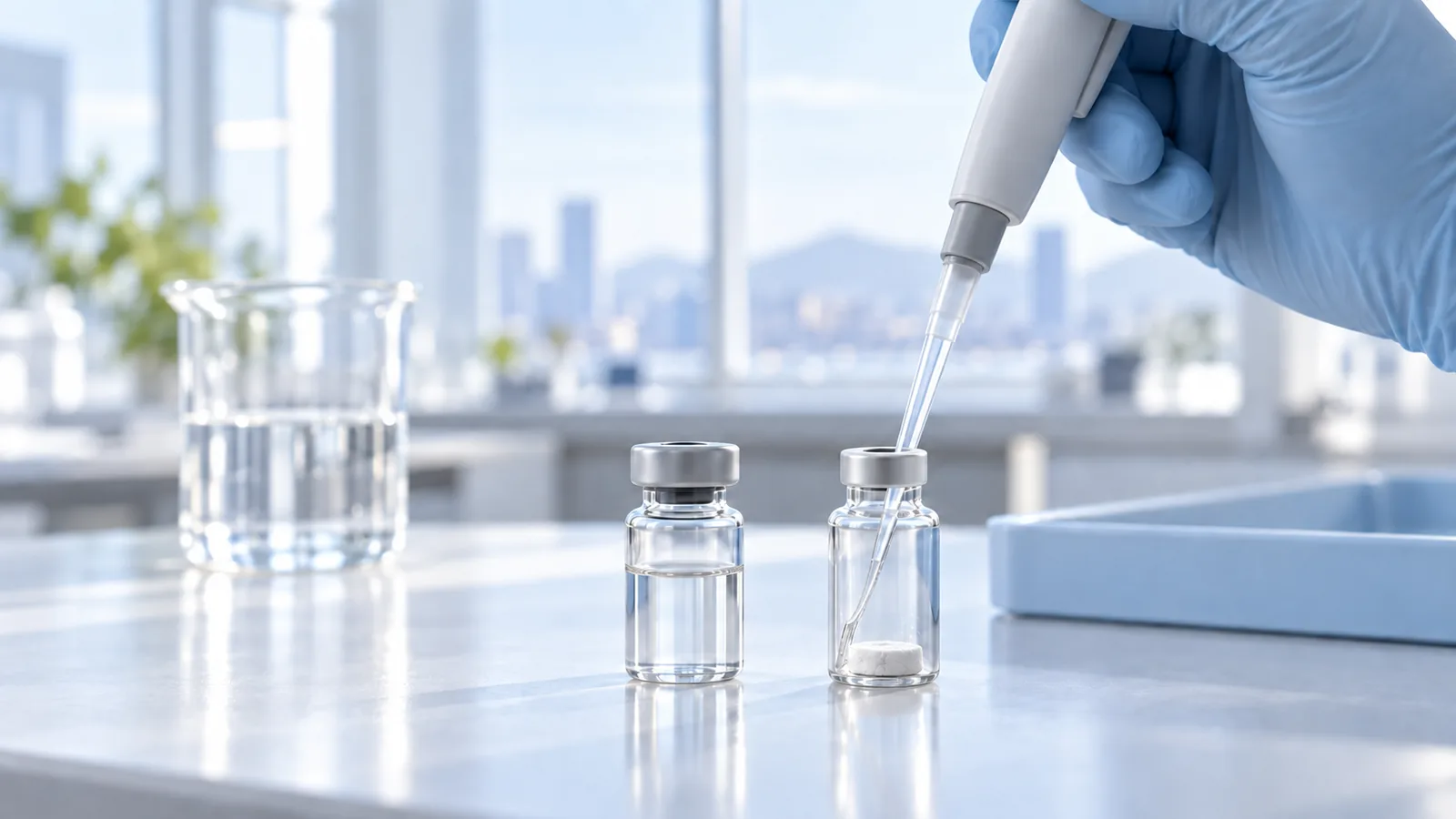
The powder is white and dissolves clear and colorless. Let the water slide down the glass wall instead of landing on the cake, then roll the vial gently until no flecks remain; shaking isn’t needed. Once mixed, the vial lives in the refrigerator, 36–46°F (2–8°C). One 10mL vial of Simms Research bacteriostatic water covers five 2mL mixes or two 4mL mixes, and Do Peptides Need to Be Refrigerated? sets out how the powder and the mixed vial should each be kept.
One vial against the two-vial schedule
The classic Wolverine protocol runs the two peptides from separate vials: BPC-157 at 250 to 500mcg once or twice a day, and TB-500 at 2 to 2.5mg twice a week for the first four to six weeks, a loading phase, then once a week. A pre-mixed vial can’t split them that way. Whatever amount of BPC-157 a draw holds, it holds the same amount of TB-500, on the same days. The weekly totals are where the two approaches line up:
| Schedule | BPC-157 per week | TB-500 per week |
|---|---|---|
| Separate vials, loading phase | 1.75–3.5mg (250–500mcg daily) | 4–5mg (2–2.5mg twice a week) |
| Separate vials, maintenance | 1.75–3.5mg (250–500mcg daily) | 2–2.5mg (once a week) |
| Wolverine, 250mcg of each daily | 1.75mg | 1.75mg |
| Wolverine, 500mcg of each five days a week | 2.5mg | 2.5mg |
| Wolverine, 500mcg of each daily | 3.5mg | 3.5mg |
| Wolverine, 750mcg of each daily | 5.25mg | 5.25mg |
Daily draws spread TB-500 evenly across the week instead of in two large doses. At 500mcg of each five days a week, weekly TB-500 matches the maintenance total, and at 500mcg daily it sits between maintenance and loading. Reaching the full loading total from the vial alone takes 750mcg of each a day, which puts BPC-157 above its usual range. Protocols that want loading-level TB-500 with BPC-157 at 500mcg add a standalone TB-500 vial: 500mcg of each daily from the Wolverine vial plus 1mg of TB-500 once a week comes to 4.5mg.
Those two-vial figures carry an assumption of their own: that 2mg of TB-500 means the same amount of peptide wherever the number is quoted. It doesn’t.
Which TB-500 is in the vial
TB-500 is not thymosin beta-4. Thymosin beta-4 is a 43-amino-acid protein found in almost every human cell, with a molecular weight of 4,963. TB-500 is seven of those amino acids, Leu-Lys-Lys-Thr-Glu-Thr-Gln, positions 17 to 23, made synthetically with an acetyl group on the front, and it weighs 889. The Hong Kong Jockey Club’s racing laboratory, which built the drug test for it in horses, described the veterinary product the same way: its key ingredient is N-acetylated LKKTETQ, and one horse dose held 10mg.
The mass spectrometry on Simms Research’s Wolverine certificates shows which one is in their vial. TB-500 appears at 445.10 as a doubly charged ion, a molecular mass of about 888: the seven-amino-acid peptide. Full-length thymosin beta-4 would appear near 4,963. Weight for weight, the two are very different amounts of molecule:
| TB-500 (Ac-LKKTETQ) | Thymosin beta-4 | |
|---|---|---|
| Amino acids | 7 | 43 |
| Molecular weight | 889.0 | 4,963 |
| Actin-binding sites per molecule | 1 | 1 |
| Molecules in 1mg | 1,125 nanomoles | 201 nanomoles |
| Same molecule count as 2.5mg of thymosin beta-4 | 0.45mg | 2.5mg |
| Published human trials | None | Intravenous Phase 1 up to 1,260mg a day; topical Phase 2 |
By molecule count, 1mg of TB-500 equals about 5.6mg of thymosin beta-4. Each carries one actin-binding site, and in a 2003 National Institutes of Health study the seven-amino-acid peptide on its own promoted wound repair in aged mice comparably to the full protein.
No published study sets the 2 to 2.5mg twice-weekly figure for either molecule. If it traces back to full thymosin beta-4, the same number of molecules of TB-500 weighs 0.45mg, less than a single 500mcg draw from the Wolverine vial. Every Wolverine figure in this guide is the seven-amino-acid peptide, weighed as it sits in the vial.
How long a 20mg Wolverine vial lasts
Once water goes in, Simms Research’s storage guidance allows 28 days in the refrigerator. How much of that window a 20mg vial fills depends on the draw and how often it is taken:
| Draw | Once a day | Five days a week | Twice a day |
|---|---|---|---|
| 250mcg of each | 40 days | 56 days | 20 days |
| 500mcg of each | 20 days | 28 days | 10 days |
| 750mcg of each | 13 days | about 19 days | about 7 days |
| 1mg of each | 10 days | 14 days | 5 days |
500mcg of each, five days a week, empties the vial in exactly 28 days, one vial per four-week block. The 250mcg draw is the one that outlasts the window: once a day it would run 40 days, so a vial mixed for it still holds 12 days of blend when its 28 days are up. The same 250mcg taken twice a day finishes the vial in 20. Across a whole protocol, the vial count follows from the same numbers:
| Protocol | 250mcg of each daily | 500mcg of each, five days a week | 500mcg of each daily |
|---|---|---|---|
| 4 weeks | 1 vial | 1 vial | 2 vials |
| 6 weeks | 2 vials | 2 vials | 3 vials |
| 8 weeks | 2 vials | 2 vials | 3 vials |
| 12 weeks | 3 vials | 3 vials | 5 vials |
Where the BPC-157 numbers come from
The 250 to 500mcg range has no clinical trial behind it; it is a translation of animal work. The rat studies that built BPC-157’s reputation, most from Predrag Sikiric’s group in Zagreb, typically injected it once a day at 10 micrograms per kilogram, often alongside 10 nanogram and 10 picogram per kilogram groups. In a 2006 quadriceps transection study, BPC-157 at those doses improved healing throughout the 72 days.
Scaling 10mcg/kg to a person depends on the method. The body-surface-area conversion the FDA uses to set first human doses divides a rat dose by about 6.2, giving 1.6mcg/kg, or about 113mcg for a 70kg adult. Scaling by body weight alone gives 700mcg. The 250 to 500mcg research range sits between the two.
A short half-life explains the daily rhythm. A 2022 pharmacokinetic study in rats and beagle dogs measured a half-life under 30 minutes, with BPC-157 broken down into its amino acids, and found 14–19% of an intramuscular dose reaching the blood in rats against 45–51% in dogs.
What the human studies used
Human data on BPC-157 is three small reports, all with the same lead author, and all three are below. Thymosin beta-4 has a longer record of formal trials; the two below give its injected and topical doses:
| Study | Who took part | What was given | What was reported |
|---|---|---|---|
| Knee pain review, 2021 | 12 patients | BPC-157 4mg, one injection into the knee | 11 of 12 reported significant improvement |
| Same review, combined | 4 patients | BPC-157 2–4mg with thymosin beta-4 3–6mg, one injection into the knee | 3 of 4 improved |
| Interstitial cystitis pilot, 2024 | 12 women aged 39 to 76 | BPC-157 10mg in total, injected around the inflamed bladder wall in one procedure | 10 reported complete resolution and 2 reported 80%; no adverse events |
| Intravenous safety pilot, 2025 | 2 adults, aged 58 and 68 | BPC-157 10mg, then 20mg the next day, each infused over an hour | No change in heart, liver, kidney, thyroid or glucose markers; no side effects |
| Intravenous thymosin beta-4, 2010 | 40 healthy volunteers in four dose groups | 42, 140, 420 or 1,260mg a day for 14 days, or placebo | No dose-limiting toxicity or serious adverse events; side effects infrequent and mild to moderate |
| Thymosin beta-4 gel on venous ulcers, 2010 | 73 patients at eight European sites | Topical gel at escalating strengths, or placebo | Safety comparable to placebo; the 0.03% gel showed faster healing |
The knee review is the only published human use of BPC-157 and thymosin beta-4 together, and it gave both as a single injection into the joint rather than daily under the skin. The intravenous thymosin beta-4 trial’s lowest dose, 42mg a day, is the same number of molecules as about 7.5mg of TB-500, more than a week of TB-500 at 1mg a day, the top of the chart, and it was given every day for two weeks.
Frequency, timing and injection site
Research protocols run the Wolverine vial once a day, five to seven days a week, sometimes split into two draws. Nothing in either peptide ties the dose to food or a time of day, so the choice between morning and evening is simply whichever time can be kept every day.
Injection site is the other recurring question. Some protocols place BPC-157 under the skin close to the injury. The rat studies behind it didn’t: they injected into the abdominal cavity, away from the transected muscle, and the muscle still healed. A standard subcutaneous site, such as the abdomen, takes both peptides into circulation.
Protocols usually run six to twelve weeks. The human reports followed single treatments for much longer: in the knee review, 7 of 12 given BPC-157 alone and 2 of 4 given both peptides reported relief lasting six months to a year.
Wolverine, Glow and Klow side by side
Simms Research carries the same 10mg of BPC-157 and 10mg of TB-500 in three vials. Glow Peptide Blend adds 50mg of GHK-Cu, and Klow Peptide Blend adds 50mg of GHK-Cu and 10mg of KPV. The difference is which peptide sets the dose:
| Vial | What the vial holds | A 500mcg BPC-157 draw also holds |
|---|---|---|
| Wolverine | BPC-157 10mg, TB-500 10mg | 500mcg of TB-500 |
| Glow | BPC-157 10mg, TB-500 10mg, GHK-Cu 50mg | 500mcg of TB-500, 2.5mg of GHK-Cu |
| Klow | BPC-157 10mg, TB-500 10mg, GHK-Cu 50mg, KPV 10mg | 500mcg of TB-500, 2.5mg of GHK-Cu, 500mcg of KPV |
In Glow and Klow the dose is set by GHK-Cu, which research protocols keep at 1 to 2mg a day, so BPC-157 and TB-500 top out at 400mcg each per draw. The Wolverine vial has no third peptide to cap it. The GHK-Cu dosage guide covers the Glow and Klow unit math.
What the Wolverine certificates measured
Every unit count above assumes the vial holds exactly what the label says, in exactly a 1:1 split. Simms Research’s published Wolverine certificates cover two batches of their earlier 10mg vial, 5mg of each peptide, and each reports the two peptides separately:
| Batch | BPC-157 measured | TB-500 measured | Purity | A 500mcg-each draw really held |
|---|---|---|---|---|
| BT193, April 14, 2026 | 7.08mg | 5.11mg | 99.71% | 708mcg BPC-157, 511mcg TB-500 |
| BT324, January 19, 2026 | 6.94mg | 4.78mg | 99.91% | 694mcg BPC-157, 478mcg TB-500 |
TB-500 measured within 5% of its 5mg label in both batches. BPC-157 ran 39% and 42% over, so the real ratio in those vials was about 1.4 to 1, and a draw worked out from the label held the TB-500 it was meant to plus about 40% more BPC-157. The same correction works on any certificate: take each peptide’s measured milligrams, divide by the milliliters of water, and use that strength for its units.
Both batches were run by HPLC with UV detection and confirmed by mass spectrometry, BPC-157 at 710.25 (a molecular mass of about 1,418) and TB-500 at 445.10 (about 888), and BT193 passed two endotoxin replicates. Both certificates open in full on the Wolverine lab results page, and How to Read a Peptide Certificate of Analysis walks through what every field on them means.
Frequently asked questions
Is the Wolverine stack taken daily or weekly?
From one pre-mixed vial, daily, five to seven days a week. The twice-weekly and weekly TB-500 schedule belongs to protocols that run TB-500 from its own vial.
How many units of Wolverine is 500mcg?
10 units in a 20mg vial mixed with 2mL of water, or 20 units with 4mL. Either draw holds 500mcg of BPC-157 and 500mcg of TB-500.
How much bac water does a 20mg Wolverine vial need?
2mL for 5mg per mL of each peptide, where every 5 units is 250mcg of each. 4mL halves the strength and doubles every unit count, which makes small draws easier to measure.
How long does a 20mg Wolverine vial last?
20 days at 500mcg of each daily, 28 days at that amount five days a week, and 40 days at 250mcg of each daily, which runs past the 28 days a mixed vial keeps.
What is the difference between a 10mg and a 20mg Wolverine vial?
Only the amount. Both are 1:1. A 10mg vial with 1mL of water has the same strength as a 20mg vial with 2mL, and the 20mg vial holds twice as many draws.
Is TB-500 the same as thymosin beta-4?
No. TB-500 is the seven-amino-acid actin-binding stretch of thymosin beta-4, with a molecular weight of 889 against 4,963. By molecule count, 1mg of TB-500 equals about 5.6mg of thymosin beta-4.
Does the Wolverine stack have to be injected near the injury?
No study requires it. In the rat studies BPC-157 was injected into the abdominal cavity, away from the injury, and still worked.
Is the Wolverine stack dosed by body weight?
Protocols use fixed amounts. The weight-based figure is the rat dose, 10mcg per kilogram, which scales to between about 113 and 700mcg for a 70kg adult depending on the method.
Is the Wolverine peptide approved?
Not as a drug. Simms Research sells the Wolverine Peptide Stack for laboratory research use only.