

Blog
Glow vs Klow Peptide Blend: Which to Choose?

Klow is Glow with one more peptide. Both vials share a base of GHK-Cu (50mg), BPC-157 (10mg) and TB-500 (10mg), and Klow adds 10mg of KPV, an anti-inflammatory fragment of alpha-MSH, for $26 more. The choice comes down to one question: does the research need KPV’s work on inflammation, infection and damaged barrier tissue?
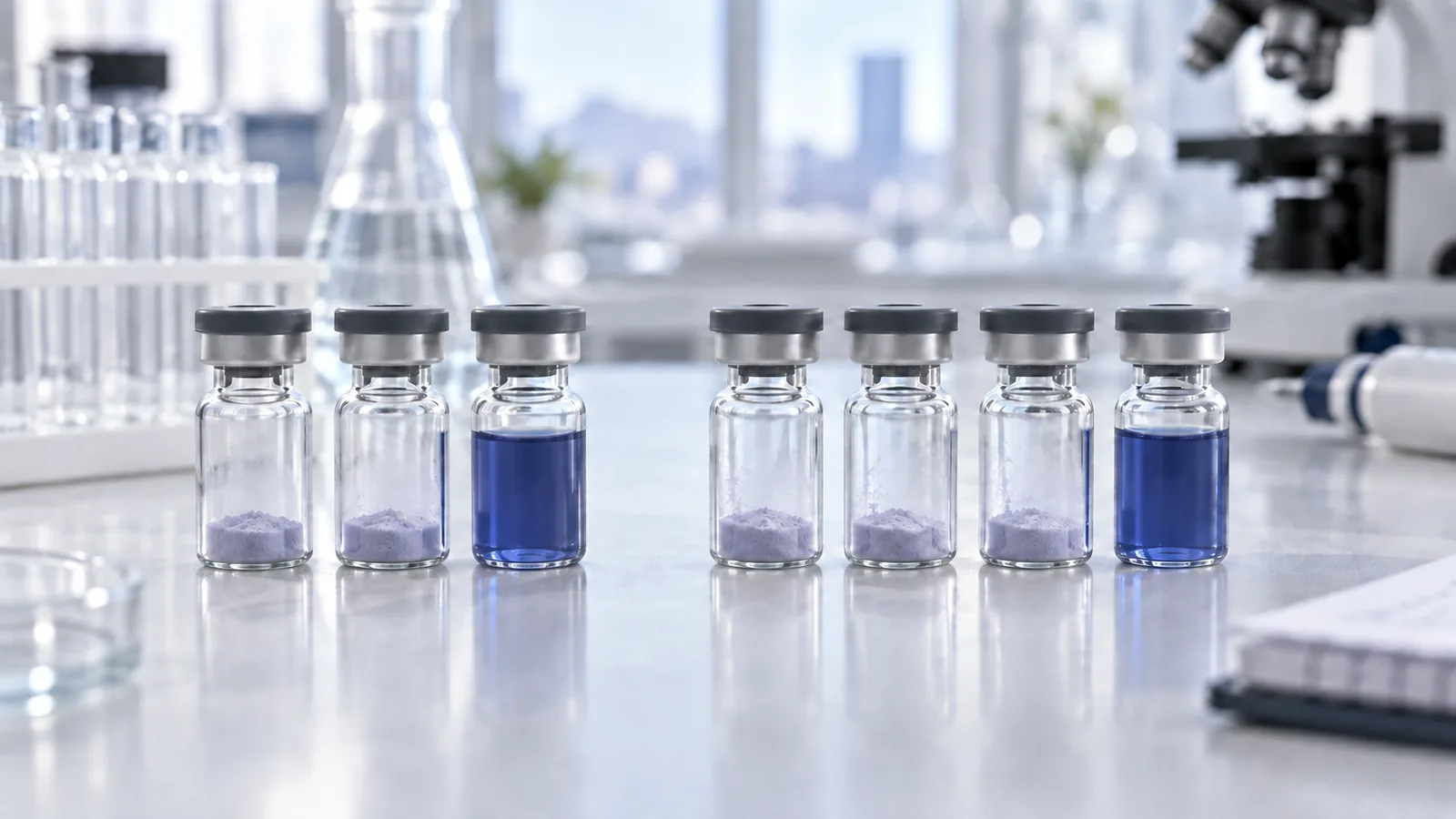
Simms Research sells both, the Glow Peptide Blend at $96 for 70mg and the Klow Peptide Blend at $122 for 80mg. Both powders are blue from the copper in GHK-Cu, and once mixed the two look the same in the vial.
What Is the Glow Peptide Blend?
Glow is a three-peptide research blend in one 70mg freeze-dried vial, five parts GHK-Cu to one part each of BPC-157 and TB-500. Each is studied for repair by a different route. GHK-Cu fills five-sevenths of the vial and sets the dose, and the other two follow at a fifth of its amount.
How Each Glow Peptide Works
BPC-157, fifteen amino acids long, is copied from part of a protective protein in stomach juice. Its research centres on tendon, ligament and gut healing and on new blood-vessel growth. After rats’ Achilles tendons were transected, daily injections raised the tendon’s load to failure, improved walking and restored full tendon integrity within 14 days (Staresinic, Journal of Orthopaedic Research, 2003).
TB-500 is a lab-made copy of the actin-binding stretch of thymosin beta-4. Cells crawl on actin, so TB-500 is studied for moving repair cells into an injury. In rats with full-thickness skin wounds, thymosin beta-4 sped resurfacing by 42% on day 4 and up to 61% on day 7, with more collagen and new vessels (Malinda, Journal of Investigative Dermatology, 1999).
GHK-Cu is a three-amino-acid peptide that carries copper and occurs naturally in human blood plasma. In fibroblast cultures it raised collagen production starting at picomolar amounts (Maquart, FEBS Letters, 1988), and gene work credits it with shifting the activity of at least 4,000 human genes (Pickart, BioMed Research International, 2015). Both blends’ skin, collagen and hair research rests on it.
What Is the Klow Peptide Blend?
Klow is Glow plus KPV: the same base of GHK-Cu, BPC-157 and TB-500 at 50, 10 and 10mg, with 10mg of KPV added for 80mg in the vial, at $122.
What KPV Does in Klow
KPV works on something the other three don’t. It is lysine-proline-valine, the last three amino acids of alpha-melanocyte-stimulating hormone (alpha-MSH). The full hormone is 13 amino acids long, SYSMEHFRWGKPV, and does two jobs: it calms inflammation, and it darkens skin through the melanocortin-1 receptor. The part that switches on pigment, His-Phe-Arg-Trp, sits at positions 6 to 9. KPV is positions 11 to 13, and keeps the hormone’s anti-inflammatory effect without its pigmentary action.
Glow vs Klow: Side-by-Side Comparison
The one difference inside the vial is the 10mg of KPV, and every other line that differs follows from it:
| Glow | Klow | |
|---|---|---|
| Peptides | GHK-Cu, BPC-157, TB-500 | GHK-Cu, BPC-157, TB-500, KPV |
| Vial total | 70mg | 80mg |
| GHK-Cu, BPC-157, TB-500 | 50mg, 10mg, 10mg | 50mg, 10mg, 10mg |
| KPV | None | 10mg |
| Price | $96 | $122 |
| Cost per day at 2mg GHK-Cu | $3.84 | $4.88 |
| Inflammation research | GHK-Cu | GHK-Cu plus KPV |
| Gut research | BPC-157 | BPC-157 plus KPV |
| Antimicrobial research | Not a focus | KPV: S. aureus, Candida |
| Skin and hair | Same 50mg GHK-Cu | Same 50mg GHK-Cu |
| Mixed vial keeps | 28 days at 2–8°C | 28 days at 2–8°C |
| Best fit | Repair, collagen, skin, hair | Repair with inflammation or infection |
Everything Glow delivers, Klow delivers in the same amount. A dose holding 2mg of GHK-Cu carries 400mcg of BPC-157 and 400mcg of TB-500 from either vial, mixed with the same water and drawn to the same unit mark. Storage, how long a mixed vial lasts and the brief sting GHK-Cu can cause match as well. Klow takes nothing away. It puts 400mcg of KPV on top of that dose, so the choice between the two blends is a choice about KPV.
The Key Difference: What KPV Adds to Klow
Glow’s three peptides are studied mainly for building tissue back: collagen, blood vessels, tendon and migrating repair cells. KPV is studied for turning the inflammatory signal down and for infection, which gives Klow three kinds of activity Glow lacks.
1. NF-κB Inhibition
Its mechanism is its own. A 2008 Gastroenterology study found KPV is carried into gut and immune cells by PepT1, a transporter for small peptides that the colon switches on during inflammation. Inside, nanomolar amounts blocked NF-κB and MAP kinase signalling, two of the main switches for inflammatory cytokines. In mice lacking a functional melanocortin-1 receptor, KPV still protected against colitis, so it doesn’t depend on the receptor behind tanning.
2. Gut Barrier Repair
BPC-157 is studied for protecting the stomach and gut lining. KPV works on the inflamed colon itself. In mice with DSS or T-cell transfer colitis, treated animals recovered sooner, regained weight and had fewer inflammatory cells in the colon (Kannengiesser, Inflammatory Bowel Diseases, 2008). Oral KPV nanoparticles sped mucosal healing and lowered TNF-α in mice with colitis (Xiao, Molecular Therapy, 2017), and a rectal KPV gel restored the colon’s epithelial barrier in rats (Zhao, Acta Biomaterialia, 2022).
3. Antimicrobial Activity
KPV also acts on microbes directly. In culture it cut Staphylococcus aureus colony formation and reduced the viability and germ-tube formation of the yeast Candida albicans, at amounts down to the picomolar range (Cutuli, Journal of Leukocyte Biology, 2000). In rats with chemotherapy-damaged gums, a KPV hydrogel improved healing and weight recovery, lowered IL-1β and TNF-α, and held back MRSA in infected ulcers (Shao, Biomaterials Science, 2021).
Published Research on Glow and Klow
Neither blend has been tested as a whole, so the evidence comes from each peptide’s own studies, mostly in rodents. One rat study tested two of the shared peptides alone and together after Achilles tendon repair. Both improved the tendon’s structure, only TB-500 raised its breaking strength significantly, and giving both added nothing over a single peptide (Biçer, Joint Diseases and Related Surgery, 2026).
KPV’s record reaches beyond the gut. In rabbits with the corneal surface scraped away, every cornea treated with KPV eye drops for four days had fully resurfaced by 60 hours, and none of the placebo corneas had (Bonfiglio, Experimental Eye Research, 2006). In mice after a traumatic brain injury, one 1mg/kg injection left smaller brain lesions and less microglial activation (Schaible, PLoS One, 2013).
Two limits matter for the choice. No human trial of KPV is registered, and no published KPV study has looked at hair, while its skin work is about inflammation and wound surfaces rather than collagen. On those endpoints the research belongs to GHK-Cu, which both blends carry at 50mg.
When to Choose Glow
Glow, for most skin research and for hair. When the work is about building and remodelling tissue and inflammation isn’t measured (collagen density, photoaged skin, hair, tendon and ligament repair, clean wound closure), Klow’s KPV is a fourth active peptide that nothing reads, which also makes it harder to say which peptide drove a result. Glow keeps the design to three peptides and costs $26 less per vial.
Hair is the clearest case. Both blends hold the same 50mg of GHK-Cu, the peptide studied in hair follicles, and KPV has no published hair research, so for hair Klow adds nothing measured. Skin moves toward Klow only when the skin itself is inflamed, irritated or infected.
Tendon, ligament and clean wound repair. BPC-157 and TB-500 carry this work, with GHK-Cu remodelling the new matrix, all at the same dose as in Klow.
When Plain GHK-Cu or Wolverine Fits Better
When the research centres on one part of the blend, a simpler vial fits better. The Wolverine Peptide Stack pairs BPC-157 and TB-500, 10mg of each, for $79; plain GHK-Cu comes in 50mg or 100mg vials for $48 or $76.
Where GHK-Cu alone is the subject, as in most skin and hair work, the plain GHK-Cu vial holds the same 50mg as either blend. Where BPC-157 and TB-500 are the subject, the Wolverine Peptide Stack lets them set the dose directly. A Wolverine vial with 2mL of water holds 5mg per mL of each, so 500mcg of each is 10 units, while the same 500mcg of BPC-157 from Glow or Klow would bring 2.5mg of GHK-Cu with it.
When to Choose Klow
Choose Klow when inflammation, infection or a damaged barrier is part of what the research measures. Three kinds of model fit that.
Gut and barrier models. Colitis and intestinal-permeability work is where KPV’s evidence is deepest, and Klow adds it on top of BPC-157, the blend’s other gut-studied peptide.
Inflamed or infected skin and wound surfaces. Wounds under a bacterial or yeast challenge, irritated skin and mucosal injury all sit inside KPV’s record.
Inflammation as an endpoint. Models that read cytokines, NF-κB activity or inflammatory cell counts alongside repair get both from one dose. The repair peptides and KPV move together at a fixed ratio, so every draw carries the same mix.
Glow and Klow Dosage: Is There Enough KPV in Klow?
Yes. On its own, KPV is run at 200 to 500mcg a day in research protocols, and a standard Klow dose delivers 200 to 400mcg of it, a full KPV amount rather than a trace.
Klow holds GHK-Cu and each partner in a fixed 5 : 1 ratio, so GHK-Cu sets the dose and the rest follow. Its research range is 1 to 2mg daily (the GHK-Cu dosage guide covers where that range comes from), and each milligram of it brings 0.2mg each of BPC-157, TB-500 and, in Klow, KPV: 200mcg of each at 1mg of GHK-Cu a day, 300mcg at 1.5mg and 400mcg at 2mg. Over a week that is 1.4mg, 2.1mg and 2.8mg of each partner.
The fixed ratio also sets KPV’s ceiling. Reaching the 500mcg top of KPV’s own range would take 2.5mg of GHK-Cu, above its 2mg research range, so Klow covers the lower and middle of KPV’s range. Research that needs KPV at the top of that range, or dosed apart from the GHK-Cu, needs it in a separate vial.
Schedules, cycle lengths and unit charts for each blend are in the Glow dosage guide and the Klow dosage guide.
Cost Comparison: Is Klow Worth the Extra $26?
Klow costs $26 more per vial, $122 against $96 for Glow, and that $26 is the whole price of the 10mg of KPV.
At 2mg of GHK-Cu a day, either vial runs 25 days on its label amount. That is $3.84 a day for Glow and $4.88 for Klow, so choosing Klow costs $1.04 a day, or $7.28 a week, for 400mcg of KPV a day.
Mixed, a vial lasts 28 days in the refrigerator, and a 2mg daily dose is what empties it inside that window. Below about 1.8mg a day the 28 days run out first, so at lower doses the cost is one vial per four weeks: $96 or $122, and Klow comes to $26 more a month.
Buying KPV on its own costs more. A 10mg KPV vial is $62, so Glow plus KPV comes to $158 against $122 for Klow. Three vials of either blend, twelve weeks at the lower doses, take 5% off and ship free by FedEx 2-Day: $273.60 for Glow, $347.70 for Klow.
Reconstitution and Storage for Both Blends
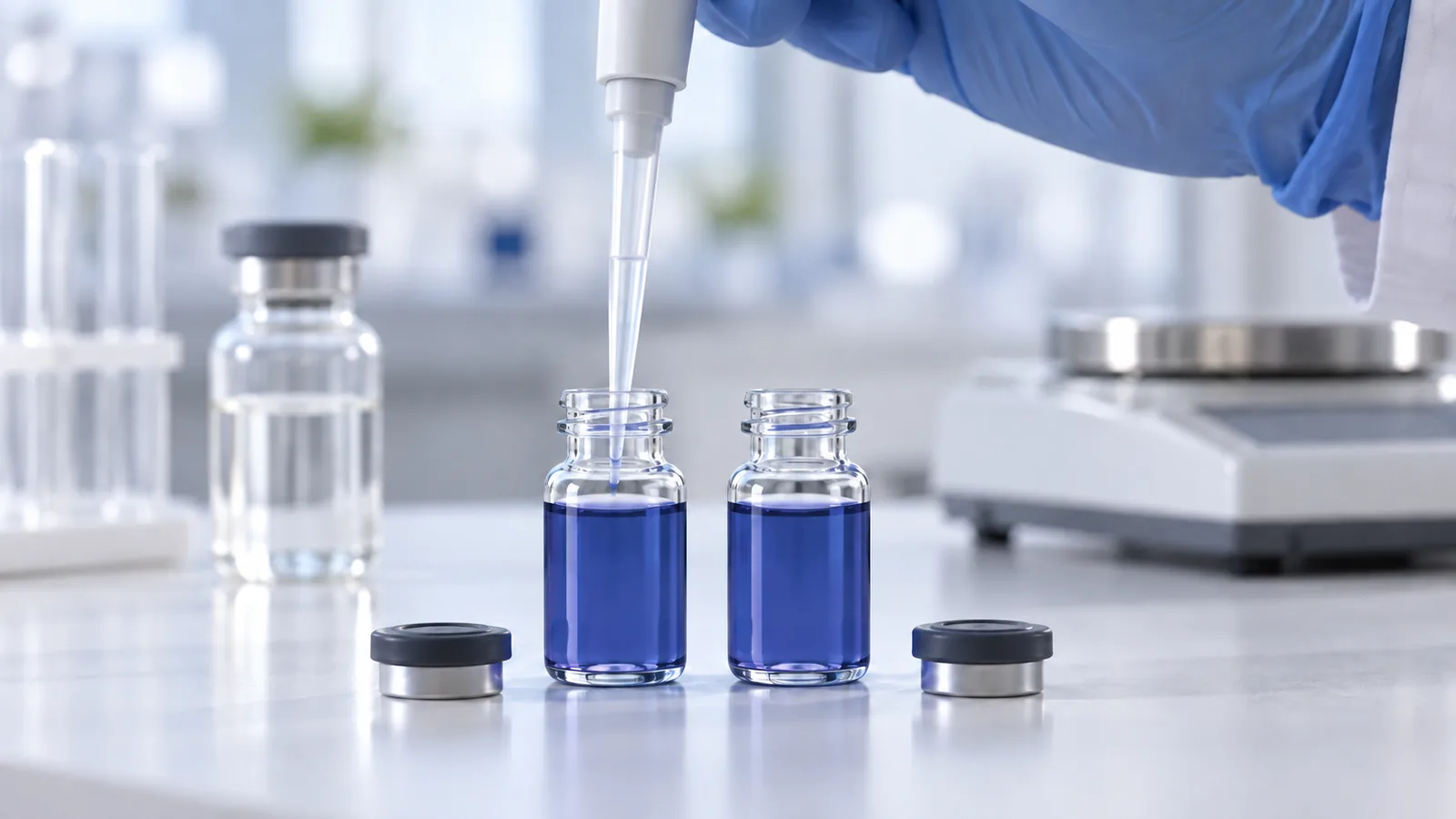
Mix both vials by their GHK-Cu, not by the vial total, and the draw stays the same across both blends. Units here are U-100 insulin-syringe units, 100 to the mL. Mixed with 2.5mL, either blend carries 20mg of GHK-Cu in each mL, so a 1mg dose is 5 units and a 2mg dose 10; mixed with 5mL it carries 10mg per mL, and the same doses take 10 and 20 units. Total peptide per mL is 28mg in Glow and 32mg in Klow at 2.5mL, and 14mg and 16mg at 5mL.
The 5mL mix doubles every unit count and spreads each dose through twice the liquid, which also eases the GHK-Cu sting (why it stings, and the fix). The Simms Research peptide calculator handles any other volume. Add the water slowly along the glass and swirl rather than shake. Bacteriostatic water comes in 10mL vials from Simms Research for $20.
Sealed vials keep best refrigerated, dry and away from light, or frozen at −20°C for long stretches. Freeze-dried, both blends tolerate room temperature for weeks, which is why they ship without ice. Once mixed, a vial stays good for 28 days in the refrigerator.
Common Mistakes With Glow and Klow
Mixing both vials to the same total strength. 3.5mL in Glow and 4mL in Klow both give 20mg of total peptide per mL, but 10 units then holds 1.43mg of GHK-Cu from Glow and 1.25mg from Klow, 12.5% less, with BPC-157 and TB-500 cut by the same share.
Running Glow and Klow together. Klow already holds everything in Glow at the same amounts, so a dose of each doubles the GHK-Cu, BPC-157 and TB-500 and pushes the GHK-Cu past its 1–2mg range.
Raising the dose to get more KPV or BPC-157. Every extra unit brings five times as much GHK-Cu. Past 2mg of GHK-Cu a day the blend leaves its research range, so a higher KPV or BPC-157 dose belongs in a separate vial.
What Each Batch Measured
An independent ISO-certified lab tests each Simms Research batch before it goes on sale. Klow’s current batch has a published report listing each of its four peptides; Glow has no published report at present.
Three vials from Klow batch 2026-KW189 were tested on July 17, 2026, each above the 80mg label: 86.68 to 88.15mg of total peptide, 87.35mg on average, at an average purity of 99.647%. By peptide, the batch held 55.84mg of GHK-Cu, 11.17mg of BPC-157, 10.82mg of TB-500 and 10.32mg of KPV.
LC-MS confirmed the blend’s identity, endotoxin and heavy metals passed, nothing grew in the microbial screen and no fentanyl was detected. On this batch a 10-unit draw of the 2.5mL mix carries 0.41mg of KPV and about 2.23mg of GHK-Cu, so a 2mg GHK-Cu dose sits closer to 9 units. The full certificate sits on the Klow lab results page; How to Read a Peptide Certificate of Analysis explains each line.
Frequently Asked Questions
Is Klow stronger than Glow?
Not in the shared peptides: the GHK-Cu, BPC-157 and TB-500 are identical in both. Klow is broader rather than stronger, with a fourth peptide that works on inflammation.
Can I add KPV to Glow instead of buying Klow?
Yes, at the cost of simplicity. A separate KPV vial needs its own water, draw and 28-day clock once mixed, and adds $62 to Glow’s $96. In return KPV runs on its own schedule, up to the top of its 200–500mcg range. For a steady share of KPV in every dose, Klow is simpler and $36 cheaper.
Are Glow and Klow just the Wolverine Stack with extras?
In part. Both carry Wolverine’s pair, BPC-157 and TB-500 at 10mg apiece, add 50mg of GHK-Cu, and Klow adds KPV. But the blends are dosed by their GHK-Cu, which holds BPC-157 and TB-500 to 400mcg a day.
Does Klow make you tan?
No. Tanning comes from the His-Phe-Arg-Trp core in the middle of alpha-MSH, the part the Melanotan peptides are built around. KPV is the hormone’s last three amino acids and does not contain it.
Does Glow make you lose weight?
No. None of its three peptides is studied for fat loss; they are repair and remodelling peptides.
What side effects do Glow and Klow have?
Mostly a short sting as a dose goes in, caused by the GHK-Cu both blends hold; mixing with 5mL of water instead of 2.5mL eases it. Human data is thin. An intravenous thymosin beta-4 study in 40 healthy adults, placebo-controlled, found no dose-limiting toxicity at doses up to 1,260mg daily for 14 days (Ruff, Annals of the New York Academy of Sciences, 2010). A BPC-157 infusion pilot of up to 20mg left two adults’ organ and glucose markers unchanged (Lee, Alternative Therapies in Health and Medicine, 2025). No human trial of KPV exists.
Are Glow and Klow approved?
No. Both are sold by Simms Research for laboratory research only.