

Blog
Klow Dosage Chart 2026
The 80mg Klow vial mapped unit by unit: units for every GHK-Cu dose at 2 to 5mL of water, the draws that keep all four peptides in range, schedule, vial life and what each batch put in a draw.

Four peptides in every unit
Every unit drawn from an 80mg vial of Klow carries four peptides at once, 50 parts GHK-Cu to 10 parts each of BPC-157, TB-500 and KPV, and no draw can change that ratio. The water added to the vial decides how much of each peptide one unit holds. The GHK-Cu, the largest share, decides how many units make a dose.
Most Klow charts stop at the blend’s total, 26.7mg per mL once 3mL of water goes in, and give the draw as a share of that number. The total hides what matters in the syringe: the same 15 units that look like a modest 4mg of blend hold 2.5mg of GHK-Cu, more than the top of its research range. Read peptide by peptide, the 80mg vial has a narrow band of draws where all four sit inside their own ranges at once, and the charts below map where that band falls at every common water volume.
Simms Research sells the Klow Peptide Blend as one 80mg vial for $122. Whether its fourth peptide, KPV, is worth having over the three-peptide Glow is a separate question, and the Glow vs Klow comparison settles it.
Klow dosage chart: units at every water volume
A Klow dose is set by its GHK-Cu, which research protocols keep between 1 and 2mg daily. Pick the GHK-Cu amount across the top and the water volume down the side; the cell is the draw in units on a U-100 insulin syringe (100 units to the mL):
| Water in the 80mg vial | GHK-Cu per mL | BPC-157, TB-500 and KPV per mL, each | 1mg GHK-Cu | 1.25mg | 1.5mg | 2mg |
|---|---|---|---|---|---|---|
| 2mL | 25mg | 5mg | 4 units | 5 units | 6 units | 8 units |
| 2.5mL | 20mg | 4mg | 5 units | 6.25 units | 7.5 units | 10 units |
| 3mL | 16.7mg | 3.33mg | 6 units | 7.5 units | 9 units | 12 units |
| 4mL | 12.5mg | 2.5mg | 8 units | 10 units | 12 units | 16 units |
| 5mL | 10mg | 2mg | 10 units | 12.5 units | 15 units | 20 units |
Each GHK-Cu milligram brings 0.2mg of each partner with it, whatever the water. A 2mg GHK-Cu dose therefore holds 400mcg each of BPC-157, TB-500 and KPV at every row of the chart; only the number of units changes. For a volume the chart doesn’t list, the Simms Research peptide calculator works it out for any vial: milligrams wanted, over milligrams per mL, times 100.
What every unit holds, and where the four ranges overlap
Each of the four peptides has its own working range in research protocols, and they don’t line up with one another inside a fixed five-to-one vial:
| Peptide | In the 80mg vial | Daily range in research protocols | GHK-Cu dose that reaches it |
|---|---|---|---|
| GHK-Cu | 50mg | 1–2mg | 1–2mg |
| BPC-157 | 10mg | 250–500mcg | 1.25–2.5mg |
| TB-500 | 10mg | 250–500mcg | 1.25–2.5mg |
| KPV | 10mg | 200–500mcg | 1–2.5mg |
GHK-Cu’s range comes from the protocols covered in the GHK-Cu dosage guide; the BPC-157 and TB-500 figures are the pre-mixed ranges set out in the Wolverine stack dosage guide, and KPV’s is the 200–500mcg convention its own protocols use. Lay all four over one another and only one stretch satisfies every row: 1.25 to 2mg of GHK-Cu. Below 1.25mg, BPC-157 and TB-500 drop under 250mcg. Above 2mg, the GHK-Cu leaves its range while the others still have room.
On a 3mL mix, the volume most Klow charts use, that stretch runs from 7.5 to 12 units. The full map of that mix, unit by unit:
| Units (mL) | GHK-Cu | BPC-157, TB-500 and KPV, each | Whole blend | Against each peptide’s research range |
|---|---|---|---|---|
| 5 (0.05mL) | 0.83mg | 167mcg | 1.33mg | All four below range |
| 6 (0.06mL) | 1mg | 200mcg | 1.6mg | GHK-Cu and KPV at their floor; BPC-157 and TB-500 under 250mcg |
| 7.5 (0.075mL) | 1.25mg | 250mcg | 2mg | All four inside range |
| 9 (0.09mL) | 1.5mg | 300mcg | 2.4mg | All four inside range |
| 10 (0.10mL) | 1.67mg | 333mcg | 2.67mg | All four inside range |
| 12 (0.12mL) | 2mg | 400mcg | 3.2mg | All four inside range; GHK-Cu at its 2mg top |
| 15 (0.15mL) | 2.5mg | 500mcg | 4mg | GHK-Cu 25% over its top; the other three at their 500mcg top |
| 20 (0.20mL) | 3.33mg | 667mcg | 5.33mg | All four over range |
| 22.5 (0.225mL) | 3.75mg | 750mcg | 6mg | All four over range; GHK-Cu nearly double its top |
The upper rows are where many published Klow schedules end. A plan that climbs to 22.5 units on a 3mL mix delivers 3.75mg of GHK-Cu, nearly twice its research top, to bring BPC-157 to 750mcg. A researcher who wants BPC-157 and TB-500 at 500mcg or more has the pair in its own vial, where no GHK-Cu rides along; the Wolverine guide gives those draws.
How much bac water for Klow 80mg
Any volume from 2 to 5mL dissolves the vial, and none of them changes the dose; the water only sets how far apart the unit marks sit. Each volume reads differently on the syringe:
2.5mL is the cleanest to read. One unit holds 0.2mg of GHK-Cu and 40mcg of each partner, so every milligram of GHK-Cu is exactly 5 units and the whole 1.25–2mg band runs from 6.25 to 10 units.
3mL is the volume most Klow charts are written for, and the one most searched. One unit holds 0.167mg of GHK-Cu and 33mcg of each partner, so no milligram lands on a round number, but the band’s two ends do: 7.5 units at the bottom and 12 at the top.
5mL doubles the 2.5mL counts: one unit is 0.1mg of GHK-Cu and 20mcg of each partner, and a 2mg dose is 20 units, still inside a 30-unit (0.3mL) syringe. It also has the lowest GHK-Cu strength, 10mg per mL against 25mg at 2mL, which matters for the brief sting the copper peptide can cause; the GHK-Cu dosage guide explains why GHK-Cu stings and why dilution eases it.
2mL is the strongest mix. The 1.25mg floor is 5 units and 2mg is 8, close enough together that a one-unit misread shifts the dose by more than 10%.
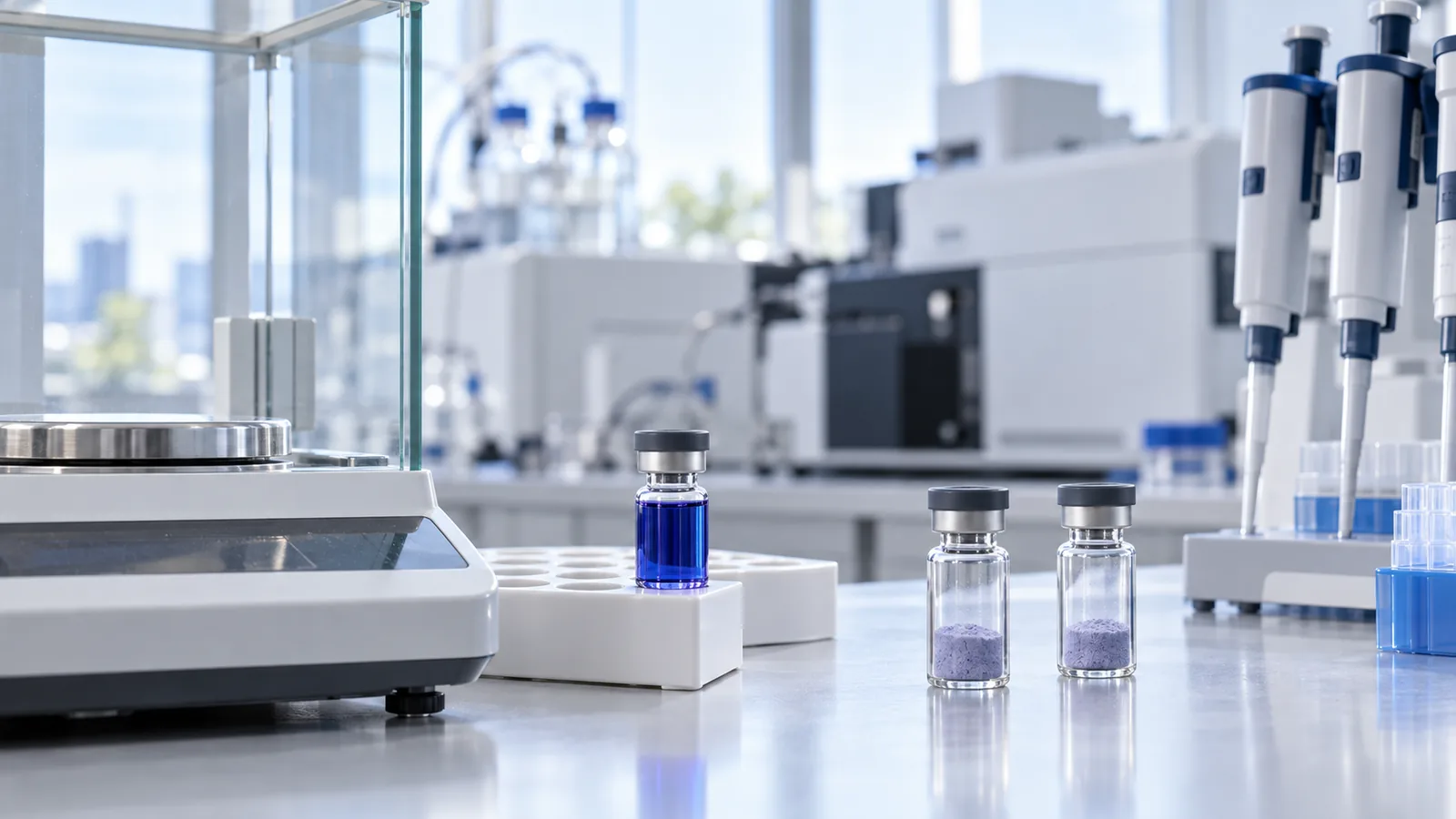
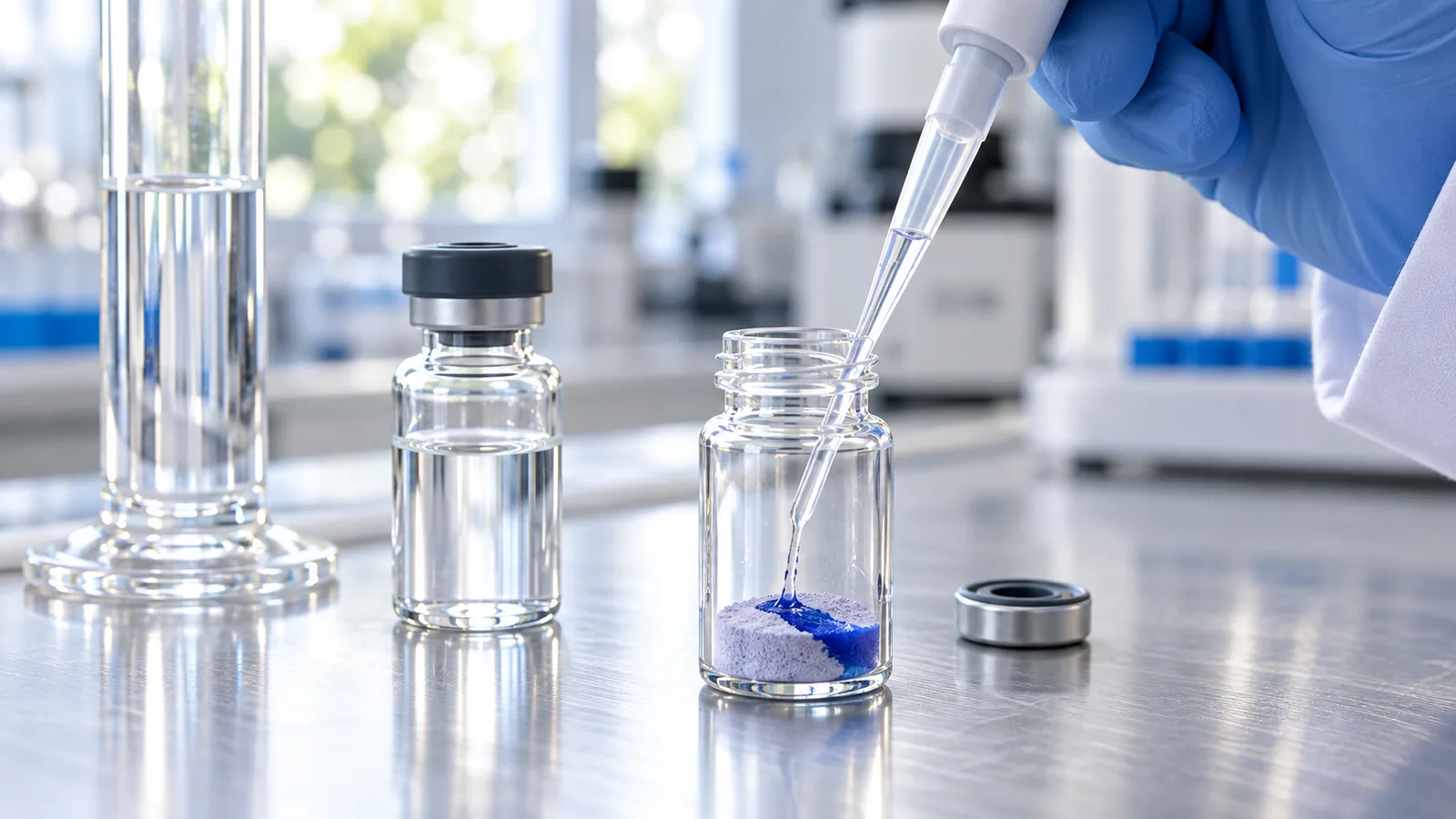
Klow’s powder is a pale lavender-blue, lighter than pure GHK-Cu because 30mg of white peptides sit in the cake with the copper. Let the water run down the inside of the glass rather than onto the powder and swirl the vial until no lavender specks cling to its shoulder and the solution has turned a uniform, see-through blue. A 5mL mix looks a lighter blue than a 2.5mL mix, since the same copper is spread through twice the liquid.
Simms Research’s Research Water is bacteriostatic water, sterile water with 0.9% benzyl alcohol, in a 10mL vial for $20. One vial covers three 3mL mixes, four 2.5mL mixes or two 5mL mixes.
How often, and for how many weeks
GHK-Cu protocols run once a day; pre-mixed BPC-157 and TB-500 protocols run on most days of the week, five at the least. Klow inherits both rhythms, so it is dosed daily or on a five-on, two-off week, with the same draw each time. Spacing it out to three days a week is also common. The weekly totals show what each schedule actually delivers:
| GHK-Cu per dose | Every day | Five days a week | Three days a week |
|---|---|---|---|
| 1.25mg (7.5 units at 3mL) | 8.75mg GHK-Cu, 1.75mg of each other | 6.25mg GHK-Cu, 1.25mg of each other | 3.75mg GHK-Cu, 0.75mg of each other |
| 1.5mg (9 units at 3mL) | 10.5mg GHK-Cu, 2.1mg of each other | 7.5mg GHK-Cu, 1.5mg of each other | 4.5mg GHK-Cu, 0.9mg of each other |
| 2mg (12 units at 3mL) | 14mg GHK-Cu, 2.8mg of each other | 10mg GHK-Cu, 2mg of each other | 6mg GHK-Cu, 1.2mg of each other |
Starting at the low end of the GHK-Cu range, as its protocols do, means 7.5 units of a 3mL mix: the smallest draw that puts all four peptides inside their ranges. Schedules that build up usually hold a step for one to two weeks before moving on, and 12 units, 2mg of GHK-Cu, is where the climb stops.
Klow is run in blocks of four to twelve weeks. The only human time points for any of its peptides belong to GHK-Cu: a skin biopsy study found collagen production up after one month, and the facial studies scored their results at twelve weeks. Measured in vials, a block is a count of 28-day mixed windows: one vial for four weeks, two for eight, three for twelve, at any dose below 2mg of GHK-Cu a day.
How long an 80mg vial of Klow lasts
Two clocks run on a Klow vial once water goes in. One is the dose: 50mg of GHK-Cu divided by the daily amount. The other is Simms Research’s storage guidance for the mixed vial, refrigerated at 2–8°C (36–46°F) and used within 28 days. Whichever runs out first ends the vial:
| GHK-Cu per dose | Daily: days to empty | Daily: left at day 28 | Five days a week: days to empty | Five days a week: left at day 28 |
|---|---|---|---|---|
| 1mg | 50 days | 22mg GHK-Cu (44%) | 70 days | 30mg GHK-Cu (60%) |
| 1.25mg | 40 days | 15mg (30%) | 56 days | 25mg (50%) |
| 1.5mg | 33 days | 8mg (16%) | 47 days | 20mg (40%) |
| 2mg | 25 days | Empty at day 25 | 35 days | 10mg (20%) |
Only one row finishes inside the window: 2mg of GHK-Cu every day, which empties the label’s 50mg in 25 days. Every lower dose, and every five-day week, reaches day 28 with peptide still in the vial, which is why the number of vials a block needs follows the calendar rather than the dose. Real vials hold more than the label. The current batch measured 55.84mg of GHK-Cu, enough for 27.9 days at 2mg a day, so on that batch the daily 2mg schedule uses the full 28 days almost to the dose.
What each batch put in a draw
Simms Research’s Klow certificates report each of the four peptides separately, so the content of a draw can be worked out from the batch rather than the label. On a 3mL mix, the 12-unit draw that the label puts at 2mg of GHK-Cu held:
| Batch and test date | GHK-Cu | BPC-157 | TB-500 | KPV | Units for exactly 2mg of GHK-Cu |
|---|---|---|---|---|---|
| 2026-KW189, Jul 17, 2026 | 2.23mg | 447mcg | 433mcg | 413mcg | 10.7 units |
| KW126, May 19, 2026 | 1.98mg | 405mcg | 392mcg | 444mcg | 12.1 units |
| Label, 80mg | 2mg | 400mcg | 400mcg | 400mcg | 12 units |
On batch 2026-KW189 every peptide came in above its label, so 12 units carried 2.23mg of GHK-Cu and 413 to 447mcg of the partners, and 10.7 units is the draw for exactly 2mg. On KW126 the GHK-Cu sat a fraction under label at 49.61mg, and 12.1 units is the 2mg draw. The same correction works for any certificate: divide each peptide’s measured milligrams by the water volume in mL; the result is that peptide’s real strength, and the units follow from it.
Batch 2026-KW189 was tested across three vials. Their total peptide content measured 88.15, 86.68 and 87.22mg, within 1.5mg of one another, at 99.452% to 99.873% purity by RP-HPLC, with identity confirmed by LC-MS, endotoxins passing, heavy metals negative, no microbial growth and no fentanyl detected. KW126 measured 99.74% purity and 80.61mg in total, with all four peptides identified by LC-MS and two endotoxin replicates passing. The Klow lab results page holds both certificates in full; How to Read a Peptide Certificate of Analysis walks through each line.
Frequently asked questions
How much Klow per day?
1.25 to 2mg of its GHK-Cu, which is 2 to 3.2mg of the whole blend and 250 to 400mcg each of BPC-157, TB-500 and KPV. That is 7.5 to 12 units of a 3mL mix, or 6.25 to 10 units of a 2.5mL mix.
What does 10 units of Klow hold?
It depends on the water. With 3mL, 1.67mg of GHK-Cu and 333mcg of each other peptide; with 2.5mL, 2mg and 400mcg; with 2mL, 2.5mg and 500mcg; with 5mL, 1mg and 200mcg.
Is Klow injected every day?
Daily or five days a week in most protocols, with three days a week as the lighter option. A five-on, two-off week at 2mg of GHK-Cu delivers 10mg of GHK-Cu and 2mg of each other peptide a week.
Should Klow be taken in the morning or at night?
Either. None of the four peptides is timed to a hormone pulse or to meals, so the right time is the one that can be kept every day.
Is the Klow dosage different for women?
No. Klow protocols give one fixed draw regardless of sex, and none of the four peptides is scaled to body weight.
How long is Klow good for after reconstitution?
28 days, provided the vial goes back to 2–8°C (36–46°F) after each draw.
How long can Klow stay out of the fridge?
As a sealed powder, weeks: freeze-dried Klow tolerates room temperature, which is why it ships without ice, and it keeps longest refrigerated or at −20°C. Once mixed it goes back in the refrigerator after every draw. Storage before and after mixing is set out in Do Peptides Need to Be Refrigerated?
Why is Klow blue?
The copper ion in GHK-Cu. With 30mg of white peptides in the same cake the powder is a pale lavender-blue, and once dissolved it turns a clear blue that grows lighter the more water is added.
Does a Klow injection burn?
A brief sting is the most common remark, and it comes from the GHK-Cu, not the other three. It is strongest with concentrated mixes: 2mL puts GHK-Cu at 25mg per mL, and 5mL brings it down to 10mg.
Is Klow approved?
No. Simms Research sells Klow for laboratory research use only.