

Blog
The Definitive Tirzepatide Dosage Chart 2026: Every Dose in Units
Tirzepatide dosing from the trials: the 2.5mg to 15mg weekly schedule, units for 10, 20, 30 and 60mg vials, maintenance, microdosing and missed doses.


How tirzepatide dosing works
Tirzepatide is dosed once a week, in milligrams, on a ladder that starts at 2.5mg and climbs 2.5mg at a time to a ceiling of 15mg. It is a 39-amino-acid peptide that activates two receptors, GIP and GLP-1, and a fatty-acid chain attached to it binds albumin in the blood. That binding slows its clearance to a half-life near five days, so one injection under the skin covers a full week. Levels peak about a day after the injection (8 to 72 hours, depending on the person), then fall slowly until the next one.
Because so much of each dose is still circulating seven days later, weekly injections stack. On a five-day half-life, the first injection reaches about 62% of the level that dose will eventually hold, the second 86%, the third 95% and the fourth 98%. That arithmetic sits behind most of the rules in this guide: why each dose is held for four weeks, why a late injection barely matters and why a long break sends the ladder back down.
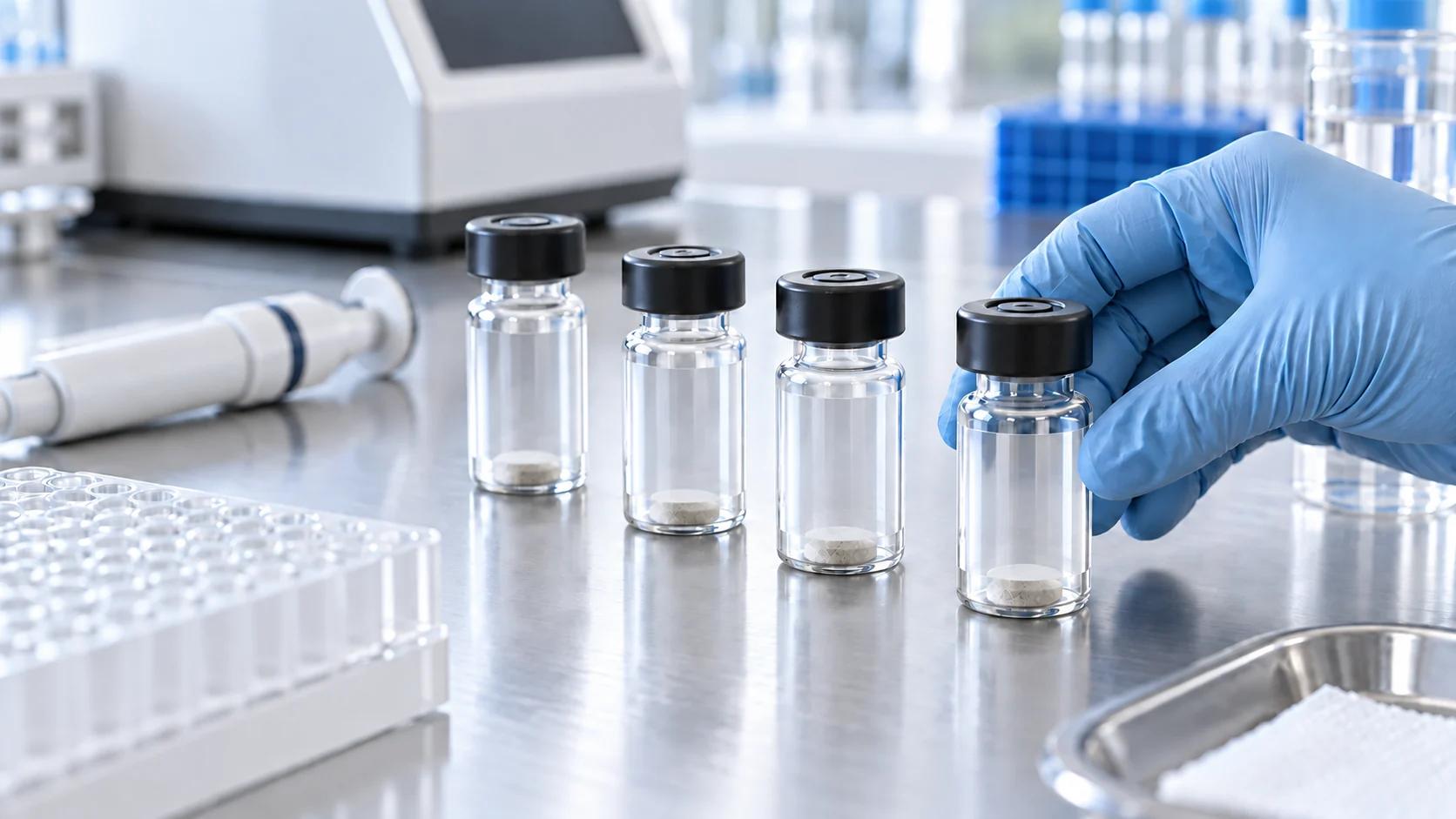
Doses are set in milligrams, but a syringe measures volume. Tirzepatide sold for research is a freeze-dried powder, so the number of units a dose takes depends on the water added to it. The sections below give the trial schedule, what each dose produced, the units for every vial size Simms Research sells its tirzepatide in (10, 20, 30 and 60mg), the maintenance and microdosing data, and what to do about a missed week. All of it assumes the powder matches its label, which the last section checks.
Tirzepatide dosage chart and dosing schedule
This is the schedule Eli Lilly used in every phase 3 trial and printed on the Zepbound and Mounjaro labels, both last revised in August 2026.
| Weeks | Weekly dose | What the step is for | Weight change at 72 weeks (SURMOUNT-1) |
|---|---|---|---|
| 1–4 | 2.5mg | Starting dose only | Not tested as a dose to stay on |
| 5–8 | 5mg | First maintenance dose | −15.0% |
| 9–12 | 7.5mg | Step toward 10mg | Passed through on the way to 10 and 15mg |
| 13–16 | 10mg | Second maintenance dose | −19.5% |
| 17–20 | 12.5mg | Step toward 15mg | Passed through on the way to 15mg |
| 21 onward | 15mg | Maximum dose | −20.9% |
Three rules come with it. Each step lasts at least four weeks, each increase is 2.5mg, and 2.5mg is a dose for starting, not for staying on. The maintenance doses are 5, 10 or 15mg, and the label says to choose between them on response and tolerability, moving to a lower maintenance dose if a higher one isn’t tolerated. For sleep apnea, the maintenance doses are 10 or 15mg.
Mounjaro, the type 2 diabetes version, uses the same start and the same steps, raised only when blood sugar needs more control. Its ceiling is 15mg for adults and 10mg for children 10 and older.
The dose doesn’t scale with body weight. SURMOUNT-1 gave the same fixed doses to 2,539 adults who averaged 104.8kg (231 lbs) and a BMI of 38 at the start.
For the separate investigational schedule, see the retatrutide dosage guide. The retatrutide vs tirzepatide comparison places both trial schedules side by side.
What each tirzepatide dose does
SURMOUNT-1 is the cleanest comparison of doses: adults with obesity and without diabetes, randomized to 5, 10 or 15mg or placebo for 72 weeks, with the 20-week climb included.
| Weekly dose | Average weight change | Lost 5% or more | Stopped for a side effect |
|---|---|---|---|
| Placebo | −3.1% | 35% | 2.6% |
| 5mg | −15.0% | 85% | 4.3% |
| 10mg | −19.5% | 89% | 7.1% |
| 15mg | −20.9% | 91% | 6.2% |
The curve bends early. The step from 5 to 10mg was worth 4.5 more points of weight loss; the step from 10 to 15mg, 1.4. Half of the 10mg group and 57% of the 15mg group lost a fifth of their body weight or more, against 3% on placebo.
Is 2.5mg of tirzepatide enough to lose weight?
It isn’t built to be. 2.5mg gives the stomach time to adjust, and it spends its four weeks at a level that is still rising. No phase 3 trial kept anyone on it. The nearest data point sits lower still: in Lilly’s 2018 phase 2 trial, 1mg a week for 26 weeks moved body weight by 0.9kg, against 0.4kg on placebo, while the same trial’s 5mg group lost 4.8kg. The weight loss in the trials comes from the maintenance doses.
Why am I not losing weight on tirzepatide yet?
A slow start is common and usually temporary. In an analysis of 1,545 SURMOUNT-1 participants who took their doses, 18% had lost less than 5% by week 12. By week 72, 90% of that group had passed 5%, taking about 25 weeks on average to get there, and they finished at 8.3%, 11.4% and 13.6% on 5, 10 and 15mg. The higher doses helped the slow starters too. Only 1.8% of everyone analyzed was still under 5% at week 72.
Is 7.5mg of tirzepatide a lot?
It is the middle of the ladder: half the maximum, reached in week 9, and a step everyone assigned to 10 or 15mg passed through. For scale, 5mg on its own beat semaglutide 1mg on both blood sugar and weight in the SURPASS-2 trial. 7.5mg is a mid-range dose.
Do you need 15mg?
Not by default. The label treats the maintenance dose as a choice between 5, 10 and 15mg, and the trial numbers show why: 10mg delivered almost all of what 15mg did, with a similar rate of people stopping for side effects.
Why the dose climbs 2.5mg every four weeks
The ladder wasn’t chosen on paper. Lilly tried faster ones first, and the stomach side effects at the top dose came down as the climb slowed.
| Trial | Who took part | How the dose climbed | Stomach side effects at 15mg |
|---|---|---|---|
| Phase 2, published 2018 | 316 adults with type 2 diabetes, 26 weeks | Started at 5mg, reached 15mg after 6 weeks | 66% had a digestive side effect |
| Escalation study, published 2020 | 111 adults with type 2 diabetes, 12 weeks | Started at 2.5mg, reached 15mg after 8 weeks | 36–39% had nausea |
| SURMOUNT-1, published 2022 | 2,539 adults with obesity, 72 weeks | Started at 2.5mg, +2.5mg every 4 weeks, reached 15mg after 20 weeks | 31% had nausea, against 9.5% on placebo |
Across the three, the starting dose came down, the steps got smaller and each step got longer. The 2020 study’s authors concluded that lower starting doses and smaller increases gave the better side-effect profile, and that result set the phase 3 schedule. The three trials differ in who took part and how long they ran, and the direction held at every stage.
Four weeks also matches the pharmacology. A dose takes about four weekly injections to reach its steady level, so each step gets judged at the level it will actually hold. In SURMOUNT-1, most stomach side effects were mild to moderate and came during the climb. The full rates are in What Are the Side Effects of Tirzepatide?, with separate guides on fatigue and hair loss.
The label sets four weeks as the shortest time on a step. Staying on a step longer, while nausea settles, is within it.
Tirzepatide dosage in units
On a U-100 insulin syringe, 100 units equals 1mL. Converting a dose takes two steps: the vial’s milligrams divided by the water added gives the strength in mg per mL, and the dose divided by that strength, times 100, gives the units.
The 60-unit method
Lilly’s own multi-dose vials of Zepbound and Mounjaro keep every dose the same volume. Each holds 2.4mL, enough for four doses of 0.6mL: the 10mg vial gives four 2.5mg doses, the 20mg vial four 5mg doses, and so on up to the 60mg vial’s four 15mg doses. Mixing a research vial with 2.4mL of bacteriostatic water gives the same strengths, so the draw stays at 60 units and the vial changes with the step.
| Weeks | Weekly dose | Vial | Strength | Units |
|---|---|---|---|---|
| 1–4 | 2.5mg | 10mg | 4.17mg per mL | 60 units (0.6mL) |
| 5–8 | 5mg | 20mg | 8.33mg per mL | 60 units (0.6mL) |
| 9–12 | 7.5mg | 30mg | 12.5mg per mL | 60 units (0.6mL) |
| 13–16 | 10mg | 60mg | 25mg per mL | 40 units (0.4mL) |
| 17–20 | 12.5mg | 60mg | 25mg per mL | 50 units (0.5mL) |
| 21 onward | 15mg | 60mg | 25mg per mL | 60 units (0.6mL) |
Weeks 13 to 20 draw 40 and 50 units from the same 60mg vial that later covers 15mg. The advantage is that the number on the syringe barely moves: a new step never means new arithmetic, and a units figure never gets carried from one strength to another by mistake.
Units by vial and water
Any other mix works as well. These are the common ones for each vial size, with the doses each usually covers:
| Vial and water | Strength | 1 unit holds | Doses in units |
|---|---|---|---|
| 10mg + 1mL | 10mg per mL | 0.1mg | 1mg = 10 units; 2.5mg = 25 units; 5mg = 50 units |
| 10mg + 2mL | 5mg per mL | 0.05mg | 1mg = 20 units; 2.5mg = 50 units; 5mg = 100 units |
| 20mg + 2mL | 10mg per mL | 0.1mg | 5mg = 50 units; 7.5mg = 75 units; 10mg = 100 units |
| 30mg + 3mL | 10mg per mL | 0.1mg | 7.5mg = 75 units; 10mg = 100 units |
| 30mg + 2mL | 15mg per mL | 0.15mg | 7.5mg = 50 units; 10mg = about 67 units; 15mg = 100 units |
| 60mg + 3mL | 20mg per mL | 0.2mg | 2.5mg = 12.5 units; 10mg = 50 units; 12.5mg = 62.5 units; 15mg = 75 units |
| 60mg + 2mL | 30mg per mL | 0.3mg | 10mg = about 33 units; 12.5mg = about 42 units; 15mg = 50 units |
The 60mg vial mixed with 3mL is where the “12.5 units” starting dose comes from: at 20mg per mL, 2.5mg is 12.5 units, a half-unit mark most syringes don’t print. Starting on a 10mg vial avoids it.
Use the smallest syringe that holds the draw: a 0.3mL syringe up to 30 units, 0.5mL up to 50 and 1mL up to 100. A draw over 100 units needs a stronger mix. The Simms Research peptide calculator runs the math for any vial and water volume.
To mix, let the vial and the water reach room temperature, run the water down the inside of the glass and swirl until the solution is clear. A mixed vial lives in the fridge at 2–8°C (36–46°F), and Simms Research’s guidance is to use it within 28 days. Simms sells bacteriostatic water in 10mL vials, and Do peptides need to be refrigerated? explains how long the powder and a mixed vial keep.
Which vial covers each step
The 28-day window decides vial size as much as price does. A four-week step is four doses, so the right vial for a step is the one those four doses empty.
| Weeks | Weekly dose | Total for four weeks | Vial | Left over | Shelf price |
|---|---|---|---|---|---|
| 1–4 | 2.5mg | 10mg | 10mg | None | $65 |
| 5–8 | 5mg | 20mg | 20mg | None | $95 |
| 9–12 | 7.5mg | 30mg | 30mg | None | $155 |
| 13–16 | 10mg | 40mg | 60mg | 20mg | $186 |
| 17–20 | 12.5mg | 50mg | 60mg | 10mg | $186 |
| Every 4 weeks after | 15mg | 60mg | 60mg | None | $186 |
The first 20 weeks take 150mg of tirzepatide across five vials, $687 at shelf prices. At 15mg, one 60mg vial covers each four weeks, about $46.50 a week. Weeks 13 to 20 leave some over because 60mg is the next size up from 30mg, and at 10mg a week a mixed 60mg vial holds six doses, one more than 28 days covers.
The window matters most at low doses. A 60mg vial at 2.5mg a week holds 24 doses, close to six months of injections, which is why the first month belongs to the 10mg vial.
Tirzepatide maintenance dose
What happens after the weight comes off is now among the best-tested parts of tirzepatide dosing. Two trials took people who had already lost weight on it and changed only the dose.
| Trial | Before the change | What changed | Result |
|---|---|---|---|
| SURMOUNT-4 (JAMA, 2024) | 670 adults lost 20.9% over 36 weeks on their highest tolerated dose, 10 or 15mg | Half kept the dose and half switched to placebo for 52 weeks | Kept the dose: lost a further 5.5%. Placebo: regained 14.0% |
| SURMOUNT-MAINTAIN (The Lancet, May 2026) | 378 adults after 60 weeks on 10 or 15mg | Kept the dose, dropped to 5mg, or switched to placebo for 52 weeks | Total loss at week 112: 21.9% on the full dose, 16.6% on 5mg, 9.9% on placebo |
SURMOUNT-MAINTAIN is the first trial of a lower maintenance dose. Dropping to 5mg kept most of the loss: 25% of that group regained half or more of what they had lost, against 8% of those who stayed on their full dose and 67% on placebo. For the maintenance dose after goal weight, the evidence reads plainly. The full dose holds all of it, 5mg holds most of it, and stopping gives much of it back within a year.
Every other week, every 10 days or twice a week
Stretching the interval is the other common way to cut exposure without changing the milligrams. No trial has tested these schedules, but the half-life shows what each does. The average level follows the weekly total, and the swing between the peak and the low point follows the gap between injections.
| Schedule | Average level against weekly | Peak against low point |
|---|---|---|
| Half the dose twice a week | Same | 1.6 to 1 |
| Full dose every 5 days | 40% higher | 2 to 1 |
| Full dose every 7 days, as on the label | Baseline | 2.6 to 1 |
| Full dose every 10 days | 30% lower | 4 to 1 |
| Full dose every 14 days | Half | 7 to 1 |
Every other week at 10mg averages the same exposure as 5mg weekly, with deeper lows before each injection; SURMOUNT-MAINTAIN’s 5mg weekly is the tested version of that exposure. Every five days at the same dose raises exposure by 40%. Splitting a dose into two halves keeps the average and flattens the peak. The label’s one firm limit is at least 72 hours between two injections.
Tirzepatide microdosing
Microdosing means weekly doses under the 2.5mg starting dose, usually 0.5 to 2mg, used for maintenance, appetite control or a gentler pace than the standard ladder. At 10mg per mL, which is a 10mg vial mixed with 1mL, the units are simple: 0.5mg is 5 units, 1mg is 10, 1.5mg is 15 and 2mg is 20.
One trial arm sits in that range. In the 2018 phase 2 trial, 1mg a week for 26 weeks lowered HbA1c by 1.06 points in people with type 2 diabetes, close to the 1.21 points from dulaglutide 1.5mg, a full-dose GLP-1 drug. Weight barely moved: 0.9kg, against 0.4kg on placebo and 4.8kg on 5mg. Digestive side effects were reported by 23% at 1mg and 66% at 15mg. At 1mg, blood sugar responded and body weight largely didn’t.
The practical catch is the vial. At 1mg a week a 10mg vial holds ten doses, twice what the 28-day window covers once it is mixed.
Missed doses, changing the day and restarting
A missed dose can go in up to four days (96 hours) late. Past that, let it go and inject on the regular day, with no double dose to catch up. The injection day can move as long as two doses are at least three days (72 hours) apart.
The half-life explains the four-day allowance. Four extra days take the level to about 57% of its usual low point, and the next injection restores it. Two missed doses take it to about a seventh of that low point, much nearer to where the first 2.5mg began. That is why prescribers commonly restart lower, at 2.5 or 5mg, after a gap of two to three weeks, and climb again in four-week steps.
Time of day doesn’t matter, and neither do meals. Keep the same weekday and rotate sites: belly, thigh and upper arm. If the day after an injection tends to be a tired one, Does Tirzepatide Make You Tired? covers timing around it.
Switching from semaglutide
Semaglutide milligrams don’t convert to tirzepatide milligrams, and Zepbound’s label advises against combining tirzepatide with any GLP-1 drug. What exists instead is head-to-head data, which shows where the doses land:
| Trial | Semaglutide dose | Tirzepatide dose | Result |
|---|---|---|---|
| SURPASS-2, type 2 diabetes, 40 weeks | 1mg | 5, 10 or 15mg | Weight −7.6, −9.3 and −11.2kg against −5.7kg; every tirzepatide dose also lowered HbA1c more |
| SURMOUNT-5, obesity, 72 weeks | 1.7 or 2.4mg, highest tolerated | 10 or 15mg, highest tolerated | −20.2% against −13.7% |
Tirzepatide 5mg already outperformed semaglutide 1mg. Even so, a 2025 study of 15 people switching from semaglutide 1mg restarted everyone at 2.5mg on the standard steps. Those who reached 10mg lowered HbA1c by 0.7 points within three months; the group that stopped at 7.5mg showed no significant change.
What is really in a tirzepatide vial
Every number above assumes a 10mg vial holds 10mg of tirzepatide. The measured content moves the dose directly. Simms Research has published two tirzepatide batches, both 10mg vials. TZ198, tested June 25, 2026, measured 10.79mg. 2026-TZ295, tested July 16, 2026, measured 10.57mg averaged over three vials, at 99.777% purity, with identity confirmed by LC-MS and endotoxins, heavy metals and sterility all passing. From that batch, a 60-unit draw out of a vial mixed with 2.4mL holds about 2.64mg, not 2.5mg.

Not every vial on the market clears that bar. Between July 10 and September 20, 2026, an independent testing service published 200 tirzepatide results from 99 sellers, and 58 failed its standard. 39 of those failed the identity test, meaning the lab could not confirm the peptide in the vial was tirzepatide. Most of the rest fell below its 99.5% purity threshold, and five were more than 35% off the labeled amount.
No units chart can correct for a vial that isn’t what it says. The certificate lines that matter for dosing are the batch number, identity by mass spectrometry, and net content in milligrams, the only figure that turns a label into a real strength. Every Simms Research tirzepatide batch is on the tirzepatide lab results page, and How to Read a Peptide Certificate of Analysis explains each field.
Frequently asked questions
How many units is 2.5mg of tirzepatide?
60 units from a 10mg vial mixed with 2.4mL of bacteriostatic water. At other strengths it is 25 units at 10mg per mL (10mg with 1mL), 50 units at 5mg per mL (10mg with 2mL) and 12.5 units at 20mg per mL (60mg with 3mL).
How many units is 5mg of tirzepatide?
60 units from a 20mg vial mixed with 2.4mL, 50 units at 10mg per mL, and 25 units from a 60mg vial mixed with 3mL.
Can I take 25 units of tirzepatide?
25 units is 0.25mL, and the dose inside it depends on the mix: 1.25mg at 5mg per mL, 2.5mg at 10mg per mL, 5mg at 20mg per mL and 7.5mg at 30mg per mL. Check the vial’s strength before reading any units figure.
How much bacteriostatic water for a 30mg tirzepatide vial?
2.4mL makes 7.5mg a 60-unit draw. 3mL gives 10mg per mL, where 7.5mg is 75 units, and 2mL gives 15mg per mL, where 7.5mg is 50 units.
How long does a 10mg vial of tirzepatide last?
Four weeks at 2.5mg a week, or two at 5mg. Once mixed, it is good for 28 days refrigerated.
How long does a 60mg vial of tirzepatide last?
Four weeks at 15mg a week. At 12.5mg it gives four doses with 10mg left over, and at 10mg it holds six doses, one more than a mixed vial’s 28 days covers.
How many mg of tirzepatide per month?
10mg in the first month at 2.5mg a week, then 20, 30, 40 and 50mg in the months that follow, and 60mg a month at 15mg.
What is the maximum dose of tirzepatide?
15mg once a week for adults, the top of the ladder in every phase 3 trial and on both labels. Mounjaro’s ceiling for children 10 and older is 10mg.
Is Zepbound dosing the same as Mounjaro dosing?
Yes: the same 2.5mg start, the same 2.5mg steps and the same 15mg ceiling. Zepbound’s maintenance doses are 5, 10 or 15mg (10 or 15mg for sleep apnea), and Mounjaro is raised only when blood sugar needs more control.
Is tirzepatide from Simms Research for human use?
No. Simms Research sells tirzepatide for laboratory research use only.