

Blog
Eloralintide vs Retatrutide: New Trial Results and Key Differences
How Lilly's amylin drug eloralintide compares with retatrutide after the September and October 2026 trial results: weight loss, side effects, approval timing and cost.


Eloralintide and retatrutide are both Lilly drugs, both weekly injections and both built for weight loss, and that is about where the likeness ends. Retatrutide works three hormone receptors at once and has finished the trials Lilly needs to file it. Eloralintide copies a single hormone, amylin, the signal that tells the brain a meal was enough, and its Phase 3 trials only began enrolling in December 2025.
The newest numbers landed four weeks apart. On September 30, 2026, Lilly showed eloralintide on its own taking 8.2% to 12.3% of body weight off adults with type 2 diabetes over 48 weeks, short of the 14.8% tirzepatide managed in the same trial, while the two together reached 23.3%. On October 28, retatrutide took 20.9% off the same kind of patient over 80 weeks, more than double what Ozempic did head to head.
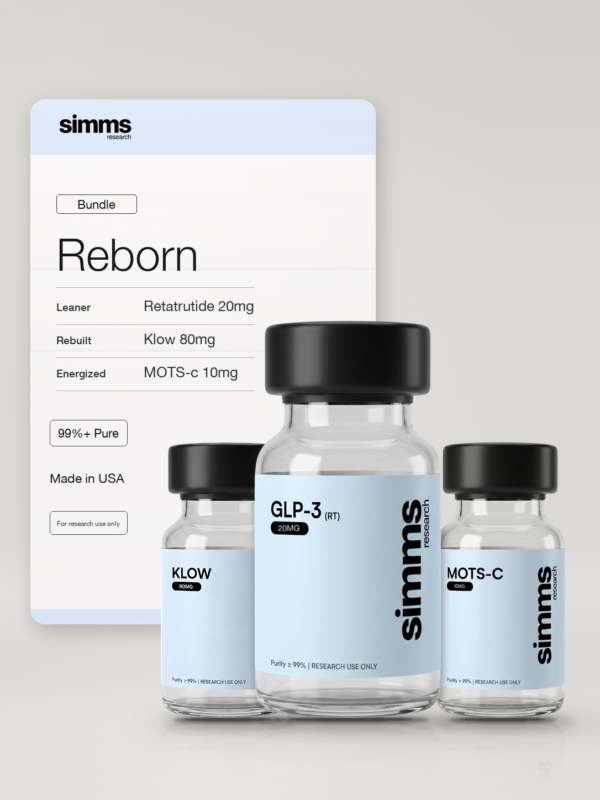
Of the two, only retatrutide is on Simms Research’s shelves. Retatrutide (GLP-3) comes in four vial sizes, and its current batch tested 99.611% pure at an outside lab. Eloralintide is still a trial drug and isn’t stocked.
Eloralintide vs retatrutide at a glance
Different hormones and a different stage. Retatrutide is the stronger drug on every result published so far and is due to be filed with the FDA in early 2027. Eloralintide is a newer, single-hormone approach whose best use may turn out to be alongside another drug rather than instead of one.
| Point | Eloralintide | Retatrutide |
|---|---|---|
| What it acts on | Amylin receptors, mainly the amylin 1 receptor | GIP, GLP-1 and glucagon receptors, in one molecule |
| Lilly code | LY3841136 | LY3437943 |
| How it’s given | Injection under the skin once a week | Injection under the skin once a week |
| Top dose with published results | 9mg | 12mg |
| Best result without diabetes | 20.1% at 48 weeks (Phase 2) | 28.3% at 80 weeks (Phase 3) |
| Best result with type 2 diabetes | 12.3% alone, 23.3% with tirzepatide, at 48 weeks | 20.9% at 80 weeks (Phase 3) |
| Where it stands | Phase 3 since December 2025, first readouts due early 2028 | Six Phase 3 trials reported, FDA filing planned for Q1 2027 |
| Approved anywhere | No | No |
| At Simms Research | Not carried | Retatrutide (GLP-3), four sizes, $84 to $259 |
What is eloralintide?
A long-acting copy of amylin. The pancreas releases amylin alongside insulin after a meal, and it does two jobs: it slows how fast the stomach empties and it tells the brain’s appetite centers that enough food has arrived. Eloralintide is built to do the same for a full week from one injection, acting mainly on the amylin 1 receptor with little pull on the calcitonin receptor that other amylin drugs also reach.
Amylin isn’t new ground: pramlintide has been prescribed for diabetes since 2005, and Novo Nordisk’s cagrilintide is the amylin half of CagriSema. Lilly’s pitch is selectivity, the same fullness signal with a gentler stomach.
Retatrutide works on a different lane entirely. It pairs the two gut hormones tirzepatide already uses, GIP and GLP-1, with glucagon, which raises the energy the body burns and draws fat out of the liver. Research sites list it as GLP-3; What Is GLP-3 (Retatrutide)? traces where that label came from.

Eloralintide trial results
Up to 20.1% weight loss on its own in people without diabetes, and up to 12.3% in people with type 2 diabetes, both over 48 weeks. No Phase 3 results exist yet.
The first full trial, presented at ObesityWeek on November 6, 2025, gave 263 adults without diabetes one of four fixed doses or one of two step-up schedules for 48 weeks. Weight loss climbed with the dose, from 9.5% at 1mg to 17.6% at 6mg and 20.1% at 9mg, against 0.4% on placebo (Billings, The Lancet, 2025). At 1mg and 3mg, stomach side effects were about as common as on placebo.
The new results, shown at the European diabetes meeting in Milan on September 30, 2026, tested eloralintide in 367 adults with type 2 diabetes, alone, against tirzepatide, and paired with it as two separate injections. Lilly calls the pairing EloraTZP:
| Arm | Average weight loss | A1C drop |
|---|---|---|
| Placebo | 3.0% | 0.3 points |
| Eloralintide 3mg | 8.2% | 1.1 points |
| Eloralintide 6mg | 12.3% | 1.4 points |
| Eloralintide 9mg | 11.1% | 1.3 points |
| Tirzepatide 15mg | 14.8% | 2.4 points |
| Eloralintide 3mg with tirzepatide 5mg | 13.2% | 2.2 points |
| Eloralintide 6mg with tirzepatide 5mg | 19.4% | 2.7 points |
| Eloralintide 6mg with tirzepatide 10mg | 19.9% | 2.6 points |
| Eloralintide 9mg with tirzepatide 15mg | 23.3% (54.1 lbs) | 2.9 points |
Two things stand out. In people with diabetes, eloralintide plateaued at 6mg, and on its own it did less than tirzepatide. The pairing beat both, but it also lost more people along the way: 10.8% to 27.0% of the combination arms stopped for side effects, against 2.9% on tirzepatide alone and 16.7% on placebo.
Lilly is taking the pairing into Phase 3 as one co-formulated injection with a reworked step-up schedule.
New retatrutide results: the head-to-head with Ozempic
More than double Ozempic’s weight loss, and a deeper drop in blood sugar.
TRANSCEND-T2D-2, reported on October 28, 2026, gave 1,298 adults with type 2 diabetes retatrutide 9mg, retatrutide 12mg or Ozempic 2mg, the highest dose approved, for 80 weeks. Retatrutide took off 19.5% and 20.9% of body weight against 9.4% on Ozempic, and lowered A1C by 2.2 points against 1.8. It was the first Phase 3 trial to put retatrutide against another drug of its family, and the sixth it has passed:
| Trial, reported | Who took part | Weeks | Top-dose weight loss | Comparison arm |
|---|---|---|---|---|
| TRIUMPH-4, Dec 11, 2025 | Obesity with knee osteoarthritis | 68 | 28.7% | 2.1% on placebo |
| TRANSCEND-T2D-1, Mar 19, 2026 | Type 2 diabetes | 40 | 16.8% | 2.5% on placebo |
| TRIUMPH-1, May 21, 2026 | Obesity without diabetes | 80 | 28.3% | 2.2% on placebo |
| TRIUMPH-2, Jul 23, 2026 | Obesity with type 2 diabetes | 80 | 20.8% | 4.0% on placebo |
| TRIUMPH-3, Jul 23, 2026 | Severe obesity with heart disease | 80 | 22.6% | 3.2% on placebo |
| TRANSCEND-T2D-2, Oct 28, 2026 | Type 2 diabetes | 80 | 20.9% | 9.4% on Ozempic 2mg |
In TRIUMPH-1, 45.3% of people on 12mg lost at least 30% of their weight, and a 104-week extension for people who began with a BMI of 35-plus reached 30.3%. A head-to-head against tirzepatide, TRIUMPH-5, is still under way; how the two compare across their own trials is in the retatrutide vs tirzepatide comparison.
Eloralintide vs retatrutide: which is better?
For weight loss, retatrutide, in every comparison the trials allow. The cleanest one uses two Phase 2 trials of the same length in people without diabetes: eloralintide 9mg reached 20.1% at 48 weeks against 0.4% on placebo, and retatrutide 12mg reached 24.2% against 2.1% (Jastreboff, New England Journal of Medicine, 2023).
In type 2 diabetes the gap widens: eloralintide’s best was 12.3% at 48 weeks, retatrutide’s 16.8% at 40 weeks and 20.9% at 80. Against approved drugs it is starker still. Eloralintide did less than tirzepatide in its own trial, and retatrutide more than doubled Ozempic in its.
Eloralintide makes its case on the other side of the ledger. Its low doses were about as easy on the stomach as placebo, and it adds to tirzepatide rather than competing with it, which is the role Lilly is now building it for. Retatrutide is the single drug that does the most; eloralintide is shaping up as the partner that makes another drug do more. For research today, depth settles it too: six Phase 3 trials against 48 weeks in a few hundred people.

Eloralintide vs retatrutide side effects
Mostly the stomach, mostly at the top doses, and mostly while the dose is still climbing. On either drug alone, the large majority stayed on through them.
Nausea is the one most people notice, and it tracks the dose on both. Eloralintide’s figures come from its 48-week trial (Billings, The Lancet, 2025), retatrutide’s from TRIUMPH-1:
| Dose | Nausea | Placebo in the same trial |
|---|---|---|
| Eloralintide 1mg | 11% | 14% |
| Eloralintide 3mg | 13% | 14% |
| Eloralintide 9mg | 33% | 14% |
| Eloralintide stepped up from 3mg to 9mg | 25% | 14% |
| Retatrutide 4mg | 28.6% | 14.8% |
| Retatrutide 9mg | 38.4% | 14.8% |
| Retatrutide 12mg | 42.4% | 14.8% |
Each drug also has a side effect that stands out in its own trials. Eloralintide’s is tiredness: 43% reported fatigue at 9mg against 12% on placebo, and 21% when the dose was stepped up slowly. Retatrutide’s is dysesthesia, an odd tingling or touchiness of the skin, in 5.1% to 12.5% of people against 0.9% on placebo; it was mostly mild, usually faded during treatment, and most people kept going.
Stopping rates stayed low. In TRIUMPH-1, 4.1% to 11.3% quit retatrutide over side effects, and placebo’s figure was 4.9%, and in the head-to-head 4.8% and 7.9% left retatrutide against 2.7% on Ozempic. In the diabetes trial, 0% to 10.8% stopped eloralintide alone, against 16.7% on placebo.
Eloralintide vs tirzepatide and cagrilintide
Eloralintide vs tirzepatide
Tirzepatide is stronger on its own, and eloralintide makes it stronger still. In the September 2026 trial, tirzepatide 15mg (sold as Zepbound and Mounjaro) took off 14.8% against 12.3% for eloralintide’s best dose, and the two together took off 23.3%: 54.1 lbs against 34.4 lbs on tirzepatide alone.
Lilly now treats eloralintide as tirzepatide’s partner as much as its rival. On research sites tirzepatide is often sold as GLP-2; Simms Research carries it as Tirzepatide (GLP-2), from $65 for 10mg to $186 for 60mg.
Eloralintide vs cagrilintide
Both copy amylin, and eloralintide has posted the bigger number on its own. Novo Nordisk’s cagrilintide reached 11.8% at 68 weeks as a single drug in its main obesity trial, against eloralintide’s 20.1% at 48 weeks. They come from separate trials, but the gap is wide.
The design differs too. Cagrilintide acts on both the amylin and calcitonin receptors; eloralintide is built to stay on the amylin side, and in Lilly’s animal work it was easier on the gut than cagrilintide (Briere, Diabetes, 2025). Cagrilintide is further along: Novo filed its CagriSema combination with the FDA in December 2025.
When will eloralintide be FDA approved?
Not before its first Phase 3 results, which are due in early 2028. Lilly hasn’t named a filing date, and the dates below are the trials’ own estimates for finishing the main measurements:
| Trial | Who takes part | People | Main results due |
|---|---|---|---|
| ENLIGHTEN-2 | Obesity with type 2 diabetes | 1,035 | January 2028 |
| ENLIGHTEN-1 | Obesity without diabetes | 1,980 | March 2028 |
| ENLIGHTEN-3 | Sleep apnea with obesity | 800 | March 2028 |
| ENLIGHTEN-4 | Knee arthritis pain with obesity | 900 | March 2028 |
| ENLIGHTEN-6 | Obesity that persists on a weekly GLP-1-type drug | 900 | June 2028 |
| AMPLIFY-1 and AMPLIFY-2 (EloraTZP) | Obesity with or without type 2 diabetes | 3,115 | October 2029 |
Retatrutide is roughly two years ahead. Lilly expects to submit it for US approval in Q1 2027, after it finishes the manufacturing data the application needs. When Will Retatrutide Be FDA Approved? walks through the review and launch timing.
What you can get now, and what it costs
Neither drug can be bought as a medicine yet, and Lilly hasn’t priced either. The nearest yardstick is Lilly’s cash price for Zepbound, which runs from $299 a month on the starting dose to $449 on the maintenance doses for anyone who refills within 45 days. Its list price is $1,087.
| Route | What it gets you | Price |
|---|---|---|
| Zepbound, Lilly self-pay | Approved tirzepatide on a prescription | $299 to $449 a month |
| Retatrutide or eloralintide on prescription | Nothing yet: neither is approved | No price set |
| Retatrutide (GLP-3), Simms Research | Freeze-dried research powder in four vial sizes | $84 to $259 a vial |
Until approval, retatrutide reaches people two ways: Lilly’s trials, covered in Retatrutide Early Access, and research supply. The Retatrutide (GLP-3) vials run from $84 for 10mg to $259 for 60mg, and on the 12mg trial dose the 60mg vial gives five weekly doses, the most a mixed vial’s 28 days allow.
The current batch report, dated July 16, 2026, covers three vials: 99.611% purity, 10.68mg found in a vial labelled 10mg, a pass on endotoxins, negative for heavy metals and no microbial growth. Earlier batches back to October 2025 are listed under retatrutide lab results, the step-up schedule is in the retatrutide dosage chart, and the retatrutide calculator converts a weekly dose to syringe units for any vial size.
Frequently asked questions
Can you take eloralintide and retatrutide together?
No trial has combined them. Lilly’s combination work pairs eloralintide with tirzepatide, and that pairing, EloraTZP, is the one heading into Phase 3.
Is eloralintide a GLP-1?
No. It acts on amylin receptors, not GLP-1 receptors, which is why Lilly tests it alongside GLP-1 drugs rather than as one.
Can you buy eloralintide?
Not as a medicine. It is in Phase 3, and the way to receive it through Lilly is a trial. Simms Research doesn’t carry it; their research line in this class is Retatrutide (GLP-3) and Tirzepatide (GLP-2).
Is there a coupon code for retatrutide on this page?
No. This page carries no coupon and no affiliate link, and the prices on it are Simms Research’s everyday ones.
Is Simms Research legit?
It is a US research supplier that keeps its testing public: the retatrutide page alone lists six batch reports since October 2025, the latest from an independent ISO-certified lab. Orders in by 5PM Eastern leave the same day, the Free Delivery Guarantee replaces or refunds a lost, stolen or damaged parcel, and support is on support@simmsresearch.com and 855-592-8507 on weekdays, 9AM to 5PM Eastern. Both vials named here, and everything else Simms Research stocks, are in the shop.