

Blog
What Is GLP-3 (Retatrutide)?
GLP-3 is the name research stores give retatrutide. Where the name comes from, how it compares with GLP-1 and GLP-2, what the trials show, and how a lab report proves what a GLP-3 vial holds.

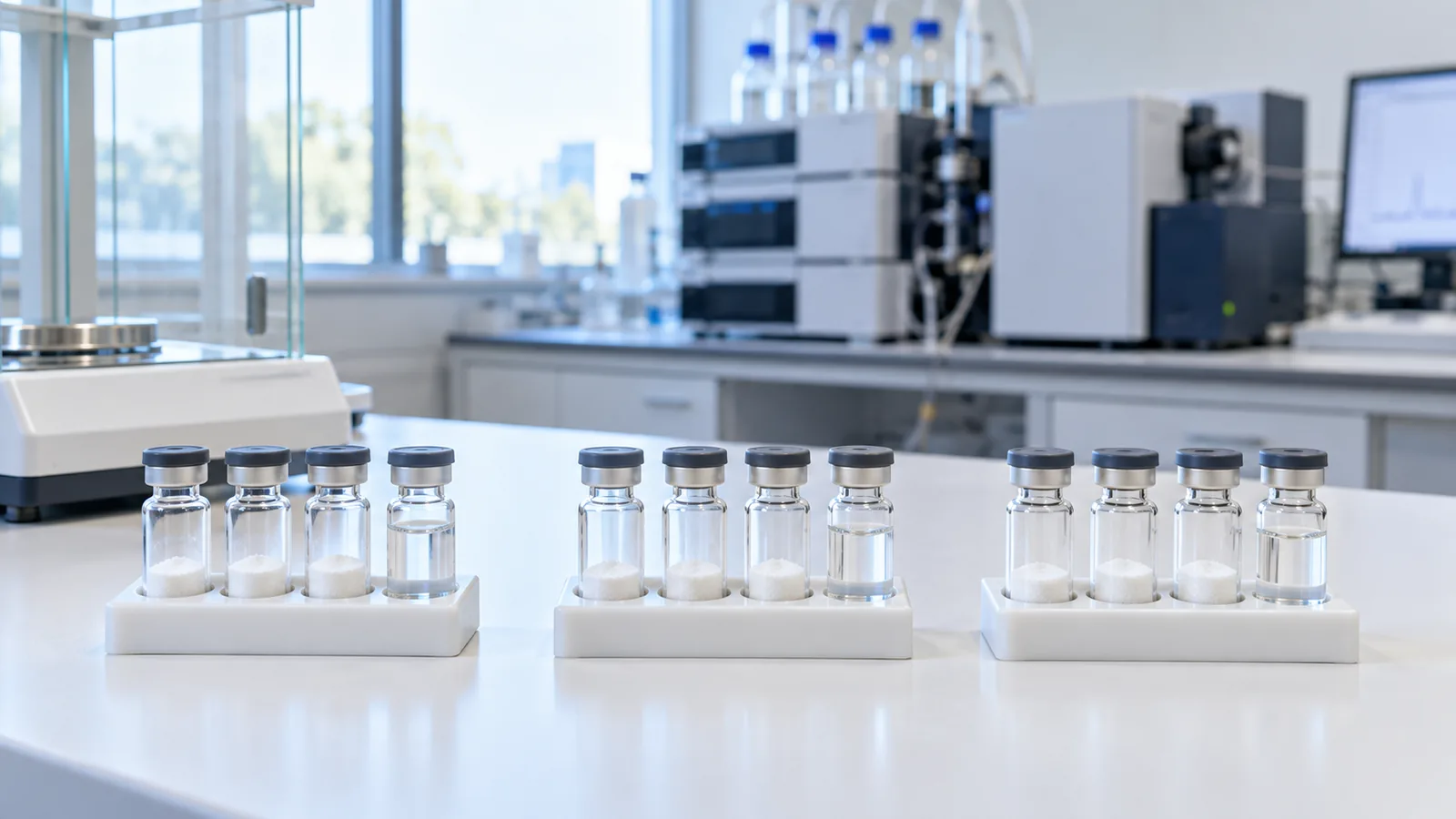
The vial says GLP-3. Sometimes it says GLP-3 RT, GLP 3 (RT) or RETA-GLP3, and sometimes the name turns up first in a short video or on a store page with nothing else to explain it. Anyone who has already seen GLP-1 and GLP-2 used the same way can tell the three names belong together, but none of them is the actual name of the compound in the vial.
This guide follows the name the way a new buyer meets it: what it refers to, why the numbers run the way they do, how the compound behind it compares with the ones sold as GLP-1 and GLP-2, what the clinical trials have shown, how stores print the name on their vials, and how to confirm what a vial marked GLP-3 actually holds.
What GLP-3 means
GLP-3 is retatrutide. Every research listing that uses the name, with or without the RT on the end, is selling the same molecule: the peptide Eli Lilly developed under the code LY3437943. It is a single chain of 39 amino acids carrying a fatty-acid tail, which binds it to albumin, the main blood protein, and stretches its action to a full week per injection.
It is not a hormone. The body makes GLP-1 and GLP-2, and it makes no third glucagon-like peptide. Both real ones are cut from a single precursor protein, proglucagon, which carries glucagon followed by two glucagon-like sequences in tandem. When that precursor was decoded in 1983, the two new sequences were numbered by where they sit along the chain. The 1 and the 2 are positions, not counts, and the chain has only two.
Lilly’s own retatrutide FAQ calls GLP-3 an informal label from the media and prefers “triple agonist”: one molecule that switches on three receptors, those for GIP, GLP-1 and glucagon. Research stores use the label as one step in a numbered naming system, which is how a vial can read GLP-3 without the word retatrutide appearing anywhere on it.
Where the GLP-3 name comes from
The market’s numbering counts receptors. Semaglutide acts on one, the GLP-1 receptor, and for it the label is accurate: semaglutide really is a GLP-1 receptor agonist. Tirzepatide acts on two, GIP and GLP-1, so stores call it GLP-2. Retatrutide acts on three, adding glucagon, so it became GLP-3. Each rung is the next weekly weight-loss molecule with one more receptor attached, and the letters after the number say which molecule it is.
| Market name | Compound | Receptors it switches on | Developer and approved brands | Codes seen on vials |
|---|---|---|---|---|
| GLP-1 | Semaglutide | GLP-1 | Novo Nordisk: Ozempic, Wegovy | SM, SEMA |
| GLP-2 | Tirzepatide | GIP and GLP-1 | Eli Lilly: Mounjaro, Zepbound | T, TZ, TR, TRZ, TIRZ |
| GLP-3 | Retatrutide | GIP, GLP-1 and glucagon | Eli Lilly: no approved brand yet | R, RT, RETA |
The ladder breaks on the middle rung. GLP-2 is a real hormone with an unrelated job: the gut releases it alongside GLP-1, and it keeps the lining of the small intestine growing and absorbing. The approved drug that copies it is teduglutide, sold as Gattex for short bowel syndrome, and it has no role in weight loss. In the research stores that use the ladder, though, GLP-2 is simply tirzepatide’s code.
The same goes for the suffixes. RT, R and RETA are all retatrutide, and a vial marked GLP-3 R holds the same molecule as one marked GLP-3 RT. TZ, TRZ, TR and T all point to tirzepatide. Simms Research writes the compound first and the code second, as Retatrutide (GLP-3) and Tirzepatide (GLP-2), so the molecule is named before the nickname.
GLP-3 vs GLP-1 and GLP-2
Since the names count receptors, the cleanest way to compare the three is to ask what each added receptor brings. All three are peptides injected once a week, with half-lives of roughly seven days for semaglutide, five for tirzepatide and six for retatrutide, so the difference lies in what they switch on, not how often.
GLP-1: the appetite receptor
This is where semaglutide does all of its work. The GLP-1 receptor slows how quickly the stomach empties, turns down hunger signals in the brain and lets the pancreas release insulin when glucose climbs after a meal. People on it eat less because they want less.
GIP: what GLP-2 adds
Tirzepatide keeps the GLP-1 action and adds GIP, the other gut hormone that triggers insulin release after eating. GIP also acts on fat tissue directly. SURMOUNT-5 put the two names against each other for 72 weeks, and tirzepatide came out at 20.2% weight loss to semaglutide’s 13.7%: a second receptor measurably beat one.
Glucagon: what GLP-3 adds
Retatrutide keeps both and adds glucagon. The body uses glucagon to lift blood sugar when it runs low, yet the same receptor pushes the liver to break down fat and raises daily energy use. Paired with GLP-1 and GIP, which keep glucose in check, that third signal works mostly on the burning side of the equation. The liver is where it shows first: in a 24-week Phase 2 substudy, liver fat dropped by more than 80% on the two highest doses.
Lined up, the best published result for each name climbs about six points per rung. The trials ran for different lengths in different groups of people, so the gaps are a guide rather than a race result.
| Market name | Trial and year | Weekly dose | Length | Weight change | Placebo |
|---|---|---|---|---|---|
| GLP-1 (semaglutide) | STEP 1, 2021 | 2.4mg | 68 weeks | −16.9% | −2.4% |
| GLP-2 (tirzepatide) | SURMOUNT-1, 2022 | 15mg | 72 weeks | −22.5% | −2.4% |
| GLP-3 (retatrutide) | TRIUMPH-1, 2026 | 12mg | 80 weeks | −28.3% | −2.2% |
The first trial to put GLP-3 directly against GLP-2, TRIUMPH-5, enrolled about 800 adults and is due to finish its main phase in late 2026. Until then, the dose-by-dose picture, side effects and cost per week of the two Lilly compounds are set out in Retatrutide vs Tirzepatide, and tirzepatide’s own doses in the tirzepatide dosage chart.
What the GLP-3 trials show
Retatrutide’s record now runs from one Phase 2 study to five Phase 3 readouts. The Phase 2 trial, published in the New England Journal of Medicine in 2023, gave 338 adults doses from 1mg to 12mg for 48 weeks. On 12mg every participant lost at least 5% of body weight, 93% lost 10% or more and 83% lost 15% or more, against 2% of the placebo group reaching that last mark. The Phase 3 TRIUMPH and TRANSCEND trials then tested the 4mg, 9mg and 12mg doses in several thousand people.
| Announced | Trial | Who took part | Length | 12mg result | Placebo |
|---|---|---|---|---|---|
| June 2023 | Phase 2 | 338 adults with obesity or overweight | 48 weeks | −24.2% | −2.1% |
| December 2025 | TRIUMPH-4 | 445 people living with knee arthritis plus obesity | 68 weeks | −28.7% | −2.1% |
| March 2026 | TRANSCEND-T2D-1 | 537 people with type 2 diabetes managed by diet and exercise | 40 weeks | −16.8%, A1C down by up to 2.0 points | Not published |
| May 2026 | TRIUMPH-1 | 2,339 adults with obesity or overweight and no diabetes | 80 weeks | −28.3% | −2.2% |
| July 2026 | TRIUMPH-3 | 1,949 people with severe obesity and established cardiovascular disease | 80 weeks | −22.6% | −3.2% |
| July 2026, full data September 2026 | TRIUMPH-2 | 1,152 people carrying excess weight alongside type 2 diabetes | 80 weeks | −20.8% | −4.0% |
Two patterns run through the list. Type 2 diabetes trims the weight loss, just as it does on semaglutide and tirzepatide, and blood sugar is where those trials shine instead: in TRIUMPH-2, whose full results were presented on September 29, 2026, up to 40% of participants reached an A1C under 5.7%, the normal range. And the weight curve was still moving where the trials ran longest. In TRIUMPH-1’s extension, participants starting at a BMI of 35 and up who stayed on 12mg to 104 weeks had lost 30.3%, about 85 lb.
The proportions tell the story better than averages. In TRIUMPH-1, 65.3% of the 12mg group ended below a BMI of 30, the line for obesity, and a third got below 25, the healthy range. The 4mg dose, reached with a single step up from the 2mg start, averaged 19.0%, which is more than semaglutide’s top dose achieved in STEP 1. The same trial cut knee pain scores by up to 73.1% in its osteoarthritis group and sleep apnea events by up to 60.6% in its apnea group.
Retatrutide is not approved anywhere yet. Lilly plans to submit it to the FDA between January and March 2027.
GLP-3 side effects
The side effects are the familiar ones from the GLP-1 and GLP-2 compounds. Most sit in the gut, most are mild to moderate, and they grow with the dose; in Phase 2, a 2mg first dose cut them compared with a 4mg one. The fairest way to read the rates is to take away what the placebo group reported anyway, which leaves the share the drug itself added. In TRIUMPH-1, the largest obesity trial, that works out as follows.
| Side effect | Placebo rate | Extra on 4mg | Extra on 12mg |
|---|---|---|---|
| Nausea | 14.8% | +13.8 points | +27.6 points |
| Diarrhea | 13.5% | +11.7 points | +18.5 points |
| Constipation | 10.9% | +12.9 points | +15.2 points |
| Vomiting | 4.8% | +5.8 points | +20.5 points |
| Dysesthesia (skin sensitivity) | 0.9% | +4.2 points | +11.6 points |
| Stopped for side effects | 4.9% | −0.8 points | +6.4 points |
Read that way, 4mg added nausea for about one participant in seven, and 12mg for a little over one in four. Vomiting is the effect that rises most with dose, from a few extra cases in a hundred at 4mg to one in five at 12mg. On 4mg, fewer people quit over side effects than did on placebo. Nausea and vomiting ran lower in the type 2 diabetes trial: in TRIUMPH-2, 28.0% reported nausea on 12mg against 8.0% on placebo, and 15.7% vomiting against 4.2%.
One effect is largely retatrutide’s own. Dysesthesia, an altered or heightened sensation in the skin, is what searches call GLP-3 skin sensitivity. In TRIUMPH-1 it reached 12.5% on 12mg against 0.9% on placebo, where tirzepatide’s trials put it below half a percent. Lilly reports that most cases were mild or moderate, most cleared up while treatment continued, and most of those affected stayed in the trial. Heart rate also rises with dose; in Phase 2 the increase peaked at 24 weeks and came down after that. The Retatrutide Dosage Guide lists side effects at every dose across the trials.
How GLP-3 is named on research vials
On research store listings the code usually leads and the compound’s name follows, if it appears at all. Here is how four stores that use the ladder list the three compounds, next to Simms Research.
| Store | Semaglutide | Tirzepatide | Retatrutide |
|---|---|---|---|
| Amino Club | GLP-1 (SM) | GLP-2 (TR) | GLP-3 (RT) |
| Ascend Science | GLP-1 SM | GLP-2 TZ | GLP-3 RT |
| Instant Peptides | GLP-1 SM | GLP-2 TRZ | GLP-3 RT |
| American Peptides | SEMA-GLP1 | TIRZ-GLP2 | RETA-GLP3 |
| Simms Research | Not sold | Tirzepatide (GLP-2) | Retatrutide (GLP-3) |
Kylo lists the same pair as GLP 3 (RT) and GLP 2 (TZ), with retatrutide spelled out only in the page title. On a listing built that way, the buyer’s first and clearest piece of information is a nickname.
Three things catch new buyers out. The first is the unlabelled vial: Instant Peptides sells each of its GLP codes in a labelled and an unlabelled version, and an unlabelled vial carries no name of any kind, so nothing on the glass separates GLP-2 from GLP-3. The second is the blend. The same catalogue lists a GLP-3 RT 25mg / Cag 5mg vial, and American Peptides sells a retatrutide and cagrilintide blend. Cagrilintide is an amylin analogue, a fourth hormone pathway, so the total on such a label is not all retatrutide: that vial holds 25mg of it in 30mg of peptide. The third is the middle rung, where a vial sold as GLP-2 holds tirzepatide and never the gut hormone or teduglutide.
Simms Research prints GLP-3 (RT) on their vial under the Simms name and spells the compound out in full on the product page: retatrutide, LY3437943, CAS 2381089-83-2, formula C221H342N46O68 and a molecular weight of 4,731.33. Their certificates carry the GLP-3 RT name and the lot number. A name on a label is still only a claim, though, which is where the lab report comes in.

How to tell what is in a GLP-3 vial
A lab report answers three separate questions, and only one of them tells GLP-3 from its neighbours. Identity asks which molecule is in the vial. Purity asks how much of the material is that one molecule. Net content asks how many milligrams are actually there. Pure tirzepatide scores 99% on a purity test just as easily as pure retatrutide does, so a purity figure on its own cannot say whether a vial marked GLP-3 holds GLP-3.
Identity: the mass peaks
Identity comes from mass spectrometry, written LC-MS on most certificates, which weighs the molecule. Retatrutide weighs 4,731.3, tirzepatide 82 units more and semaglutide about 618 less, so the three cannot be confused on a mass reading. The instrument sees each molecule carrying several extra protons, so the report shows peaks at the weight divided by that charge rather than at the weight itself.
| Market name | Compound | Molecular weight | Peak for the 3+ ion | Peak for the 4+ ion |
|---|---|---|---|---|
| GLP-1 | Semaglutide | 4,113.6 | About 1,372 | About 1,029 |
| GLP-2 | Tirzepatide | 4,813.5 | About 1,606 | About 1,204 |
| GLP-3 | Retatrutide | 4,731.3 | About 1,578 | About 1,184 |
Simms Research’s certificate for retatrutide lot G392 shows exactly that pattern: peaks near 1,183 and 1,579, marked as the 4+ and 3+ ions, beside an identity line that reads GLP-3 RT. A tirzepatide vial would put its peaks near 1,204 and 1,606 instead, close enough to look similar at a glance and far enough apart for the instrument to separate them cleanly.
Purity and net content
Purity comes from HPLC, which separates the sample and reports the main peak as a share of everything it detects. Net content measures how much peptide is really in the vial, which matters because every dose is worked out from the number on the label. Across Simms Research’s six published retatrutide batches, average purity is 99.78%. The 10mg vials ranged from 10.19mg to 11.95mg, and the single 20mg batch came in at 19.82mg. Batch 2026-G460, the most recent, was tested across three vials for purity, identity, net content, endotoxins, heavy metals and sterility.
Simms Research publishes every batch in their retatrutide batch records, and the Simms certificate guide walks through each field of a certificate. Once a vial checks out, How to Reconstitute Retatrutide gives the water for each vial size and the Retatrutide Dosage Guide sets out the trial schedule in units.
Frequently asked questions
Is GLP-3 the same as retatrutide?
Yes. GLP-3, GLP-3 R, GLP-3 RT and Reta all refer to retatrutide, Lilly’s LY3437943. Lilly’s own term for it is a triple agonist, after the three receptors it switches on.
What is the difference between GLP-1 and GLP-3?
GLP-1 is a real hormone and the class name for drugs such as semaglutide that act on its receptor alone. GLP-3 is a nickname for retatrutide, which acts on the GLP-1 receptor plus the GIP and glucagon receptors. Their best published trial results are 16.9% and 28.3% weight loss.
Is GLP-3 RT the same as tirzepatide?
No. Tirzepatide is the compound the market calls GLP-2. It acts on two receptors, GIP and GLP-1, and is approved as Mounjaro and Zepbound. Retatrutide adds glucagon, and on a mass reading it weighs 82 units less.
Does GLP-3 work for weight loss?
Yes. All five Phase 3 trials reported so far met their main goals, with average weight loss on the top dose ranging from 16.8% in a 40-week diabetes trial to 28.7% at 68 weeks.
How much weight do you lose on GLP-3?
In TRIUMPH-1, adults without diabetes lost an average of 28.3% on 12mg, 25.9% on 9mg and 19.0% on 4mg over 80 weeks, or 70.3 lb, 64.4 lb and 47.2 lb. Adults with type 2 diabetes lost up to 20.8% in TRIUMPH-2.
What is the best GLP-3 for weight loss?
Only one compound is sold as GLP-3, so the choice is not between molecules. What differs from one vial to the next is what is actually inside it, which only a certificate with mass, purity and net content results shows. On the trial record, 12mg gave the most weight loss, with 9mg close behind.
How is GLP-3 used in the trials?
As a weekly subcutaneous shot, opening at 2mg and rising every four weeks through 4, 6 and 9mg to 12mg. The freeze-dried powder is dissolved in bacteriostatic water first. How to Reconstitute Retatrutide covers the water and the Retatrutide Dosage Guide covers the steps in syringe units.
What are the side effects of GLP-3?
Mostly nausea, diarrhea, constipation and vomiting, generally mild to moderate and larger at higher doses. Retatrutide also causes dysesthesia, a skin sensitivity, which affected about one in eight people on 12mg in TRIUMPH-1.
What does RT mean in GLP-3 RT?
It stands for retatrutide, in the same way that TZ or TRZ marks tirzepatide and SM marks semaglutide. GLP-3 R and GLP-3 RT are the same compound.
Is GLP-3 a peptide?
Yes. Retatrutide is a 39-amino-acid peptide with a fatty-acid chain attached, supplied as a white freeze-dried powder.
Is GLP-3 FDA approved?
No. Lilly expects to submit retatrutide for FDA review in early 2027. Simms Research sells it for laboratory research use only.