

Blog
Is Ascension Peptides Legit? Independent Review
An independent review of Ascension Peptides with no code, no affiliate link and no sponsor: where the 2024 blend brand came from, why its top reviews all sell a discount, and what buyers and outside testers actually say.


Ascension Peptides belongs to the crop of US research shops that opened in 2024, a year before the shutdown wave started clearing out the older names. It is best known for its house blends, KLOW and the Wolverine Stack above all, and its name now comes up often enough that Google answers the legit question before anyone clicks.
That answer is a yes, and most of the reviews ranked under it put a discount code in the headline, right next to the verdict. This review carries no code, no affiliate link and no sponsorship. What follows is the outside view: where Ascension came from, where it sits in the market, what buyers and independent testers say about it, how much of its reputation runs through paid partners, and what ordering looks like once the coupon pages are set aside.
Where Ascension Peptides came from
Ascension started in Castle Rock, Colorado, in 2024. The brand mark went up in the spring and the store was taking orders by the summer. From the start it was built as a distribution business as much as a web shop. One of its earliest pages, still live today, is a pitch to smoke and supplement stores: a starter kit of popular vials priced for resale, a promise to triple the store’s profits, and a free backlit sign for the shop window, under the line that there was no competition yet. A wholesale and distributor program sits next to it on the site.
That origin explains a lot about how the brand grew. The vendors buyers trusted in 2022 earned their names slowly, in forum threads and buyer-run lab tests, long before scorecard sites filled page one. Ascension came up in the era of partner programs and coupon reviews, and it built for that era: retail counters, wholesale tiers, and a multi-tier partner program that pays commission every month and gives select partners branded discount codes.
Then the market around it changed. Amino Asylum went dark in mid-2025, Peptide Sciences closed in March 2026, and a large share of the research market went looking for a new shop at the same time. Ascension was already trading, already had its blends, and already had partners writing about it. Around the turn of 2026 its mailing address moved from Castle Rock to Kansas City, Missouri, while the Colorado phone number stayed. Most directories, and Google’s own summary, still place the company in Colorado.
What Ascension is known for
Ask anyone who has come across the name and the answer is the blends. KLOW puts GHK-Cu, BPC-157, TB-500 and KPV in one vial. GLOW is the same mix without KPV. The Wolverine Stack pairs BPC-157 with TB-500, and the FIT Stack pairs CJC-1295 with ipamorelin. Pre-mixed blends were not Ascension’s invention, but it put them at the front of the shop and gave them names people remember, and every directory entry for the brand leads with them. For a buyer who wants the classic recovery pairing in one vial instead of two, that convenience is real. Simms Research’s GLOW vs KLOW breakdown covers how the two best-known mixes differ.
The weight-loss compounds are handled differently. Retatrutide, tirzepatide, semaglutide and cagrilintide appear on the shelf only as letter codes (R-10, R-30, T-10, T-30, S-5 and C-10), and the listings say little beyond research use. The compound names live in the certificate library. Regular buyers learn the codes quickly; a first-time buyer has to work them out from the reports.
The sticker price is not where Ascension competes. Nearly every listing is marked down from a higher crossed-out figure, and what a buyer actually pays depends on which partner sent them. PeptideMind, one of the few directories that prints weaknesses next to strengths, says it plainly in its community note: prices are high before a discount and only compete once an affiliate code is applied. The shelf has also narrowed into a vial shop. Directory entries still describe topical serums, tablets and drops that are no longer listed.
Why every top result sells a code
Read the first page for the legit question the way a buyer would and the pattern shows quickly. Four of the nine results sell a code outright; the store’s own site and an unrelated UK shop’s review page take two more. The top review site builds its headline around the discount, applies it automatically through its own link and ranks Ascension near the top of its vendor table. A scoring site gives the brand a near-perfect grade with a coupon in the title. A third review answers its own question with an emphatic yes, a few lines from its own code. Further down sits a gardening-forum thread whose title is an Ascension promo code and nothing else, and the peptide forums carry posts that are nothing but a code.
None of that happened by accident. Ascension’s partner program pays monthly commission on referred sales and advertises multi-tier network opportunities. Its partner terms forbid promoting a coupon unless the store assigned one, so the codes on page one are the store’s own codes, handed to the sites that sell them. The terms also ask partners to disclose the relationship, and most of these pages do, somewhere below the verdict.
The real problem is what a page paid per sale has no reason to bring up. Across the four review pages, none mentions that Trustpilot removed Ascension’s profile, though three still quote its rating. None says the company’s address moved. None notes that no outside tester has published a result on an Ascension vial, and the return terms get a single line telling buyers to check with the vendor. One review, updated at the end of September 2026, still compares Ascension with Peptide Sciences as if both were trading, and credits it with expedited shipping that Ascension’s own FAQ says it does not offer. The one listing that calls itself an independent vendor review is a directory card last checked in February, naming a testing lab that does not appear on Ascension’s current reports.
So the thing a buyer is actually searching for is the part these pages leave out: the record that sits outside the store and its partners. The next sections are that record.
What buyers and independent testers say
Take away the paid pages and the independent record on Ascension is small. The buyers who post about it in peptide threads mostly say the parcel came and support answered. One this summer called the shipping and customer service great and only wanted opinions on quality; another, in September, named Ascension as one of two shops they had never had a problem with. Stories of parcels that never turned up are close to absent.
The complaints are about what was inside the vial. In late July 2026 a buyer wrote that a peptide clumped after mixing and that Ascension would not acknowledge the problem. In August another reported no effect at all from an Ascension retatrutide vial and asked the store for a replacement or a refund. Neither posted an outcome. Two posts are not a pattern, and nobody followed up with an outside test, which is the real point: nothing on the public record settles them in either direction.
The one open review page is gone. Trustpilot’s page for ascensionpeptides.com now reads “This profile has been removed” and says the business goes against its guidelines, with no reason given beyond that and no date. A buyer noticed in July, asked whether anyone else had run into trouble, and added that the company had not answered. On its own, a removed profile says nothing about whether any order arrived. What it changes is what a buyer can check: the rating Google and the coupon pages still quote describes a page nobody can open, and the one public place where unhappy customers could post and the store had to answer in front of everyone no longer exists.
Independent testing is the larger gap. Finnrick, where buyers mail in vials for free outside testing, keeps an Ascension page with no published results. No buyer has posted an outside lab result on an Ascension vial anywhere else either, so every report on the record is one the store ordered itself. The rest of the trail is thin. PeptideMind’s review tab holds a short run of uniformly five-star notes, all from 2025. On TikTok, where much of the newer buying crowd talks, “ascension” is looksmaxing slang, and the brand barely registers among gym clips and shops with similar names.

How Ascension’s testing reads
This is where Ascension has done real work, and it deserves the credit. Its certificate library can be searched by product, batch, cap colour and test date, and each entry opens the full report. Batch numbers are built around production runs, so the 10mg and 30mg vials made in the same run share a run code and tie back to one set of tests. The newest reports, from a spring 2026 run, cover purity, identity by mass spectrometry, endotoxin, heavy metals and a sterility screen. Reports on the 2025 runs came from other labs and covered purity, content and identity.
Two things sit outside the library. The listings do not say which run a buyer will receive, so the match happens after the vial arrives, by batch number or cap colour. And the newest entries went up in July, so anyone ordering this autumn should find their vial’s run in the library before mixing anything, and treat a vial they cannot match as untested until they can. Simms Research’s guide to reading a peptide COA explains what each line on a report actually proves, and what it does not.
Ordering from Ascension in practice
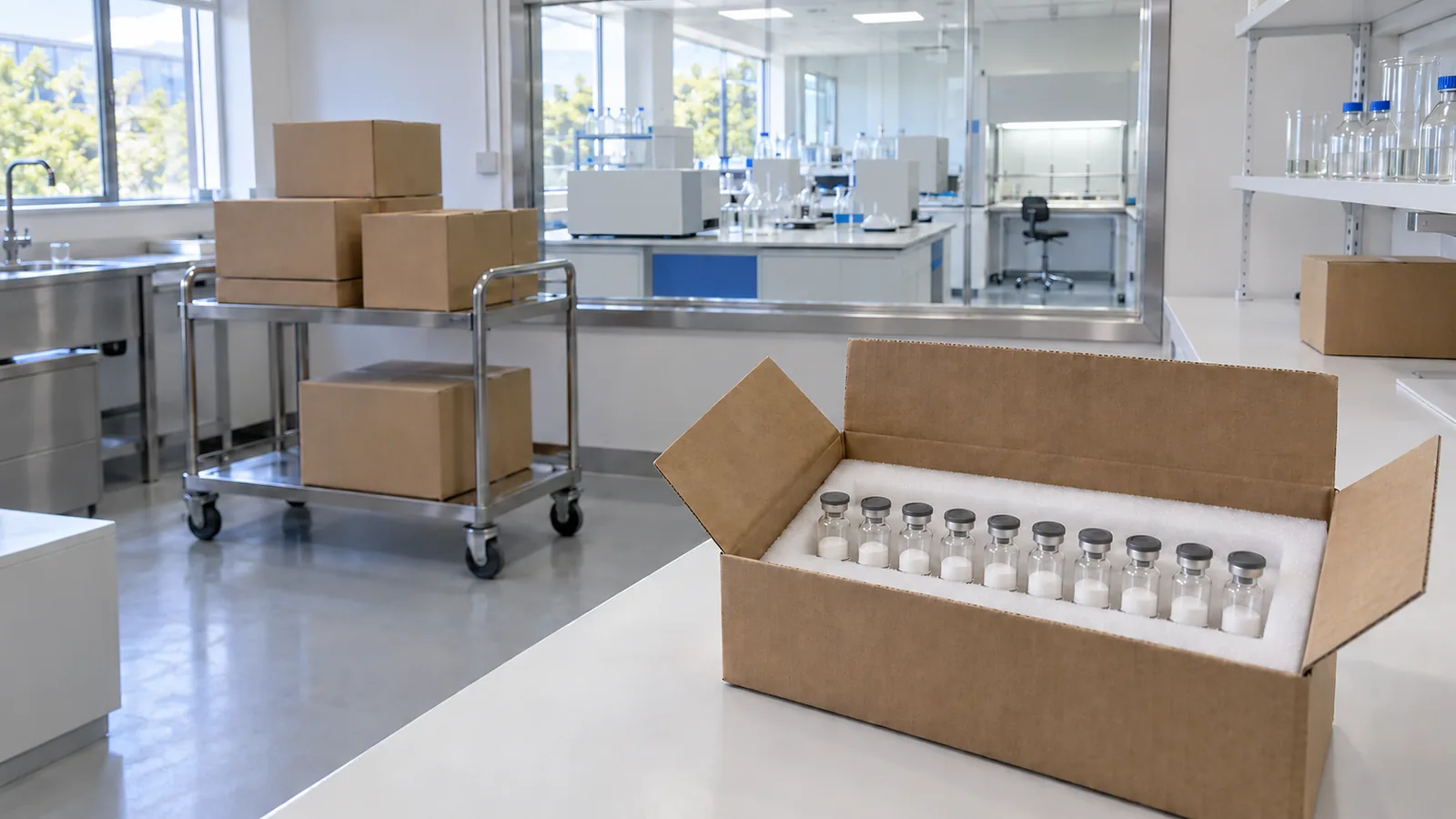
Ascension ships inside the United States only, for a flat fee, and most orders leave within a day once the payment has cleared the bank. The shipping page quotes 2 to 5 business days by UPS or USPS. The FAQ, updated more recently, says UPS Ground only, 5 to 7 business days and no faster option. Plan around the longer one. Freeze-dried powder travels fine without ice, so a box with no cold pack is normal; Simms Research’s piece on whether peptides need to be refrigerated explains why.
The terms that matter most are the ones about what happens when something goes wrong. Once a parcel is with the carrier, Ascension says it is no longer responsible for it, and that includes a box that goes missing after a delivery scan. Its answer is Route, a paid protection add-on at checkout, with claims filed through Route rather than the store. Without it, a lost parcel is the buyer’s loss. Damaged or wrong orders have to be reported within 24 hours of delivery under the return policy, even though the FAQ allows 48, so the box is worth opening and photographing the day it lands.
All sales are final, as they are at nearly every research shop, and an order cannot be changed once the payment is authorised. The return policy also carries a pointed chargeback clause: a buyer who disputes a charge without contacting support first is warned of legal action and a fee. In practice, that means emailing support and keeping the thread before going anywhere near the bank. Support answers by email and phone on weekdays, Central time.
Same name, different store
The store the reviews are about is ascensionpeptides.com, typed in by hand rather than reached through a coupon link. The name has collected copies in 2026, and some of them rank. ascensionpeptides.us went up at the end of August: a template site with no shop that retells the Castle Rock founding story in its own words. ascensionpeptidez.com, with a z, appeared earlier the same month. Ascension Labs is a separate store that opened in May. None of them is the shop this review covers.
Google’s related questions show how far the confusion runs, with buyers asking about “ascended peptides”, Ascension LLC and Ascension Laboratories in the same breath. Ascend Science is a different shop with a much larger TikTok following, covered in Simms Research vs Ascend Science. Ascend Peptides in the UK and an Ascend account in Malaysia are unrelated to both. And because Ascension sells wholesale into smoke and supplement stores, a vial bought over a counter has been through a reseller’s shelf and pricing, outside the store’s own damage and refund terms.
Is Ascension Peptides legit?
Ascension Peptides is a real US shop that has been trading since 2024. The buyers who post about orders mostly say they arrived, and it keeps a better-organised testing library than many shops its age. Its blends gave it an identity early, and the shutdowns of 2025 and 2026 sent it a wave of buyers it was well placed to catch.
What it lacks is an independent record to match its reputation. The yes Google gives rests on a review page Trustpilot took down and on directory entries that still describe an older store, in another state, with products it no longer lists. Nearly everything else that ranks for its name is paid per sale through codes the store hands out. No outside tester has published a result on its vials, the unhappy buyers on the record have no posted resolution, and the policies leave a lost parcel with the buyer unless they paid extra for protection.
Put together, Ascension reads as a young shop whose reputation was built mostly by people paid to build it, with real paperwork underneath and very little independent confirmation on top. A buyer who orders anyway should type the address in, match every vial to its library entry, open the box the day it arrives, and judge the shop by the parcel in hand rather than by the scorecards.
Simms Research, for comparison
Simms Research is a newer shop that ships from Florida. Each batch is tested by an independent ISO-certified lab before it goes on sale, the batch ID is printed on every vial, and that batch’s report is posted among the Simms Research batch reports; the newest batches also show endotoxin, heavy-metal and sterility results. Retatrutide is sold under its own name, at $84 for 10mg.
Orders placed before 5 PM Eastern leave the same day, by UPS Standard or by FedEx 2-Day, which is free above $200. A Free Delivery Guarantee comes with every order with nothing to add: if a parcel is lost in transit, goes missing after a delivery scan or turns up damaged, Simms Research replaces it and deals with the carrier itself, as its refund and return policy explains. Payment is by Zelle or Venmo, both 5% off.
Frequently asked questions
Is Ascension Peptides legit?
Ascension Peptides is a real US shop at ascensionpeptides.com, trading since 2024, and most buyers who post about an order say it arrived. Its Trustpilot profile has been removed, no outside lab has published a test of its vials, and most reviews that rank for its name carry an affiliate code. Its independent record is thin for the reputation it has.
Is Ascension Peptides legit on Reddit?
Buyer threads mostly report parcels arriving and support answering. The complaints posted in 2026 are about vial contents, a peptide that clumped after mixing and a retatrutide vial with no effect, and neither has a posted resolution. Many of the longest posts that name Ascension are promotional guides to its blends or bare coupon codes rather than buyer reports.
Does Ascension Peptides have a coupon code?
Codes circulate through its partner program, which gives select partners branded codes and pays them commission on each sale. That is why most review pages for the brand put a discount in the headline. This review carries none. PeptideMind notes that Ascension’s prices only compete once a code is applied.
Is Ascension Peptides on Trustpilot?
No longer. The Trustpilot page for ascensionpeptides.com reads “This profile has been removed” and says the business goes against Trustpilot’s guidelines. Ratings quoted elsewhere, including in Google’s AI summary and on the coupon review sites, date from before the removal.
Where is Ascension Peptides located?
It started in Castle Rock, Colorado, which is where most directories still place it. Since around January 2026 its contact page has listed a mailing address in Kansas City, Missouri, with the same Colorado phone number. It ships within the United States only.
Is Ascension Peptides the same as Ascend Science?
No. Ascend Science is a separate shop with a large TikTok presence. Ascension Labs is also a separate store, and ascensionpeptides.us is a 2026 site with no shop that borrows Ascension’s founding story.
Does Ascension Peptides sell tirzepatide?
Yes, under the codes T-10 and T-30 for the 10mg and 30mg vials. Retatrutide is listed as R-10 and R-30 and semaglutide as S-5. The listings do not spell out the compound; the certificate library does.
How do you tell if a peptide vendor is legit?
Start with the evidence the vendor cannot write for itself: outside test results on its vials, a public review page it has to answer on, batch reports that match the vial in hand, and policies that say who pays when a parcel goes missing. The Simms Research buyer’s guide on where to buy peptides covers those checks.