

Blog
BPC-157 Dosage Calculator and Chart: How Much to Take and When
BPC-157 dosage for the 10mg and 20mg vials: one chart in units, how much bac water, once or twice a day, cycle length, vial life and batch results.

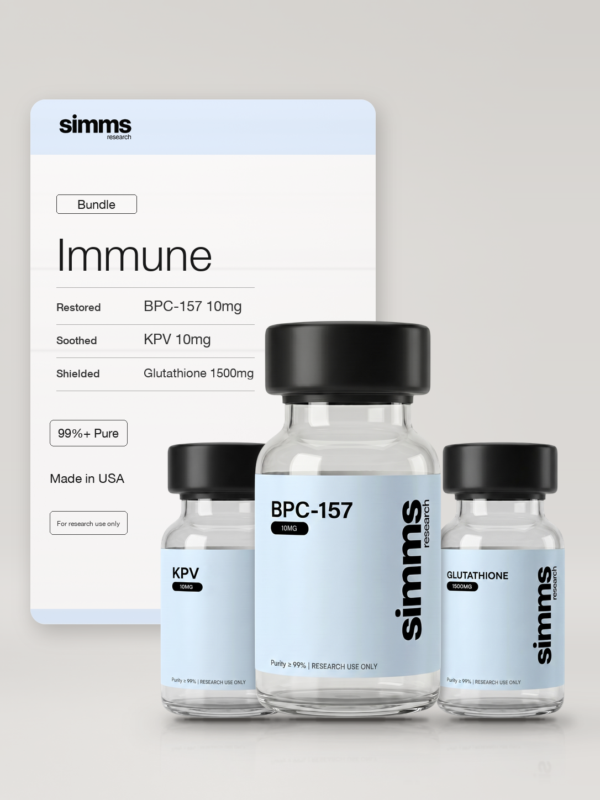
BPC-157 is dosed in micrograms and drawn most days, so the figure that matters on the bench is a unit count. Simms Research sells BPC-157 as a 10mg vial ($69) and a 20mg vial ($109), and mixed the way this guide sets out, the two sizes behave identically: the 10-unit mark on an insulin syringe is 500mcg whichever vial it came from. The bigger vial just holds twice as many draws.
BPC-157 dosage calculator
Pick the vial, the water and the dose, and the calculator gives the units to draw on a U-100 insulin syringe. It opens on a 10mg vial with 2mL and a 500mcg dose: 10 units.
BPC-157 dosage chart
250 to 500mcg a day is the range BPC-157 protocols work in. With 2mL in the 10mg vial or 4mL in the 20mg vial, both solutions come out at 5mg per mL, so each unit carries 50mcg and one chart serves both sizes:
| Amount drawn | U-100 units | 10mg vial holds | 20mg vial holds |
|---|---|---|---|
| 250mcg | 5 | 40 draws | 80 draws |
| 500mcg | 10 | 20 draws | 40 draws |
| 750mcg | 15 | 13 draws | 26 draws |
| 1mg | 20 | 10 draws | 20 draws |
Most protocols open at 250mcg, a 5-unit draw, and settle at 500mcg, 10 units. Draws of 750mcg and 1mg sit above the usual range, and protocols that reach a 1mg day mostly take it as 500mcg twice. A 0.3mL insulin syringe is marked one unit per line, which makes a 5- or 10-unit draw easy to read.
How to reconstitute BPC-157 10mg and 20mg
Add 2mL of bac water to the 10mg vial and 4mL to the 20mg vial. Double the powder, double the water: the strength stays the same, so one chart covers both.
Trickle the water down the glass wall rather than onto the white cake, and swirl instead of shaking. The powder is gone in about a minute, leaving a solution with no color and nothing floating in it. Mark the mixing day on the vial and store it cold. The full sequence, start to finish, sits in the hub guide on how to reconstitute peptides.
One $20 bottle of Simms Research’s Research Water (10mL) covers five 10mg vials or two 20mg ones. Why its benzyl alcohol suits a vial that gets punctured again and again for weeks is explained in the bac water guide. Some guides put 3mL in the 20mg vial; less water concentrates each unit, so their counts won’t line up with this chart.
BPC-157 10mg reconstitution calculator
Other mixes, such as a 5mg vial, 3mL of water or a dose that falls between two rows, go into the peptide calculator, and it hands back the units.
What is BPC-157 peptide used for
BPC-157 is a 15-amino-acid fragment of body protection compound, a protein found in human gastric juice. Researchers use it to study healing. The bulk of its record is rat work on injured tendon, ligament and muscle, and on the gut, where it was tested against colitis, fistulas and the stomach damage left by anti-inflammatory painkillers.
Two traits set it apart from most research peptides: it stays intact in stomach acid, so it has been studied by mouth as well as by injection, and it was effective in many rat models at doses as low as nanograms per kilogram. BPC-157 vs TB-500 sets out how it differs from its usual partner.
BPC-157 dosage per kg in the studies
10 micrograms per kilogram of body weight, once a day. That is the dose behind most of the published work, much of it from Predrag Sikiric’s group at the University of Zagreb. Their 2003 Achilles tendon study is typical: rats with a cut tendon got a daily injection of 10mcg/kg, 10ng/kg or 10pg/kg, and across the 14 days the treated tendons bore more load before failing and closed the gap, while untreated ones healed poorly.
For the oral groups, the same lab dissolved BPC-157 in the rats’ drinking water at 0.16mcg per mL, about 12mL a rat each day, which works out to roughly the same 10mcg/kg (Japjec, Biomedicines, 2021). There is no trial-tested human dose. Converted to a 70kg adult, the rat figure lands anywhere from about 110 to 700mcg depending on the method, and the Wolverine stack dosage guide sets out both conversions. Protocols settle between them at a flat 250 to 500mcg, with no adjustment for weight or sex.
BPC-157 once or twice a day
Either: once a day at 250 to 500mcg, or the same total split into a morning and an evening draw. The rat studies injected once a day. The case for splitting comes from how briefly the peptide lasts: a 2022 study in rats and beagle dogs measured a half-life under 30 minutes, so two smaller draws keep it present across more of the day.
Split protocols most often run 250mcg twice, 5 units each time, which keeps the day at 500mcg. The top of the range is 500mcg twice, 1mg a day, and that is the schedule the 20mg vial suits best. Injected BPC-157 isn’t tied to meals or sleep, so the time of day is whatever can be kept steady.
BPC-157 cycle length and dosage
Four to twelve weeks at 250 to 500mcg a day, with six to eight weeks the most common block, followed by a break of roughly the same length. Shorter blocks go with acute injuries, longer ones with slow-healing tissue such as tendon.
The studies sit inside that span. Most rat studies ran two to six weeks, and a 2006 quadriceps study followed its rats for 72 days. No study has found BPC-157 losing its effect with steady use, so the break is a protocol convention rather than a finding.
How long a 10mg or 20mg vial of BPC-157 lasts
Twenty days at 500mcg a day from the 10mg vial, and forty from the 20mg. The common schedules work out like this:
| Schedule | BPC-157 per day | 10mg vial | 20mg vial |
|---|---|---|---|
| 250mcg once a day | 250mcg | 40 days | 80 days |
| 500mcg once a day | 500mcg | 20 days | 40 days |
| 250mcg twice a day | 500mcg | 20 days | 40 days |
| 500mcg twice a day | 1mg | 10 days | 20 days |
A mixed vial keeps 28 days in the fridge, so the size that fits a protocol is the one it empties inside that window. At 500mcg a day that is the 10mg vial, done in 20 days; at 1mg a day it is the 20mg vial, also done in 20. A 20mg vial at 500mcg a day holds 40 days of draws, twelve more than the mix keeps, and at 250mcg a day even the 10mg vial outlasts it. An eight-week block takes three 10mg vials at 500mcg a day, or three 20mg vials at 1mg a day.
BPC-157 10mg vs 20mg
The same peptide at the same strength once mixed. The 20mg vial costs $109 against $138 for two 10mg vials, about a fifth less per milligram, and it is the natural fit for 1mg-a-day protocols, 500mcg twice daily. A single daily draw of up to 500mcg fits the 10mg vial.
BPC-157 oral vs injection
Both routes have research behind them, which is rare for a peptide. BPC-157 holds up in gastric juice, and the Zagreb rats often got it in their water bottles at the same 10mcg/kg used for injections, in gut models from colitis to surgical joins in the bowel, and in ligament and muscle-tendon injuries as well. In a 2021 study of injured muscle-tendon junctions, the oral regimen and the injected one both worked.
Capsule protocols in circulation take 250 to 500mcg once or twice a day on an empty stomach, mostly for gut research, while tendon, ligament and muscle protocols inject. No study has compared the two routes in people, and the chart in this guide is for the injectable vial.
Can you take too much BPC-157?
No study has found a dose that harms. The fullest toxicology program, published in 2020 by the Fourth Military Medical University in Xi’an, tested BPC-157 in mice, rats, rabbits and dogs. A single injection of 20mg per kilogram, two thousand times the standard study dose, caused no deaths and no change in rats’ weight, eating or behavior. Four weeks of daily doses at up to 4mg/kg in rats and 2mg/kg in dogs left the animals matching their untreated controls, with one exception covered under side effects below.
The human data points the same way. In a 2025 pilot, two healthy adults received 10mg by intravenous infusion and 20mg the next day, and their heart, liver, kidney, thyroid and glucose markers didn’t move. On the syringe, 10 units is the standard 500mcg draw and 20 units, 1mg, is the most a common protocol takes in a day. A 30-unit draw, 1.5mg at these mixes, sits above the range protocols use.
BPC-157 side effects
For most, nothing is noticed past the moment of the injection. The 12 women in a 2024 bladder pilot, given 10mg around the bladder wall in a single procedure, had no adverse events, and the two adults in the infusion pilot had no side effects. The 2020 toxicology work rated irritation at the injection site as mild and found no genetic or embryo-fetal toxicity.
Its one lab change answers the kidney question: dogs on 2mg/kg a day for four weeks showed lower creatinine, not higher, back to normal within two weeks of stopping, and the lower doses changed nothing (Xu, Regulatory Toxicology and Pharmacology, 2020). Reports from people running BPC-157 add brief redness or itching at the site and, less often, nausea, light-headedness, headache or fatigue early in a block.
BPC-157 and TB-500 dosage
The two are dosed separately. BPC-157 stays in micrograms every day, while TB-500 runs in milligrams, usually twice a week, with its own units in the TB-500 dosage chart. Simms Research’s Wolverine Peptide Stack puts 10mg of each in one 20mg vial for $79, where a 10-unit draw holds 500mcg of both; the Wolverine stack dosage guide maps that vial. Glow adds GHK-Cu to the same pair, and its units are in the Glow peptide dosage guide.
BPC-157 batch test results
All five published batches came in over the 10mg printed on the label. For the newest, checked in mid-July 2026 by an independent ISO-certified lab, three vials were weighed and run one at a time:
| Sample | Net peptide | HPLC purity |
|---|---|---|
| Vial A | 10.15mg | 99.818% |
| Vial B | 10.28mg | 99.479% |
| Vial C | 10.13mg | 99.655% |
| Three-vial mean | 10.19mg | 99.651% |
RP-HPLC set the purity and LC-MS confirmed the molecule. That batch also cleared the endotoxin limit, had no heavy metals detected and stayed clean through sterility culture. The four earlier batches, September 2025 through April 2026, were single-vial tests reading 10.23 to 11.29mg at 99.13 to 99.58% purity. Every posted batch is a 10mg vial.
Applied to the chart, 10.19mg dissolved in 2mL means the 10-unit draw really carries about 510mcg. Typing a certificate’s measured milligrams into the calculator gives units for that exact vial. The BPC-157 lab results page opens every certificate in full, and the COA reading guide decodes its fields.
Frequently asked questions
How much bac water do you mix with 10mg of BPC-157?
2mL, which makes 10 units 500mcg. A 20mg vial takes 4mL for the same strength.
What is the recommended dosing protocol for BPC-157?
250 to 500mcg a day, once or split into two draws, for four to twelve weeks, then an equal break. At the mixes above that is 5 to 10 units a day.
How much BPC-157 should you start with?
250mcg, 5 units, for the first week, then 500mcg, 10 units, for the rest of the block.
Is 10 units of BPC-157 too much?
No. With 2mL in the 10mg vial or 4mL in the 20mg vial, a 10-unit draw holds 500mcg, the amount most protocols run on.
How long does BPC-157 last once mixed?
Refrigerated, 28 days from the day water goes in. Sealed powder tolerates room temperature well enough to ship without cold packs, and both stages are in the peptide refrigeration guide.
How long until BPC-157 shows results?
In the rat injury studies, treated animals pulled ahead of untreated ones within one to two weeks, and the gap held through studies that ran six weeks and longer. People have no published timeline yet.
Is the BPC-157 dose different for women?
No. Protocols give the same 250 to 500mcg regardless of sex or body weight.
Is BPC-157 approved?
No country has approved it as a medicine, and the World Anti-Doping Agency has listed it as prohibited since 2022. Simms Research sells BPC-157 for lab research use.