

Blog
SS-31 Peptide Dosage Chart and Calculator: Elamipretide 10mg Vial Protocol
SS-31 dosage for a 10mg vial: units per draw with 2mL of bac water, the cycles in circulation beside the elamipretide trials, and how long a vial lasts.

SS-31 is a four-amino-acid peptide that goes to the inner membrane of the mitochondria and binds cardiolipin, the lipid the cell’s energy machinery is built on. In drug development it carries the name elamipretide. It ships as a dry white powder, and the amounts below are in micrograms: a 10mg vial with 2mL of water added gives 20 draws of 500mcg.
Simms Research stocks SS-31 in a 10mg vial at $78, and every number below is written for that vial.
SS-31 peptide dosage calculator
Pick the water and the dose, and the calculator gives the units to draw on a U-100 insulin syringe. It opens on a 10mg vial with 2mL and a 500mcg dose: 10 units.
SS-31 peptide dosage chart
500mcg to 1mg a day, 10 to 20 units of an insulin syringe, is the range a 10mg vial is sized for. With 2mL of water in the vial, one unit is 50mcg:
| Amount | Syringe units (U-100) | Draws per vial |
|---|---|---|
| 250mcg | 5 units | 40 |
| 500mcg | 10 units | 20 |
| 1mg | 20 units | 10 |
| 2mg | 40 units | 5 |
| 5mg | 100 units, a full 1mL syringe | 2 |
The protocols in circulation fall into two bands. The microgram band holds at 500mcg or 1mg, often five days a week, and fits a 30-unit (0.3mL) insulin syringe, whose marks fall at single units. The milligram band runs 2 to 5mg a day: 40 units for 2mg, and for 5mg the whole 1mL syringe, 100 units, which is half the vial in a single draw.
The human trials sit far above both bands. The subcutaneous elamipretide studies gave 40mg a day, with one heart-failure arm at 4mg, and the approved drug uses 40mg; the trials are set out under the cycle section below. A different vial or a different amount of water goes through the peptide calculator instead.
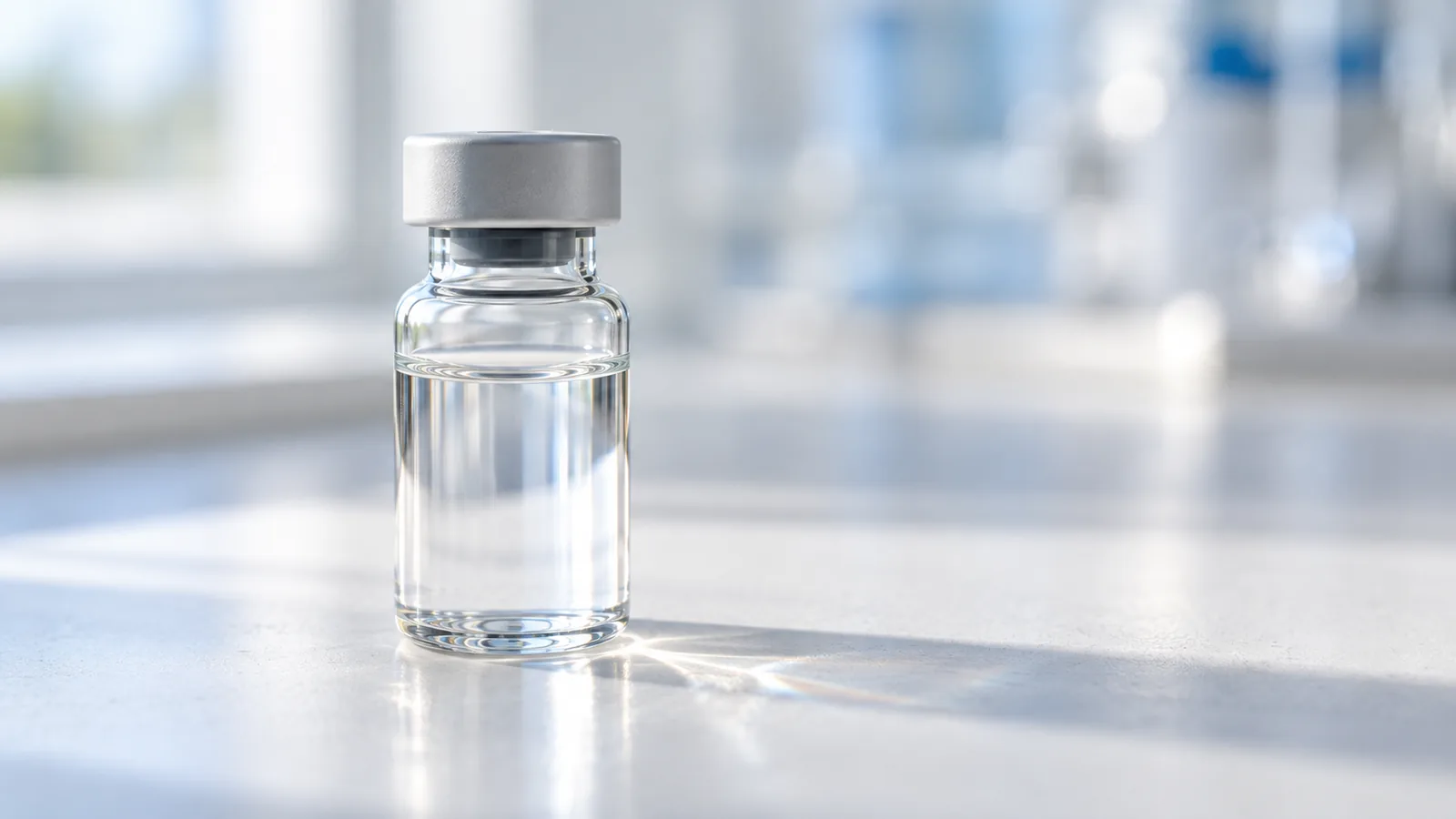
SS-31 reconstitution: bac water for 10mg
2mL. Each 10 units then holds 500mcg and each unit 50mcg, the numbers the chart is built on, and the same 2mL that Simms Research lists for most of its 10mg vials.
Run the water down the inside of the glass instead of onto the cake, then turn the vial slowly; shaking only raises foam. SS-31 is tiny and dissolves readily in bacteriostatic water, so the cake clears inside a couple of minutes. A finished vial is clear and colorless, as clear as plain water, with nothing floating and nothing on the bottom. Write the mixing date on it and store it cold. Every other vial follows the routine set out in how to reconstitute peptides.
A 10mL vial of Research Water, Simms Research’s bacteriostatic water at $20, covers five SS-31 vials. Why a vial drawn from for weeks needs the benzyl alcohol preservative, which plain sterile water lacks, is explained in the bac water guide.
SS-31 peptide dose per day
One draw a day: 500mcg to 1mg in the microgram protocols, 2 to 5mg in the milligram ones. Every human trial of elamipretide dosed it once daily, and its pharmacology fits that rhythm. Under the skin it reaches its peak in the blood 30 to 60 minutes after the dose, nearly all of it has left in urine within 48 hours, and it barely builds up from one day to the next (Forzinity prescribing information, 2025).
Most protocols take it in the morning, some shortly before a workout. Neither the trials nor the drug label tie it to a time of day or to meals, so what matters is the same hour each day. Microgram protocols hold one amount from the first day; milligram protocols often step up after a week or two, for example from 2mg to 4mg.
SS-31 cycle and dosing protocol
A common cycle is 500mcg on a 5-on/2-off week for eight weeks, followed by eight weeks off. Other protocols run blocks of four to twelve weeks with two to eight weeks between them. The rest weeks come from community practice rather than the trials: every elamipretide study dosed daily, without a break, and the longest has run for years.
| Trial | Who took part | Daily dose | Length |
|---|---|---|---|
| TAZPOWER | 12 people with Barth syndrome | 40mg | 12 weeks, then an extension past 3 years |
| MMPOWER-3 | 218 adults with mitochondrial myopathy | 40mg | 24 weeks |
| ReCLAIM-2 | 176 adults with dry macular degeneration | 40mg | 48 weeks |
| PROGRESS-HF | 71 adults with heart failure | 4mg or 40mg | 4 weeks |
Next to those numbers, a 500mcg draw is one-eightieth of the trial dose and a 5mg draw one-eighth. No trial has tested the lower amounts; they come from community protocols written around the 10mg vial. An eight-week block at 500mcg on weekdays takes two vials.
SS-31 10mg: how long one vial lasts
Four weeks at 500mcg on a 5-on/2-off week: 20 draws of 10 units, finished in the same week the mixed vial reaches its 28-day limit. On other schedules the vial ends on whichever comes first, the last draw or day 28:
| Schedule | Draw | One vial lasts |
|---|---|---|
| 250mcg every day | 5 units | 28 days, the mixed-vial limit |
| 500mcg, 5 on and 2 off | 10 units | 4 weeks |
| 500mcg every day | 10 units | 20 days |
| 1mg, 5 on and 2 off | 20 units | 2 weeks |
| 1mg every day | 20 units | 10 days |
| 5mg every day | 100 units | 2 days |
Mixed SS-31 keeps 28 days between 2 and 8°C (36 to 46°F). The sealed powder keeps best in the fridge, or at −20°C for long storage, and can sit at room temperature for weeks; Simms Research ships it without ice for that reason. Powder and mixed vial are both covered in the peptide refrigeration guide.
SS-31 peptide benefits: what it does
SS-31 protects the inner membrane of the mitochondria. Its sequence, D-Arg-Dmt-Lys-Phe-NH2, alternates positive charges with aromatic rings, which lets it pass through cell membranes and gather on cardiolipin, the lipid that holds the electron-transport chain’s protein complexes together. Oxidative stress damages cardiolipin, the folds of the inner membrane lose their shape and ATP output drops. Bound SS-31 keeps that structure, and the energy output with it, closer to normal.
That one mechanism is studied across heart failure, kidney injury, aging muscle, the eye and inherited mitochondrial disease. In 39 adults aged 60 to 85, a single two-hour infusion raised the hand muscle’s maximum ATP production straight away, an effect gone a week later (PLoS One, 2021). The larger trials were mixed: elamipretide did not beat placebo on walking distance or fatigue in mitochondrial myopathy, and in dry macular degeneration it missed its main targets but slowed loss of the retina’s photoreceptor layer by 43% against placebo (Ophthalmology Science, 2024).
In September 2025 the FDA granted elamipretide accelerated approval, as Forzinity, for Barth syndrome, a rare inherited disease in which cardiolipin itself is built wrong, at 40mg a day for patients from 30kg (Forzinity label, FDA, 2025).
SS-31 peptide and the kidney
The kidney is one of SS-31’s longest-running research lines, since its tubule cells run on a steady supply of ATP. In rats whose kidney blood flow was cut and restored, SS-31 sped the recovery of ATP and reduced the death of tubule cells (Journal of the American Society of Nephrology, 2011). In mice aged 24 months, eight weeks of it improved the structure of the kidney’s filters and lowered markers of cell aging (Kidney International, 2017).
One human study has tested it in the kidney. Fourteen patients having a narrowed kidney artery stented received an elamipretide infusion (six) or placebo (eight) around the procedure. Three months later, blood flow to the stented kidney had risen from 202 to 262mL a minute in the elamipretide group only, and estimated filtration had improved more than with placebo (Circulation: Cardiovascular Interventions, 2017).
The kidney is also how SS-31 leaves the body. Nearly the whole dose is in urine within 48 hours, and the Forzinity label halves the dose when kidney function is severely reduced.
What to stack with SS-31
MOTS-c most often, then NAD+. MOTS-c is a 16-amino-acid peptide written in the mitochondria’s own DNA and studied for metabolism, so the pairing puts a peptide that guards the membrane beside one that signals from it. Each runs from its own vial at its own dose, often on the same five-day week; some protocols run a block of SS-31 first and MOTS-c after. MOTS-c is $65 for a 10mg vial at Simms Research, and the MOTS-c dosage guide maps its units.
NAD+ is the coenzyme that carries electrons into the same chain SS-31 protects, and longevity protocols often add it as a third vial. Its amounts run in milligrams and its water differs; the NAD+ injection dosage chart has them. Simms Research stocks NAD+ in 500mg and 1,000mg vials.
SS-31 peptide side effects
Reactions where the injection went in, mostly mild to moderate, made up most of what the trials recorded at 40mg a day. In the placebo-controlled part of the Barth syndrome trial, all 12 patients had some local reaction on elamipretide, against 8 of 12 on placebo: redness in 12 against 3, pain in 9 against 5, and itching and hardening of the skin in 8 against 2 (Forzinity prescribing information).
In MMPOWER-3, 218 adults over 24 weeks, serious events came to 4.6% on elamipretide and 2.8% on placebo, none judged to be caused by the drug, and 7.3% stopped early for a side effect against 1.8%. In the heart failure trial, drug-related events were about as common at 4mg and 40mg as on placebo. Beyond the skin, the label notes a rise in eosinophils, a type of white blood cell, after a month or more of daily use; it peaks around 90 days and returns to baseline without symptoms.
Those figures come from 40mg a day. The draws in the chart run from 250mcg to 5mg.
Frequently asked questions
What is 500mcg of SS-31 in units?
10 units, with 2mL of water in the 10mg vial. 1mg is 20 units and 250mcg is 5.
How long does SS-31 last after reconstitution?
28 days refrigerated, starting from the day of mixing.
Is SS-31 the same as elamipretide?
Yes. Elamipretide is SS-31’s drug-development name, it has also been coded MTP-131 and Bendavia, and Forzinity is the brand of the approved drug.
How long does SS-31 take to work?
In the older-adult muscle study, ATP capacity rose by the end of a single two-hour infusion. The strength gains behind the Barth syndrome approval took months, appearing in the extension that followed the 12-week trial.
Is SS-31 dosed by body weight?
Not under the skin. The subcutaneous trials gave one fixed 40mg to everyone from 30kg, and the protocols in circulation use fixed draws too. Only the hospital infusion studies dosed per kilogram.
Does SS-31 work by mouth or as a nasal spray?
There is no human data for either. Every trial gave SS-31 by injection under the skin or by infusion into a vein.
Why is my mixed SS-31 cloudy?
Usually it hasn’t fully dissolved. Let the vial rest for ten minutes and give it one more slow swirl; mixed SS-31 is as clear as water.
Where can I get SS-31 peptide?
Simms Research carries SS-31 in a 10mg vial for $78, supplied for laboratory research use.