

Blog
KPV vs BPC-157: Calm the Gut or Rebuild It
How KPV and BPC-157 differ, what the colitis and gut-lining studies show for each, whether to run them together, and what each costs to run per month.

When the research is the gut, KPV and BPC-157 are the first two names on the list. Gut stacks and blends tend to carry them as a pair, so buyers often meet both before they know what either one does. Past the shared goal they have little in common. KPV is three amino acids clipped from a hormone that calms immune cells; BPC-157 is fifteen, taken from a protein in stomach juice. One went as far as phase II drug trials, and the other has yet to reach a human trial.
Simms Research carries both, KPV in a 10mg vial and BPC-157 in 10mg or 20mg, and pairs them in the Immune Bundle and the Klow Peptide Blend. The right pick comes down to whether the problem is the inflammation or the damage it leaves behind.
Difference between KPV and BPC-157
The target. KPV goes after the inflammatory signal itself, BPC-157 after the tissue being repaired.
KPV is lysine, proline and valine, the last three links of alpha-MSH, a hormone made in the pituitary and the skin that damps down immune cells. The fragment keeps that calming effect and drops the hormone’s pull on skin color. It gets into cells through PepT1, the transporter that carries the small peptides left over from digested protein, and inside them it blocks NF-κB and MAP kinase, the switches that tell a cell to release inflammatory cytokines. An Emory University study in 2008 found it doing that at nanomolar concentrations.
BPC-157 sits on the other side of an injury. It holds together in human gastric juice, home of the protein it was cut from, and its studies credit it with growing new blood vessels into damaged tissue, steadying the nitric oxide system and shielding the lining of the stomach and bowel from what erodes it, alcohol and anti-inflammatory painkillers among them. What its papers keep measuring is tissue closed and rebuilt: ulcers, fistulas, tendons and ligaments.
Put simply, KPV turns the alarm down and BPC-157 repairs what set it off. Neither one does the other’s job.
KPV and BPC-157 side by side
Set next to each other, with what Simms Research charges and what its newest batches measured:
| KPV | BPC-157 | |
|---|---|---|
| Length | 3 amino acids (Lys-Pro-Val) | 15 amino acids |
| Taken from | The tail of alpha-MSH, a hormone that calms immune cells | A protective protein in human gastric juice |
| Works on | The inflammatory signal inside the cell | Blood supply and the tissue being rebuilt |
| Way into the gut | PepT1, a transporter the inflamed colon switches on | Survives stomach acid intact |
| Strongest research | Colitis in mice; inflamed skin, eye and mouth | Gut lining, fistulas, tendon, ligament and muscle in rats |
| Human trials | None registered | Phase II for bowel inflammation; a hamstring trial running in 2026 |
| Daily research amount | 200–500mcg | 250–500mcg |
| Simms Research price | $62 for 10mg | $69 (10mg) or $109 (20mg) |
| Newest batch | 99.53% pure, 10.78mg measured against a 10mg label | 99.65% pure, 10.19mg measured against a 10mg label |
KPV vs BPC-157 for gut health
Both have real gut records, and they cover different halves of the problem: KPV the inflamed colon, BPC-157 the damaged lining from the esophagus down.
KPV’s evidence is colitis in mice, and there is plenty of it. In the Emory work, mice with two different chemically induced forms of colitis drank KPV in their water and developed less colitis, with fewer inflammatory cytokines made in the colon. In work by a Münster team the same year, treated mice recovered sooner, regained more weight and showed fewer inflammatory cells in the colon wall; KPV also worked against a second, immune-driven colitis, and in mice whose MC1R, the receptor alpha-MSH acts through, was broken, it kept every treated animal alive. Researchers have since packed it into colon-targeted nanoparticles that matched plain KPV’s effect at a 12,000-fold lower concentration, and in a 2016 colitis study it held back colitis-driven tumors in normal mice while doing nothing in mice bred without PepT1.
BPC-157’s gut evidence is broader and runs the length of the tract. The Zagreb lab’s gut work covers esophagitis, stomach and duodenal ulcers, and fistulas running from the stomach, duodenum and colon out to the skin, which closed in rats even when treatment started a month late. Surgical joins in the bowel healed, and rats left with a shortened bowel climbed above their pre-surgery weight straight away, on BPC-157 by mouth or by injection, with taller villi and deeper crypts in the gut that remained. Under the code PL 14736 it went on to phase II trials for inflammatory bowel disease in Croatia, reported without side effects.
KPV or BPC-157 for inflammation
KPV, when inflammation itself is the target. Its record reaches well past the colon: it calmed skin cells exposed to fine dust, sped the healing of scraped corneas in rabbits, and in a 2021 rat study of chemotherapy mouth ulcers a KPV gel cut inflammatory cytokines and helped ulcerated gums close. It also held back Staphylococcus aureus and Candida albicans in culture. BPC-157 brings inflammation down too, with adjuvant arthritis in rats both prevented and reversed, but it gets there through repair, and its studies score healed tissue rather than the immune signal.
Oral KPV and BPC-157
Both work by mouth in the gut studies, which sets the pair apart from nearly every other research peptide. KPV rides PepT1, which the healthy colon carries little of and inflammation switches on, so the tissue that needs it is the tissue best placed to take it in. BPC-157 simply survives the stomach, and the Zagreb rats drank it at about the same dose per kilo as the injected groups. Capsules of both are sold for gut work; research aimed at a tendon, a ligament or skin uses the injectable vial, the form Simms Research supplies.
Can you take KPV and BPC-157 together?
Many gut protocols do exactly that, because the two don’t compete: one quiets the inflammation, the other rebuilds the lining it damaged. No study has tested KPV and BPC-157 against each other or combined. The nearest published design is a 2023 Louvain study that built one nanoparticle around both halves of the idea, a KPV coating for the immune side and teduglutide, a drug that grows the gut lining, inside. The particles damped the immune response only when the KPV coating was on them.
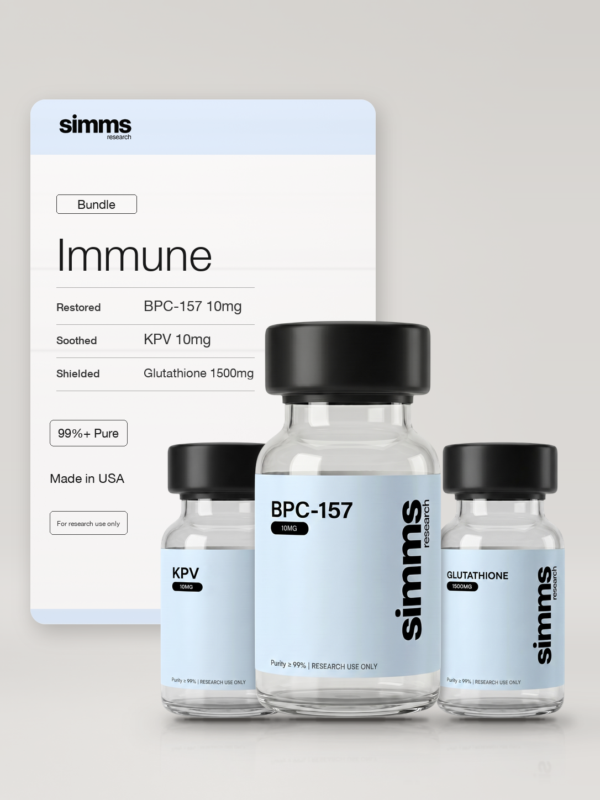
Running both takes one of three forms. Separate vials keep the two independent, KPV at 200–500mcg a day and BPC-157 at 250–500mcg, either one free to stop early. The Immune Bundle ($162) ships the pair that way, a 10mg vial of each, with 1,500mg of glutathione as the third vial. The Klow Peptide Blend ($122) freeze-dries both into one 80mg vial alongside GHK-Cu (50mg) and TB-500 (10mg). Its GHK-Cu sets the dose, and the 2mg a day at the top of the copper peptide’s range delivers 400mcg each of KPV and BPC-157. The Klow dosage chart maps its units, and Glow vs Klow covers what the KPV adds over the three-peptide Glow.
KPV, BPC-157 and TB-500
TB-500 is BPC-157’s usual partner for injury work, the pair sold together as the Wolverine Peptide Stack ($79, 10mg of each). KPV adds the inflammation piece neither covers, and Klow is the one vial holding all three, plus GHK-Cu. BPC-157 vs TB-500 sets out how the first two divide the work.
KPV and BPC-157 side effects
Most of the time, nothing at all. BPC-157 is the one with human numbers: a 2024 bladder pilot in 12 women and a 2025 infusion pilot in two adults, the second given 10mg one day and 20mg the next, logged no adverse events between them, and the 2020 toxicology program, run in four species, found nothing serious at doses far above the ones used in studies.
KPV has no human trial to quote, so its record is the animal work and its origin. It is a piece of a hormone the body already makes, it ran nonstop in the Emory colitis mice’s drinking water, and the nanoparticle papers found KPV-loaded particles harmless to gut cells. Reports from people running either peptide center on mild redness where the dose goes in.
KPV and BPC-157 dosage
Almost the same draw. A 10mg vial of either takes 2mL of water, which puts 50mcg in every unit on a U-100 syringe, so one set of unit counts serves both:
| KPV 10mg | BPC-157 10mg | BPC-157 20mg | |
|---|---|---|---|
| Water added | 2mL | 2mL | 4mL |
| One unit holds | 50mcg | 50mcg | 50mcg |
| Daily range in units | 4 to 10 | 5 to 10 | 5 to 10 |
| Days at 500mcg a day | 20 | 20 | 28, the limit once mixed |
Protocols that run both keep them in their own vials and draw each one separately, and 10 units is 500mcg of either. The KPV peptide dosage chart and the BPC-157 dosage chart cover starting amounts, split doses and cycle length for each, and the peptide calculator works out units for any other vial or mix. One 10mL bottle of Research Water ($20) mixes a 10mg vial of each twice over, with 2mL to spare.
What KPV and BPC-157 cost per month
KPV costs less to run. At 500mcg a day a 10mg vial of either lasts 20 days, which works out to about $93 per 30 days for KPV ($62 a vial) and about $104 for BPC-157 ($69). The pair in separate vials totals about $197 a month.
At 250mcg a day the fridge sets the pace instead. A mixed vial keeps 28 days, so each one is replaced every four weeks with powder left over, roughly $66 a month for KPV and $74 for BPC-157.
Klow at 2mg of GHK-Cu a day, 10 units with 2.5mL of water in the vial, runs 25 days on one $122 vial, close to $146 a month, delivering 400mcg each of KPV and BPC-157 with the GHK-Cu and TB-500 thrown in.
Is KPV better than BPC-157?
Neither is better across the board. Each one wins on its own ground, and the ground is set by the problem being studied.
Choose KPV when inflammation is the target: colitis-type research, and inflamed skin, eyes or gums. Its studies aim squarely at the inflammatory signal, it reaches the inflamed colon by mouth through PepT1, and it costs about a quarter less to run.
Choose BPC-157 when tissue has to be rebuilt: ulcers, fistulas and lining damage from the esophagus to the colon, and tendon, ligament and muscle, where KPV has no record at all. It also has what KPV lacks entirely, human trials: phase II bowel trials in its past and a 120-person placebo-controlled trial on hamstring strains running since February 2026.
Choose both for gut research where the tissue is inflamed and damaged at once. Separate vials or the Immune Bundle keep each at its own dose. Klow suits research that also takes in skin and collagen, where GHK-Cu leads, as BPC-157 vs GHK-Cu explains.
KPV and BPC-157 batch testing
Above label, both of them. Simms Research’s current KPV and BPC-157 batches were each tested in July 2026 by an independent ISO-certified lab. Three KPV vials averaged 10.78mg against the 10mg label, at 99.53% purity; three BPC-157 vials averaged 10.19mg, at 99.65%. Both passed the endotoxin limit, came back negative for heavy metals and showed no microbial growth, with LC-MS confirming each molecule.
The history runs the same way. KPV’s earlier batch, from August 2025, measured 11.65mg, and all five BPC-157 batches published since September 2025 sit between 10.19 and 11.29mg. In Klow’s newest batch, tested a day later, the KPV and BPC-157 shares both measured above their 10mg. Each batch is posted in full: the KPV lab results and BPC-157 lab results pages hold these two, the lab results library the rest of the catalog, and the certificate reading guide explains each field.
Frequently asked questions
Is BPC-157 hard on the kidneys?
Not in any study so far. The highest dose in the 2020 dog work lowered creatinine rather than raising it, and the level was back to normal within two weeks of stopping. The two adults infused in 2025 kept normal kidney markers throughout.
Can KPV and BPC-157 be mixed in one vial?
Klow does, freeze-drying both with GHK-Cu and TB-500, and each Klow certificate reports the four peptides one by one. Plain 10mg vials are mixed on their own, 2mL each, which keeps each amount adjustable.
Where can you buy KPV and BPC-157?
Simms Research sells KPV at $62 for 10mg and BPC-157 at $69 (10mg) or $109 (20mg), each with its latest batch results on the product page. Orders placed before 5PM Eastern ship the same day, and every order carries the Free Delivery Guarantee: a lost, stolen or damaged parcel is replaced or refunded with no carrier claim to file.
Is KPV or BPC-157 FDA approved?
No. Neither has been approved as a medicine, and Simms Research sells both for laboratory research only.